All species › Passerines › Swallows › Tree Swallow
Position in the tree Birds Aves › Birds with a flexible palate Neognathae › All other modern birds Neoaves › Landbirds Telluraves › Falcons, parrots and passerines Australaves › Falcons and passerines Eufalconimorphae › Parrots and passerines Psittacopasserae
Tree Swallow | Tachycineta bicolor
Boomzwaluw | Golondrina bicolor
The Tree Swallow is a sturdy swallow with glossy blue-green upperparts and clean white underparts. It breeds in North America in tree cavities and nest boxes and comes to the guide area in winter, where it sometimes hunts in large flocks over marshes, lakes and coastal lagoons.

Voice
Clear, liquid chirps and a twittering cheet; flocks give a continuous twitter.
Recording: AUDEVARD Aurélien — CC BY-NC-SA 4.0 · converted to mono · xeno-canto
Identification
13–15 cm. Adult male glossy blue-green above, bright white below; the dark of the head reaches to below the eye, with no white above it. Tail short and slightly notched. First-year females are largely greyish brown above with little gloss. Juveniles are greyish brown above and often show a faint grey breast band. Flight a mix of rapid wingbeats and long glides.
Confusion species
Mangrove Swallow Tachycineta albilinea is smaller, has a white rump and a narrow white line above the lores. Violet-green Swallow Tachycineta thalassina has white above and behind the eye and white patches on the sides of the rump. Bank Swallow Riparia riparia is smaller and has a sharply defined brown breast band; young Tree Swallows show at most a faint grey band.
Habitat
Open country near water: freshwater marshes, lakes, coastal lagoons, salt marshes, rice fields and open farmland. Hunts flying insects in the air, often low over water; in winter it also eats berries. Roosts communally in reeds or other marsh vegetation.
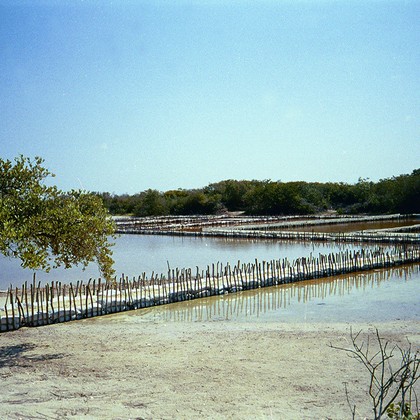
Where the bird is most at home, classified by the vegetation units of Mexico and Central America.





Range and movements
Winter visitor to much of Mexico, most numerous in the north and along the coasts, and in decreasing numbers south through Central America to Panama. Does not breed in the guide area. Breeds across much of Canada and the United States; also winters in the southern United States and the Greater Antilles.
- Winter visitor (c. Oct–Mar)
- dark = core range, pale = thinly spread
How and when to look
In winter best seen over marshes and lagoons in northern Mexico and along the Gulf coast, often in flocks of tens to hundreds of birds. The white underparts without a breast band and without a white rump are the best feature.
Conservation status
Not threatened. The species is common and widespread; in parts of North America the breeding population has declined.
Scientific name
Tachycineta bicolor | (Vieillot, 1808)
Vieillot described the species in 1808 as Hirundo bicolor; because it was later moved to another genus, the author and year stand in brackets. The genus Tachycineta was introduced in 1851 by Cabanis. Tachycineta is Greek, from takhukinētos 'moving quickly', after the fast, agile flight. bicolor is Latin for 'two-coloured', after the glossy blue-green upperparts and white underparts. The specimen the first description was based on came from New York (USA).