All species › Waterfowl › Ducks, swans and geese › White-cheeked Pintail
Position in the tree Birds Aves › Birds with a flexible palate Neognathae › Fowl Galloanserae
White-cheeked Pintail | Anas bahamensis
Bahamapijlstaart | Pato gargantillo
The White-cheeked Pintail is a dabbling duck of the Caribbean and South America and a vagrant in the guide area, not a native species. Only a few records are known, mainly from southern Central America. Because the species is also kept as an ornamental bird, escape from captivity cannot always be ruled out for single birds.

Voice
Mostly silent; the male gives a soft, high whistle, the female soft, descending quacks.
Recording: Ignacio Escobar — CC BY-NC-SA 4.0 · converted to mono · xeno-canto
Identification
38–50 cm, slender, with a pointed, pale tail. Warm brown with dark spots on the breast and flanks; cheeks, throat and foreneck are bright white and sharply demarcated from the brown crown. The bill is blue-grey with a red patch on each side of the base. The sexes are alike; the female is duller, with a shorter tail. In flight a green speculum with broad buff borders.
Confusion species
No other duck in the guide area combines white cheeks with a red bill base. The female Northern Pintail Anas acuta is larger and greyer, with a plain grey bill and no white cheeks.
Habitat
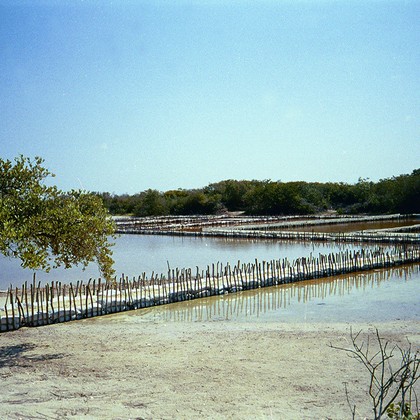
Brackish and saline coastal lagoons, salt pans and mangrove, also freshwater lakes and ponds.
Where the bird is most at home, classified by the vegetation units of Mexico and Central America.


Range and movements
A few records in the guide area, including Costa Rica and Panama. Resident in the Bahamas and the Greater Antilles, locally in the Lesser Antilles, along the coasts of northern South America and, as another subspecies, from Ecuador to Chile and Argentina and on the Galápagos Islands.
- Resident
- Summer visitor (c. Apr–Sep)
- Winter visitor (c. Oct–Mar)
- Passage (Mar–Apr, Oct–Nov)
- dark = core range, pale = thinly spread
How and when to look
A duck with white cheeks and a red bill base in a coastal lagoon is worth noting; look for rings and tameness, which may point to an escaped bird.
Conservation status
Not threatened globally. In the guide area a vagrant with no regular presence; there is no evidence of a trend.
Scientific name
Anas bahamensis | Linnaeus, 1758
Linnaeus described the species in 1758 and placed it straight away in the genus where it still stands. He introduced the genus Anas in that same work. Anas is the Latin word for 'duck'. bahamensis means 'of the Bahamas', where the described specimen came from. The specimen the first description was based on came from the Bahamas.