All species › Waders, gulls and terns › Skimmers, noddies, terns and gulls › Yellow-footed Gull
Position in the tree Birds Aves › Birds with a flexible palate Neognathae › All other modern birds Neoaves › Birds of the elements Elementaves › Cranes and waders Gruimorphae
Yellow-footed Gull | Larus livens
Californische mantelmeeuw | Gaviota pata amarilla
The Yellow-footed Gull is a large, dark-backed gull found almost only in the Gulf of California, making it one of the few gulls almost entirely restricted to the guide area. It was long regarded as a subspecies of Western Gull, but differs in leg colour, call and moult.

Voice
A deep, low kyow and a slow series of low, laughing calls, deeper and slower than in Western Gull.
Recording: Manuel Grosselet — CC BY-NC-SA 4.0 · converted to mono · xeno-canto
Identification
54–71 cm, a large, heavy gull with a thick yellow bill with a red spot near the tip of the lower mandible. Adults have a dark slate-grey mantle and wings, black wingtips with a small white mirror, a broad white trailing edge to the wing, a pale eye and bright yellow legs. The head stays largely white even in winter. Adult plumage is reached in the third year, faster than in most large gulls. Juveniles are mottled brown with a white belly, a dark tail and a black bill; in their second winter they already acquire a dark mantle and yellowish legs.
Confusion species
Western Gull Larus occidentalis is slightly smaller, with pink legs and a less heavy bill; it lives mainly on the Pacific side of Baja California and is rare in the Gulf of California. Lesser Black-backed Gull Larus fuscus, a rare winter visitor, is much smaller and slimmer, with a thinner bill and a streaked head in winter. Heermann's Gull Larus heermanni is smaller, with a dark grey body and a red bill.
Habitat
Rocky and sandy coasts, islands and inshore waters of the Gulf of California, and harbours, fishing villages and rubbish dumps. It breeds scattered in small groups or single pairs on islands and rocky coasts. It eats fish, squid, crabs, eggs and young of other seabirds, and refuse.
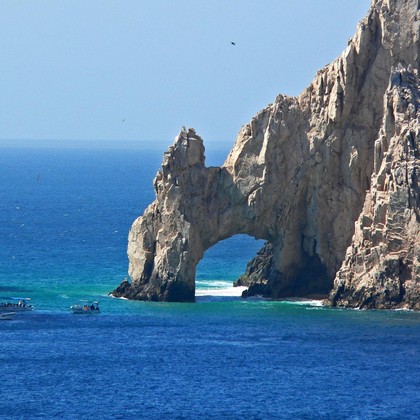
Where the bird is most at home, classified by the vegetation units of Mexico and Central America.




Range and movements
Along the coasts and on the islands of the Gulf of California, from the northern tip at the mouth of the Colorado to Cabo San Lucas on the west side and to northern Sinaloa on the east side. Outside the breeding season also further south along the coast of Sinaloa and rarely to Nayarit, and rare on the Pacific side of Baja California. Outside the guide area mainly young birds move to the Salton Sea in California after the breeding season.
- Resident
- dark = core range, pale = thinly spread
How and when to look
Harbours and beaches around the Gulf of California, such as at Puerto Peñasco, Bahía de Kino, Guaymas, Bahía de los Ángeles and La Paz, offer the best chance all year. The bright yellow legs are the best feature.
Conservation status
Not threatened globally. The population is small and largely restricted to the Gulf of California, but stable; the breeding islands are largely protected. In the guide area a resident.
Scientific name
Larus livens | Dwight, 1919
Dwight described the species in 1919 and placed it straight away in the genus where it still stands. The genus Larus was introduced in 1758 by Linnaeus. Larus is Latin, from Ancient Greek laros, and appears to have referred to a gull or another large seabird. livens is Latin for 'bluish, lead-coloured', after the dark slate-grey mantle. The specimen the first description was based on came from Isla San José, Baja California Sur, Mexico.