All species › Nightjars › Nightjars and nighthawks › Yucatan Nightjar
Position in the tree Birds Aves › Birds with a flexible palate Neognathae › All other modern birds Neoaves › Birds of the elements Elementaves › Nightjars and swifts Strisores
Yucatan Nightjar | Antrostomus badius
Yucatánnachtzwaluw | Tapacaminos yucateco
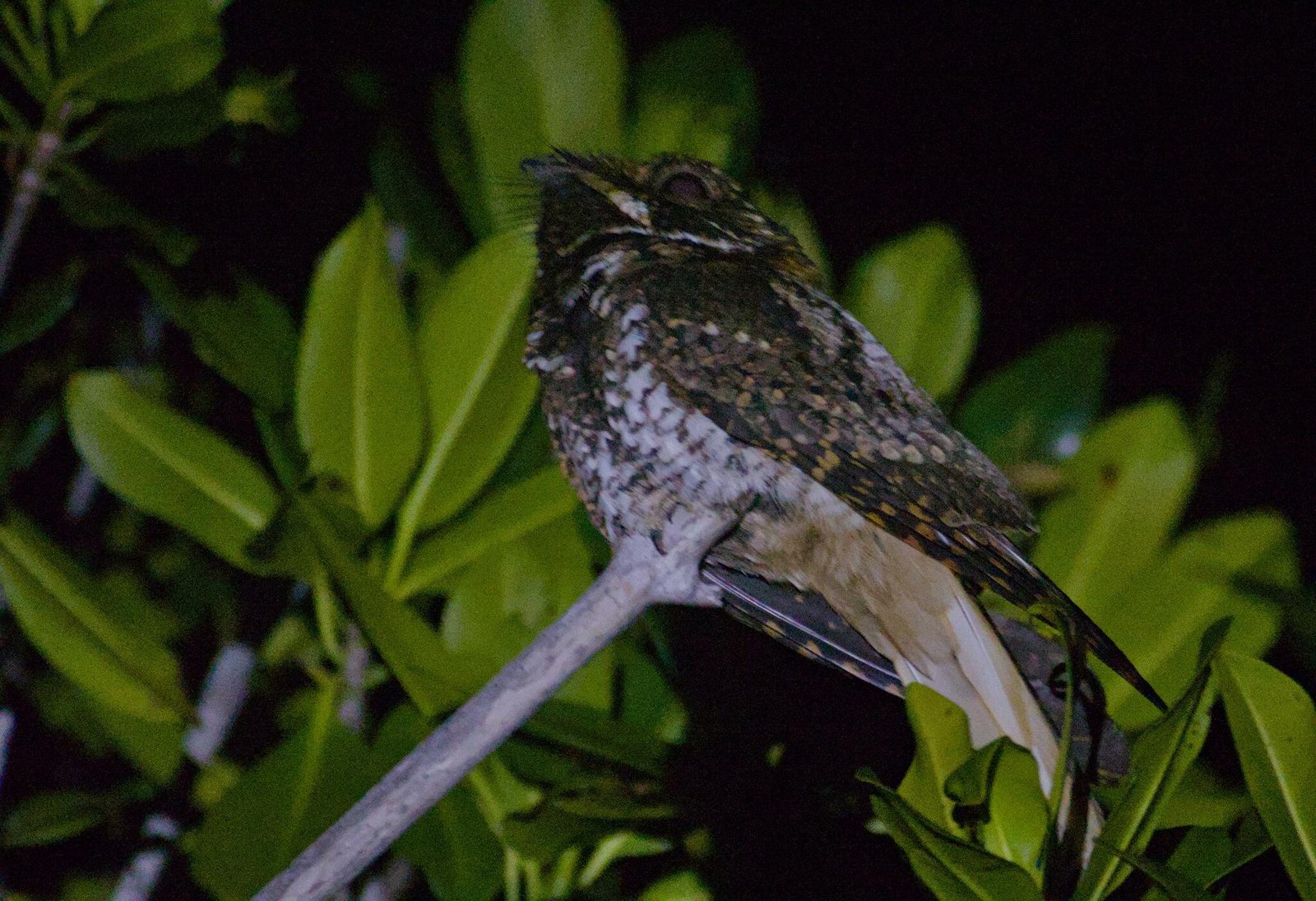
The Yucatan Nightjar is a medium-sized, dark brown nightjar with a rufous hindneck collar, found only in the guide area. It breeds on the Yucatán Peninsula and in Belize and outside the breeding season partly moves south to Guatemala and Honduras. For a long time it was treated as a subspecies of the Tawny-collared Nightjar.
Voice
The song is described as a rich, whistled whit-wheeeoo or chuck-whit-wheeeoo, with one or two short introductory notes, repeated at intervals, mainly at dusk in spring and early summer. Largely silent in winter.
Recording: GABRIEL LEITE — CC BY-NC-SA 4.0 · converted to mono · xeno-canto
Identification
23–26 cm. A medium-sized nightjar with a large head, rounded wings and a fairly long, rounded tail. The plumage is warm dark brown, densely marbled and spotted with black and buff, with black streaks on the crown. A rufous collar crosses the hindneck. The throat is dark with a white band below. The male has broad white tips to the three outer tail feathers; in the female these tips are narrower and buff. The wings lack a white bar.
Confusion species
The Tawny-collared Nightjar Antrostomus salvini of eastern Mexico is very similar but slightly greyer and has a different song; the two are separated mainly by range and voice. Chuck-will's-widow Antrostomus carolinensis, also on the peninsula in winter, is larger and paler rufous-brown, without a distinct collar and with less white in the tail. The Yucatan Poorwill Nyctiphrynus yucatanicus is smaller, with a short tail and finer markings. The Pauraque Nyctidromus albicollis is larger and longer-tailed and the male has a white wing band.
Habitat
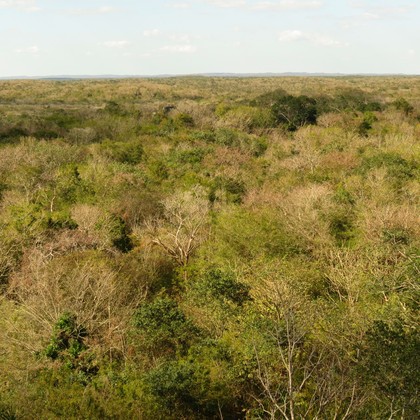
Seasonal and semi-evergreen forest of the Yucatán Peninsula, forest edges, secondary forest, scrub and pasture with trees, mainly in the lowlands. By day it rests on the ground among leaves. At night it hunts flying insects from a branch or the ground. Little is known about breeding; the eggs are laid on the ground.
Where the bird is most at home, classified by the vegetation units of Mexico and Central America.



Range and movements
Breeds on the Yucatán Peninsula in the states of Yucatán, Campeche and Quintana Roo and in northern Belize. Outside the breeding season also further south, in Belize, in Petén in Guatemala and in northern Honduras, where it is mainly reported from December to March. The species does not occur outside the guide area.
- Resident
- Winter visitor (c. Oct–Mar)
- Passage (Mar–Apr, Oct–Nov)
- dark = core range, pale = thinly spread
How and when to look
In spring the song can be heard at dusk in the seasonal forest of northern Yucatán and Quintana Roo, for example along dirt roads inland. In winter birds are best found by searching forest edges at night with a torch for the red eyeshine in Belize and on the peninsula.
Conservation status
Not threatened. Locally fairly common in the guide area. The species tolerates secondary forest and forest edges but loses habitat through the conversion of seasonal forest to farmland and the growth of tourist coastal areas in Quintana Roo.
Scientific name
Antrostomus badius | Bangs & Peck, 1908
Bangs & Peck described the species in 1908 and placed it straight away in the genus where it still stands. The genus Antrostomus was introduced in 1838 by Bonaparte. Antrostomus is Greek, from antron 'cave' and stoma 'mouth': 'cave-mouth', after the enormous gape. badius is Latin for 'chestnut-brown', after the warm brown plumage. The specimen the first description was based on came from Toledo District, Belize.