All species › Passerines › White-eyes › Abyssinian White-Eye
Abyssinian White-Eye | Zosterops abyssinicus
Abessijnse brilvogel | Anteojitos abisinio
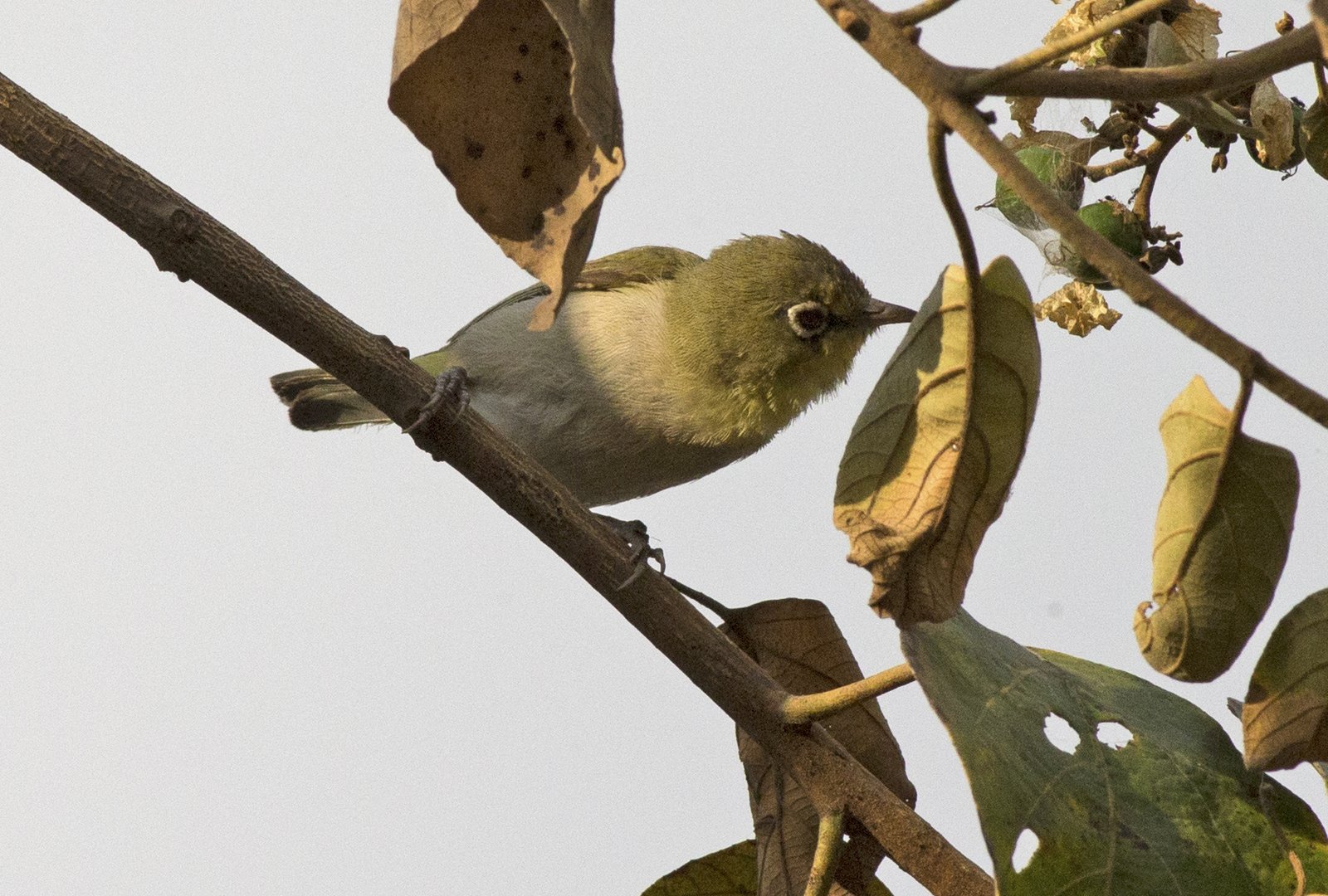
Abyssinian White-eye is the only white-eye of mainland Arabia: a small yellow-green bird with a white eye-ring that moves in small, restless groups through the juniper and acacia woods of the mountains of south-west Arabia and Dhofar. The form arabs occurs in Arabia; in addition a small, recently discovered population lives in the mangroves of the Saudi Red Sea coast.
Voice
Groups keep in constant contact with a high, thin, soft tsiu or tsee-tsee. The song is a fast, high and rather shrill twittering of fine falling and rising notes, mainly in the early morning.
Recording: Stanislas Wroza — CC BY-NC-SA 4.0 · shortened to the first 60 s, mono · xeno-canto
Identification
10–11 cm. Small and round-headed, with a fine, slightly decurved bill. Upperparts yellowish olive-green, throat and undertail-coverts bright yellow, breast and belly dull yellowish-white to greyish white. A broad, conspicuous white eye-ring, narrowly broken at the front, with a fine black loral line. Wings and tail dark with green fringes. Mangrove birds are smaller, with more golden yellow on the throat and greener upperparts. Sexes alike; juveniles have a less complete eye-ring.
Confusion species
On the Arabian mainland there is no other white-eye except a small, isolated group of Indian White-eyes (Zosterops palpebrosus) in the mangroves of Mahawt Island in Oman, which have a yellower throat, a greener back and a darker bill. Leaf warblers such as Brown Woodland Warbler (Phylloscopus umbrovirens) of the same mountain woods lack the white eye-ring. Sunbirds such as Arabian Sunbird (Cinnyris hellmayri) have a long, strongly decurved bill.
Habitat
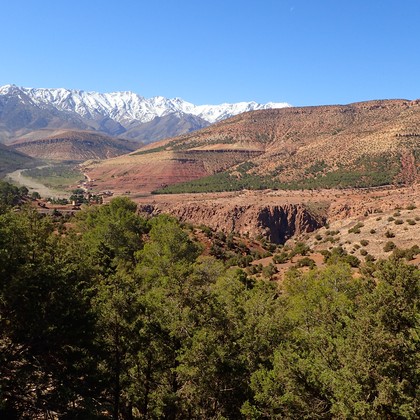
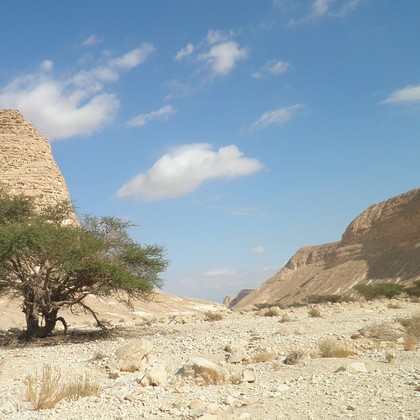
Mountain woodland of juniper, acacia and wild olive, wooded wadis, terraced fields with trees, gardens and orchards, mostly above 1000 m and up to over 3000 m; lower in the monsoon woodland of the coastal mountains of Dhofar. On the Saudi Red Sea coast in old, tall mangroves at the water's edge.
Where the bird is most at home, classified by the habitats of North Africa and the Middle East.

Range and movements
In south-west Saudi Arabia in the mountains of Asir and southern Hijaz, from around Taif southwards, and in the Yemen highlands from the border to the south and east of the mountain chain; in Oman in the coastal mountains of Dhofar. In addition a small, vulnerable population in the mangroves along about 175 km of the Saudi Red Sea coast, between Ash Shuqaiq and Al Qunfudhah. Beyond the region in Eritrea, Ethiopia, Djibouti, northern Somalia, Sudan, Kenya and northern Tanzania.
- Resident
- Summer visitor (c. Oct–Mar)
- Passage (Mar–Apr, Oct–Nov)
- dark = core range, pale = thinly spread
How and when to look
In Dhofar, Ayn Hamran, Ayn Razat and Wadi Darbat are the well-known sites, also during the cool khareef. In Saudi Arabia the juniper woods around Abha and Asir National Park are reliable: listen for the thin contact calls of a group moving through the canopy.
Conservation status
Not globally threatened and locally common in the Arabian mountains. The Red Sea mangrove population, however, is very small and threatened by cutting and coastal development. Genetic work suggests the Arabian birds may be closer to Socotra White-eye than to African birds, so the taxonomy may still change.
Scientific name
Zosterops abyssinicus | Guérin-Méneville, 1843
Guérin-Méneville described the species in 1843 and placed it straight away in the genus where it still stands. The genus Zosterops was introduced in 1827 by Vigors & Horsfield. Zosterops comes from the Greek zōstēr, 'belt, girdle', and ōps, 'eye' — for the white eye-ring shown by most white-eyes. abyssinicus means 'Abyssinian', after Abyssinia, the old name of Ethiopia. The specimen the first description was based on came from Ethiopia.