All species › Passerines › Wagtails and pipits › African Pipit
African Pipit | Anthus cinnamomeus
Kaneelpieper | Bisbita africano
The African Pipit is an African grassland pipit with a small, isolated population in the highlands of Yemen and south-western Saudi Arabia, the form eximius. It is one of the least known birds of the Arabian Peninsula.

Voice
The call is a short chip or chisip. In display flight it gives a repeated, monotonous chree-chree-chree while flying in undulations over the grassland before dropping steeply.
Recording: Dawie de Swardt — CC BY-NC-SA 4.0 · converted to mono · xeno-canto
Identification
16–18 cm. Medium-sized and fairly upright, with long, flesh-coloured legs and a medium-length bill with a yellow base to the lower mandible. Warm brown above with clear dark streaks on the crown and mantle, warm buff below with a band of short, sharp streaks across the breast. A striking pale supercilium, a dark eye-stripe and a clear dark malar stripe. The outer tail feathers are white or whitish. The Arabian form eximius is smaller and darker than most African forms.
Confusion species
Richard's Pipit (Anthus richardi), a winter visitor to Arabia, is very similar but larger, with a longer tail, even longer legs and a very long hind claw; it has left Arabia by the breeding season. Tawny Pipit (Anthus campestris) is paler and almost unstreaked above and below. Long-billed Pipit (Anthus similis), which lives in the same mountains, is plainer, with faint breast streaking and buff rather than white tail edges. Tree Pipit (Anthus trivialis) is smaller and shorter-legged, with a finer bill and heavier streaking on the flanks.
Habitat
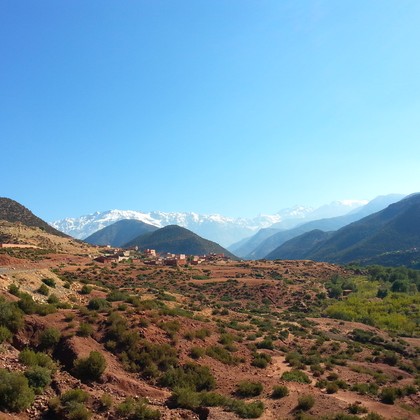
Open grassland, grazed slopes and terraced fields with short grass in the highlands, mainly between about 1800 and 3000 m, often near juniper woodland and villages.
Where the bird is most at home, classified by the habitats of North Africa and the Middle East.

Range and movements
In the region only in the highlands of Yemen and in the Asir mountains of south-western Saudi Arabia, where recent records come mainly from around Abha, Tanoumah and An Namas. Beyond the region widespread in sub-Saharan Africa.
- Resident
- Summer visitor (c. Oct–Mar)
- Winter visitor (c. Apr–Sep)
- Passage (Mar–Apr, Oct–Nov)
- dark = core range, pale = thinly spread
How and when to look
Look for it in spring in the Asir highlands between Abha and An Namas, on short-grazed slopes and terraced fields; listen for the chisip and watch for birds in display flight. In Yemen the species has hardly been studied because of the security situation.
Conservation status
Not globally threatened and common in Africa. The Arabian form eximius, however, has a small range and is poorly known: in Saudi Arabia there were no records between the 1990s and 2018, after which it has been seen regularly in small numbers. Conversion of grassland to building and farmland is a threat.
Scientific name
Anthus cinnamomeus | Rüppell, 1840
Rüppell described the species in 1840 and placed it straight away in the genus where it still stands. The genus Anthus was introduced in 1805 by Bechstein. Anthus is the Latin word for a small bird of grasslands mentioned by Pliny the Elder. cinnamomeus is Latin for 'cinnamon-coloured' — for the warm brown tone of the plumage. The specimen the first description was based on came from Simien Mountains, Ethiopia.