All species › Passerines › Wagtails and pipits › Long-Billed Pipit
Long-Billed Pipit | Anthus similis
Langsnavelpieper | Bisbita piquilargo
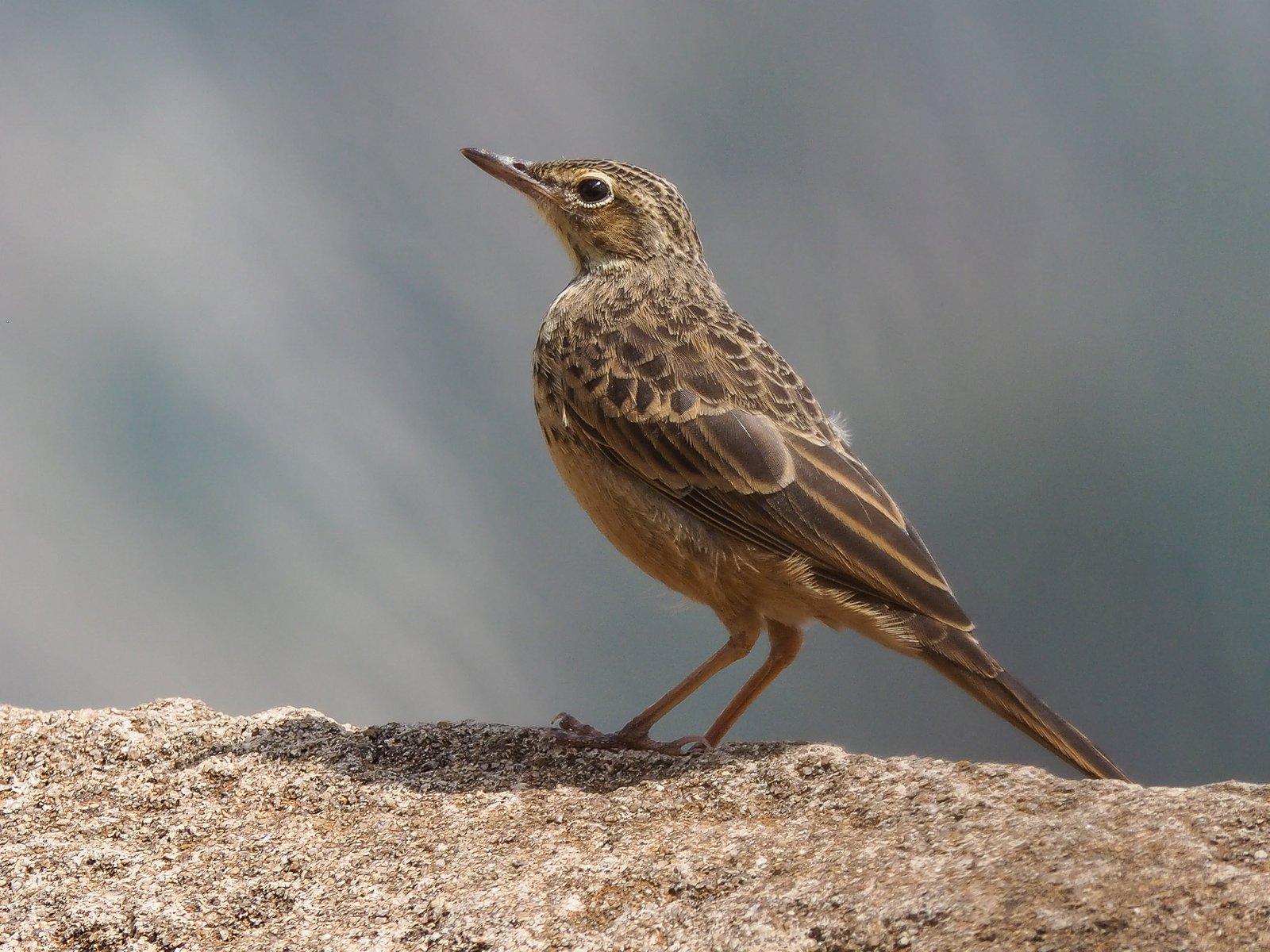
The Long-billed Pipit is a large, plainly marked pipit of stony mountain slopes. In the region it is a resident of the Levant, the mountains of the Arabian Peninsula and Socotra, each with its own subspecies.
Voice
The song is a slow series of short, measured phrases of two or three notes, chree… choo-eet… chreep, with pauses between them, from a boulder or bush or in a short song flight. The call is a sparrow-like chip or a soft, disyllabic choo-weep.
Recording: Mohannad Baghlaf — CC BY-NC-SA 4.0 · converted to mono · xeno-canto
Identification
16–18 cm. Large and long-tailed, with a long, slightly decurved bill and fairly short, flesh-coloured legs. Greyish brown above with faint streaks on the mantle, warm buff below with weak, blotchy streaking on the upper breast. A pale supercilium, dark lores and a narrow malar stripe. The median coverts have dark centres and broad pale fringes. The outer tail feathers are warm buff, not white. Around the Levant lives the form captus, on the Arabian Peninsula the warmer arabicus, on Socotra the dark sokotrae; the Iranian form decaptus winters in eastern Arabia.
Confusion species
Tawny Pipit (Anthus campestris) is paler and sandier, with a clearer supercilium, a striking dark wing bar and whitish outer tail feathers; young Tawny Pipits are more heavily streaked. Richard's Pipit (Anthus richardi) is longer-legged, with pale lores, a much longer hind claw and white tail edges, and prefers damp grassland to rocky slopes. Blyth's Pipit (Anthus godlewskii) is smaller and more clearly streaked above.
Habitat
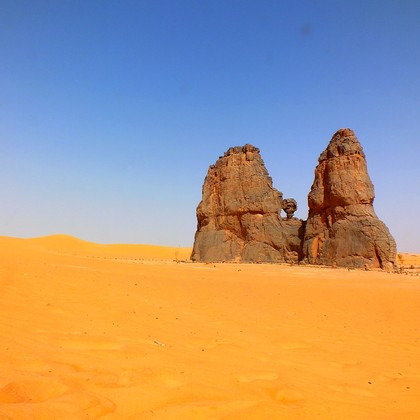
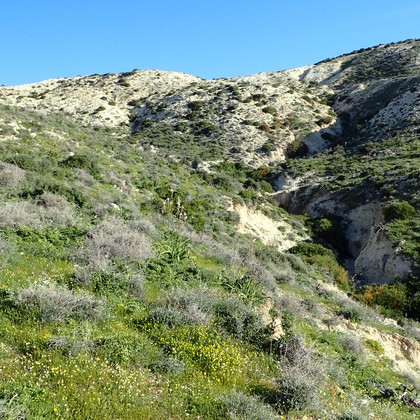
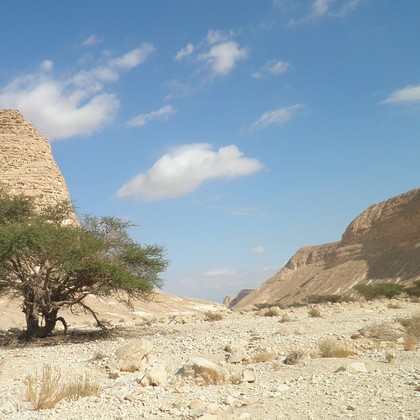
Stony and rocky mountain slopes with scattered bushes and grass tussocks, terraced fields, mountain wadis and the edges of juniper woodland, from about 200 to over 2500 m. In winter also in lower wadis, stone desert and field edges at the foot of the mountains.
Where the bird is most at home, classified by the habitats of North Africa and the Middle East.
Range and movements
Resident in Israel (Negev highlands, Judean Desert, Golan and Galilee), Jordan (the western edge of the Rift Valley and the south around Petra), Lebanon and Syria, and in the mountains of southern Sinai; also in the Hejaz and Asir mountains of Saudi Arabia, in Yemen, in the mountains of Oman (Hajar and Dhofar) and the border mountains of the United Arab Emirates, and on Socotra. Breeds in the mountains of northern Iraq; in winter spread over lower parts of Iraq, Kuwait and the Gulf states. Absent from north-west Africa. Beyond the region across much of sub-Saharan Africa and from Turkey and Iran to India and Myanmar.
- Resident
- Summer visitor (c. Oct–Mar)
- Winter visitor (c. Apr–Sep)
- dark = core range, pale = thinly spread
How and when to look
Best in spring on rocky slopes in the Negev, at Petra or in the mountains of Oman, where the bird sings from a boulder and wags its tail. In winter in the United Arab Emirates on Jebel Hafeet or in the wadis of the Hajar mountains.
Conservation status
Not globally threatened. Populations in the region appear stable; overgrazing and building on mountain slopes are local threats. The Socotra form sokotrae occurs nowhere else.
Scientific name
Anthus similis | (Jerdon, 1840)
Jerdon described the species in 1840 as Agrodoma similis; because it was later moved to another genus, the author and year stand in brackets. The genus Anthus was introduced in 1805 by Bechstein. Anthus is the Latin word for a small bird of grasslands mentioned by Pliny the Elder. similis is Latin for 'like, resembling'; which other pipit the bird is said to resemble is not stated in the description. The specimen the first description was based on came from Jalna, India.