All species › Passerines › Accentors › Alpine Accentor
Alpine Accentor | Prunella collaris
Alpenheggenmus | Acentor alpino
Alpine Accentor is the accentor of bare summits: a stout grey bird with chestnut flanks that walks among boulders and short turf above the treeline. In this region it breeds in the High Atlas and the mountains of Kurdistan; in winter small groups appear on Mount Hermon and in the high mountains of Lebanon, often remarkably tame around ski lifts and mountain huts.

Voice
The song is a fairly long, rolling, lark-like phrase of clear jingling notes, from a boulder or in a short song flight. The call is a rolling tchirrup or a slightly nasal drüü, carrying far on the wind.
Recording: Benjamin Drillat — CC BY-NC-SA 4.0 · shortened to the first 60 s, mono · xeno-canto
Identification
15–17.5 cm. Large and stocky for an accentor, closer to a small thrush in build, with a heavy head and a fairly short tail. Head, throat and breast grey; the throat white with dense fine black spotting, a small chequered bib. Flanks and breast sides with broad chestnut streaks that form a warm orange-brown panel at distance. Back grey-brown with dark streaks; on the closed wing a black panel with two rows of white spots, and white tips to the tail feathers. The bill is thin and pointed, dark with a bright yellow base to the lower mandible; the legs are orange-red. Sexes alike; juveniles duller, with a less clearly spotted throat. Walks with springy steps over rock and turf.
Confusion species
Dunnock (Prunella modularis), which winters in the same mountains, is clearly smaller and slimmer, with a plain slate-grey throat, no chestnut flanks, no white wing spots and an all-dark bill. Radde's Accentor (Prunella ocularis) in Kurdistan has a dark head with a broad creamy supercilium. Rock Sparrow (Petronia petronia) has a thick conical bill, a pale crown stripe and a yellow throat spot. Water Pipit (Anthus spinoletta) and Horned Lark (Eremophila alpestris) use the same ground but are slimmer and longer-tailed and lack the grey hood with chequered throat.
Habitat
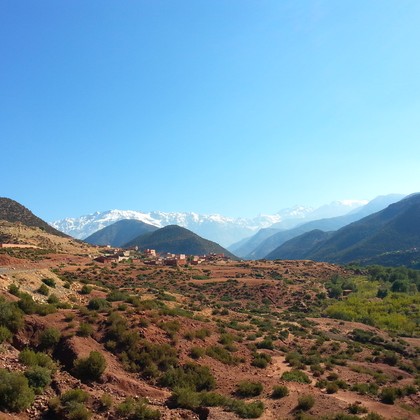
Bare, rocky high mountains above the treeline: scree slopes, cliffs with ledges, boulder fields and short alpine grassland, in the High Atlas mainly above 2500 m up to the summits. Eats insects and spiders in summer, mainly seeds in winter. In winter lower on sunny rocky slopes and in gorges, and readily around ski stations, mountain huts and villages, where it picks up crumbs.
Where the bird is most at home, classified by the habitats of North Africa and the Middle East.

Range and movements
In North Africa the form collaris breeds in the High Atlas of Morocco (Toubkal massif, Oukaïmeden, Jbel Ayachi) and locally in the Middle Atlas; in northern Algeria (Djurdjura, Aurès) it is recorded mainly in winter and breeding there is not certain. In the Middle East the form montana probably breeds in the highest mountains of Iraqi Kurdistan and is a regular winter visitor to Mount Hermon (Israel, Syria), the mountains of Lebanon and the Anti-Lebanon; further south a vagrant. Beyond the region it breeds in the mountains of southern Europe, Turkey, the Caucasus and Iran east to the Himalayas and Japan.
- Resident
- Summer visitor (c. Apr–Sep)
- Winter visitor (c. Oct–Mar)
- Passage (Mar–Apr, Oct–Nov)
- dark = core range, pale = thinly spread
How and when to look
In Morocco in summer at the Oukaïmeden ski station and on the trails to Toubkal above Imlil, where birds often feed around the huts. In winter (December to March) on Mount Hermon around the ski station: small groups walk between the snow patches and the car park and are not shy.
Conservation status
Not globally threatened and stable over most of its range. Within this region the breeding populations are small and isolated, especially in the High Atlas, and therefore vulnerable to warming, which shrinks the open stony ground, and to overgrazing and increasing disturbance in the mountains. Little is known about numbers in Kurdistan.
Scientific name
Prunella collaris | (Scopoli, 1769)
Scopoli described the species in 1769 as Sturnus collaris; because it was later moved to another genus, the author and year stand in brackets. The genus Prunella was introduced in 1816 by Vieillot. Prunella comes from the German Braunelle, the name for the dunnock, a diminutive of braun 'brown'. collaris is Latin for 'collared', from collum 'neck'. The specimen the first description was based on came from Carinthia, Austria.