All species › Passerines › Wagtails and pipits › American Pipit
American Pipit | Anthus rubescens
Pacifische waterpieper | Bisbita norteamericano
The American Pipit breeds on the tundra and in the mountains of North America and north-eastern Siberia. All birds in the region belong to the Siberian race japonicus, which normally winters in eastern and southern Asia; at the western edge of that winter range it appears as a rare but now almost annual winter visitor in the Gulf states and in Israel, often on the same fields as Water and Meadow Pipits.

Voice
The call is thin, high and sharp and often doubled, tsip-it or pi-pit, shorter and thinner than the full feest of Water Pipit. Many records in the region were first picked up on call. The song is not heard in the region.
Recording: Manuel Grosselet — CC BY-NC-SA 4.0 · converted to mono · xeno-canto
Identification
15–17 cm, about the size of a Water Pipit but with a slightly shorter tail and a finer bill. In winter the race japonicus is cold and contrasting: grey-brown above with little streaking, clean white to pale buff below with heavy, black, sharply defined streaks on breast and flanks, a clear dark malar stripe, a white supercilium and two prominent white wing-bars. The best feature is the pink to flesh-coloured legs, where Water Pipit always has dark legs. The outer tail feathers are white. Towards spring the underparts become warmer buff.
Confusion species
Water Pipit (Anthus spinoletta) is the main pitfall: it has dark legs, whiter, less heavily streaked underparts with finer streaks, a longer tail, a weaker malar stripe and a full, single call. Meadow Pipit (Anthus pratensis) also has pale legs but is more olive-brown, with finer, less black streaks and a plain face, and gives a repeated ist-ist-ist. Red-throated Pipit (Anthus cervinus) has a heavily streaked rump and a mantle with white stripes. On a silent bird in flat light leg colour alone is not enough; photographs and a sound recording are almost always needed for acceptance.
Habitat
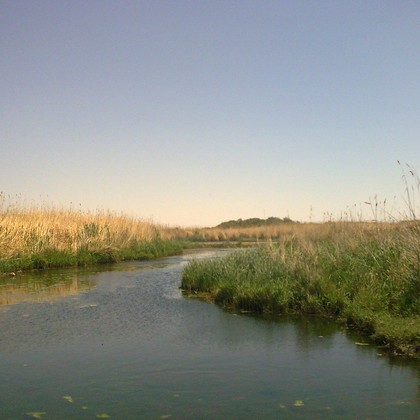
In the region mainly irrigated farmland with short crops: alfalfa and fodder under centre-pivot sprinklers (pivot fields), lawns and parks, also the muddy edges of sewage works and outfall channels, often with Water Pipits.
Where the bird is most at home, classified by the habitats of North Africa and the Middle East.

Range and movements
In the region a rare winter visitor and vagrant in the east. In the United Arab Emirates rare but regular, mainly from Dubai northwards, since the first record at Ruwais in December 1996; in Oman a handful of records; in Qatar at least six birds at Al Shamal Park in winter 2014–2015; in Bahrain one bird trapped at Alba Marsh in January 2012; in Kuwait a rare, irregular winter visitor (Jahra, Al Abraq, Sulaibiya, up to three birds in February 2009); in Saudi Arabia the first record near Salwa in December 2022. In Israel a rare passage migrant and winter visitor, mainly in the east of the country, from late October to March or early April. No certain records elsewhere in the region. Beyond the region it breeds in North America and north-eastern Siberia; Asian birds winter from Japan and eastern China to northern India and Pakistan.
How and when to look
From December to February search among Water Pipits on pivot fields, lawns and at sewage works in the Emirates, Qatar or Kuwait, or in the Beit She'an Valley and the Arava in Israel. Listen for a thin, doubled tsip-it among the full calls of the Water Pipits, and check every heavily streaked pipit for leg colour.
Conservation status
Not globally threatened, with a very large range. In the region a rare winter visitor at the extreme western edge of the winter range; the rising number of records in the Gulf states probably reflects mainly greater attention from birders to pipits on pivot fields.
Scientific name
Anthus rubescens | (Tunstall, 1771)
Tunstall described the species in 1771 as Alauda Rubescens; because it was later moved to another genus, the author and year stand in brackets. The genus Anthus was introduced in 1805 by Bechstein. Anthus is the Latin word for a small bird of grasslands mentioned by Pliny the Elder. rubescens is Latin for 'reddish', from ruber 'red'. The specimen the first description was based on came from Pennsylvania.