All species › Passerines › Sunbirds › Arabian Sunbird
Arabian Sunbird | Cinnyris hellmayri
Arabische honingzuiger | Suimanga árabe
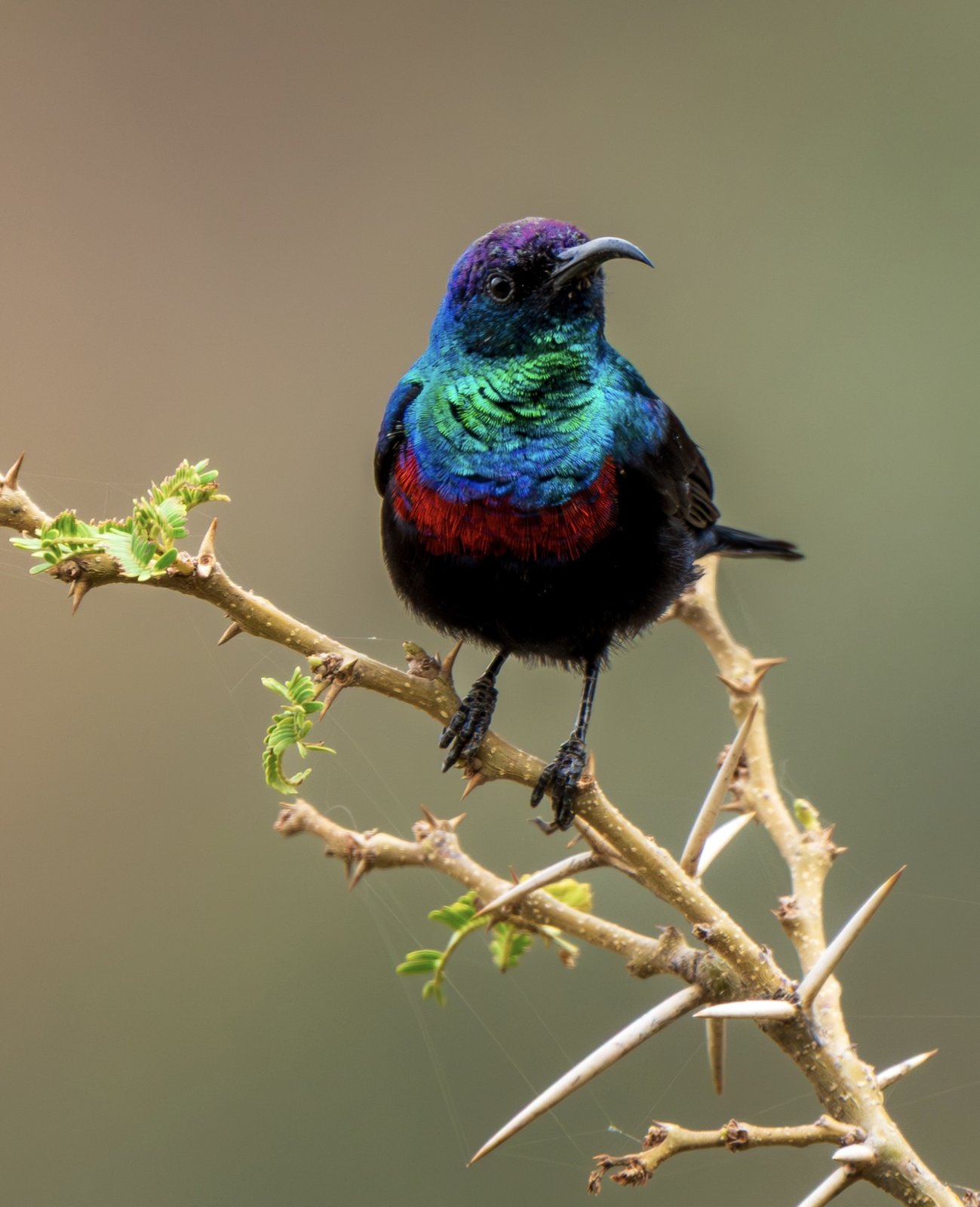
The Arabian Sunbird is a sunbird endemic to south-west Arabia and Dhofar. It was long treated as a subspecies of the Abyssinian (Shining) Sunbird of the Horn of Africa, but is now regarded as a separate species.
Voice
The call is a hard, metallic tchik or tchip, often repeated; the song is a lively, rolling series of high, clear notes and trills.
Recording: David Darrell-Lambert — CC BY-NC-SA 4.0 · converted to mono · xeno-canto
Identification
12–14 cm. Medium-sized, with a long, curved bill. The male is glossy metallic green on head, throat and back, with a violet-blue rump; a red band crosses the breast, narrowly bordered violet-blue above, and the belly is black; yellow pectoral tufts sit at the breast sides. Wings and tail are black. The female is grey-brown above and dull greyish-white below, with a faint pale supercilium and a dark, rather longer tail; young males already show a blackish throat.
Confusion species
Palestine Sunbird (Cinnyris osea), which shares its range, is smaller and the male lacks the red breast band and green gloss; females of the two are very alike, but the female Arabian Sunbird is larger and greyer with a longer tail. Nile Valley Sunbird (Hedydipna metallica) has a short bill and a yellow belly. Abyssinian Sunbird (Cinnyris habessinicus) of the Horn of Africa is larger with a broader red breast band and does not occur in Arabia.
Habitat
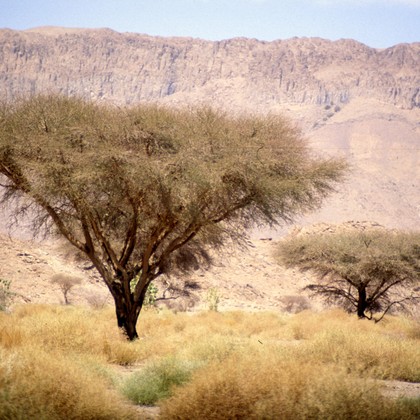
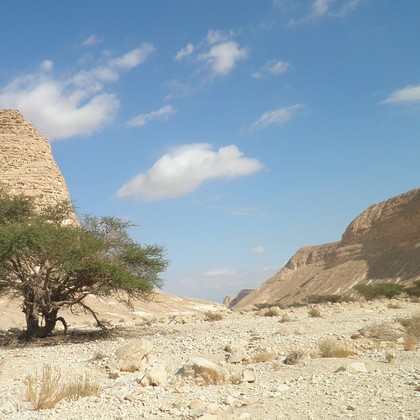
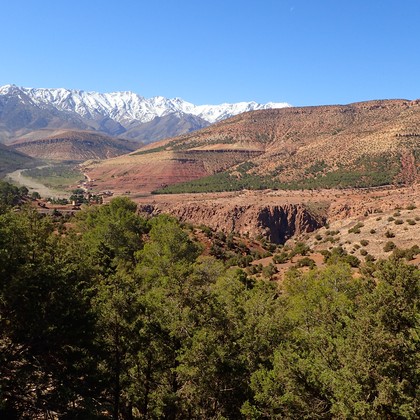
Acacia savanna, vegetated wadis and terraced cultivation on the slopes of the Sarawat mountains, up into the juniper woodland; in Dhofar the monsoon-fed scrub and deciduous woodland of the hills and wadis with figs and acacias. Often at flowering Aloe, mistletoes and ornamental plants in villages.
Where the bird is most at home, classified by the habitats of North Africa and the Middle East.
Range and movements
In south-west Saudi Arabia (Asir and the Hejaz south of Taif), in Yemen on the slopes, highlands and the valleys running down to the Tihama, and in Dhofar in southern Oman. Endemic to southern Arabia; not known beyond it. Older reports of Abyssinian Sunbird from Saudi Arabia and Oman refer to this species.
- Resident
- Passage (Mar–Apr, Oct–Nov)
- dark = core range, pale = thinly spread
How and when to look
Look for it in the acacia wadis around Abha and Al Baha or in the wadis of Dhofar, such as Wadi Darbat and Ayn Hamran. Check flowering aloes: a male only shows its red breast band well when it faces you.
Conservation status
Not globally threatened (IUCN: Least Concern). Common in suitable habitat; possibly sensitive to the decline of juniper woodland and to overgrazing in south-west Arabia.
Scientific name
Cinnyris hellmayri | Neumann, 1904
Neumann described the species in 1904 and placed it straight away in the genus where it still stands. The genus Cinnyris was introduced in 1816 by Cuvier, GLCFD. Cinnyris is from the Ancient Greek kinnuris, an unidentified small bird mentioned by Hesychius of Alexandria. hellmayri honours Carl Eduard Hellmayr (1878-1944), Austrian ornithologist. The specimen the first description was based on came from mountains north of Lahij, Yemen.