All species › Passerines › Sunbirds › Purple Sunbird
Purple Sunbird | Cinnyris asiaticus
Purperhoningzuiger | Suimanga asiático
The Purple Sunbird is an Asian sunbird that reaches its western limit in the region in northern Oman and the UAE. There it is a common bird of gardens, wadis and date-palm groves, and is spreading further as cities are greened.
Voice
A sharp, metallic tsweet or chwit and a buzzing zit; the song is a fast, excited series of high, shrill notes, often ending in a short trill.
Recording: David Darrell-Lambert — CC BY-NC-SA 4.0 · converted to mono · xeno-canto
Identification
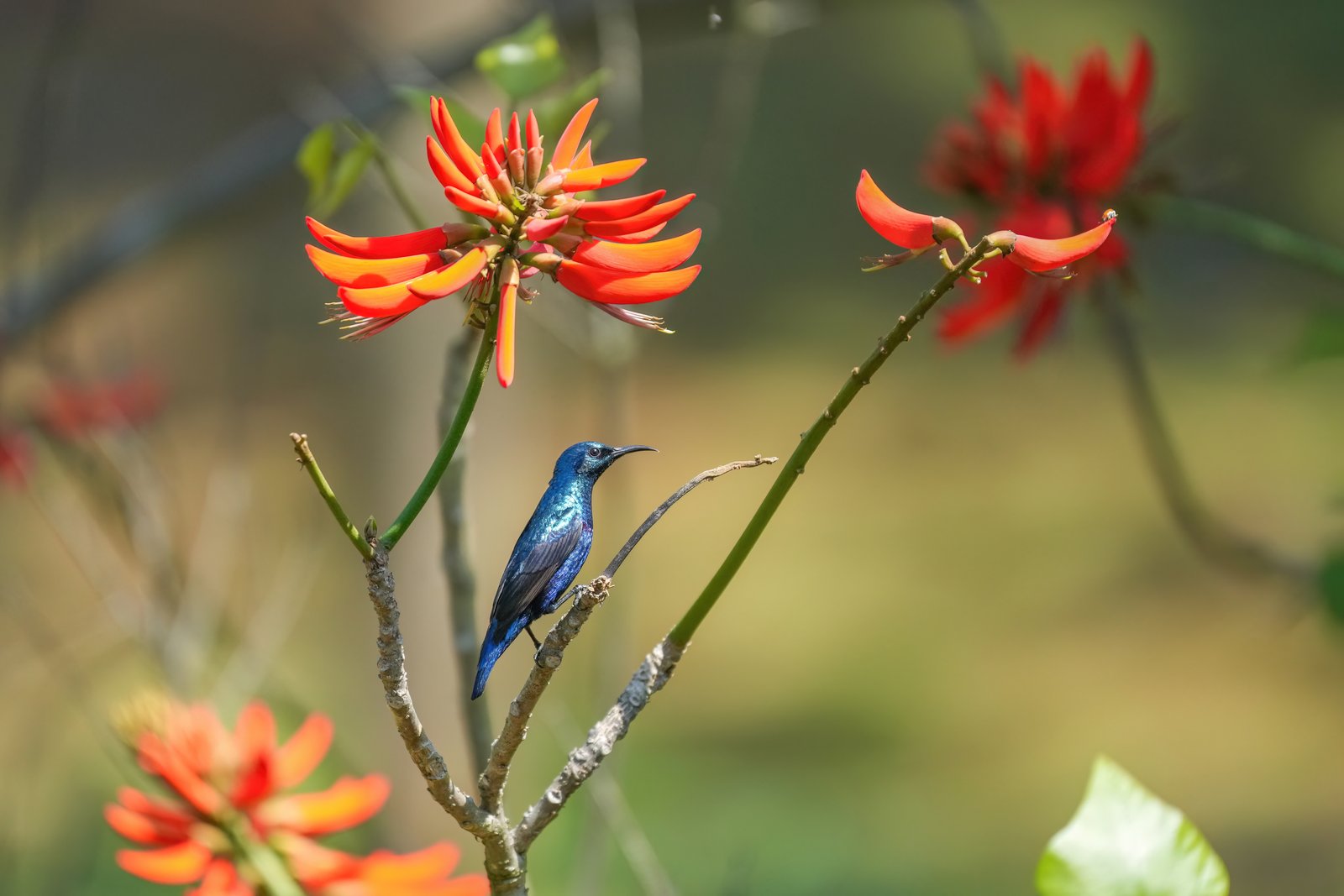
10–11 cm. Small, with a fairly short tail and a long, curved bill. The breeding male is entirely glossy blue-black to purple, with a narrow, dark maroon band across the breast visible only at close range, and yellow-orange pectoral tufts. The non-breeding male is olive-brown above and yellow below, with a conspicuous black stripe down the centre of the throat and breast and dark wings. The female is olive-grey above and pale yellow below, with a pale supercilium, a dark eye-stripe and a dark tail with white edges.
Confusion species
Palestine Sunbird (Cinnyris osea) does not occur in the UAE or northern Oman; the female is grey, not yellow, below and the male glosses greener. Nile Valley Sunbird (Hedydipna metallica), only in Dhofar and further west, has a short bill, and the male has tail streamers and a yellow belly. Females may be mistaken for a warbler, but the curved bill and constant wing-flicking give the sunbird away.
Habitat
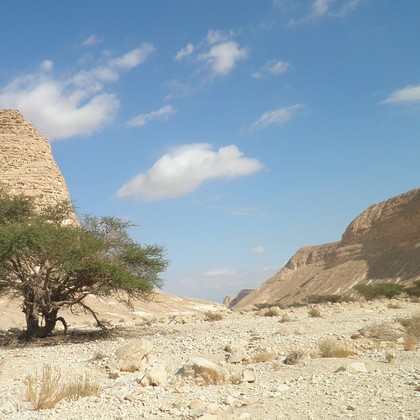
Gardens, parks, orchards and date-palm groves in villages and towns; in the Hajar mountains vegetated wadis with acacias and Ziziphus; also mangrove edges and coastal villages with flowering shrubs.
Where the bird is most at home, classified by the habitats of North Africa and the Middle East.


Range and movements
In northern Oman (the Batinah coast, the Hajar mountains and Musandam) and the UAE, mainly in the east, the Hajar region and around Al Ain, but now also in parks in Dubai and Abu Dhabi. Exceptional elsewhere in the region. Beyond it from south-east Iran and Pakistan through India and Sri Lanka to South-East Asia.
- Resident
- Summer visitor (c. Oct–Mar)
- Winter visitor (c. Apr–Sep)
- Passage (Mar–Apr, Oct–Nov)
- dark = core range, pale = thinly spread
How and when to look
In Oman and the UAE it is easy to see at flowering ornamentals in parks and hotel gardens, and in date-palm groves at the foot of the Hajar mountains. In spring and summer look for the blue-black males singing from a bare twig.
Conservation status
Not globally threatened (IUCN: Least Concern). Common in Oman and the UAE; the greened urban areas of the UAE have allowed it to spread westwards over recent decades.
Scientific name
Cinnyris asiaticus | (Latham, 1790)
Latham described the species in 1790 as Certhia asiatica; because it was later moved to another genus, the author and year stand in brackets. The genus Cinnyris was introduced in 1816 by Cuvier, GLCFD. Cinnyris is from the Ancient Greek kinnuris, an unidentified small bird mentioned by Hesychius of Alexandria. asiaticus is Latin for 'Asian'. The specimen the first description was based on came from India.