All species › Passerines › Chats and flycatchers › Atlas Pied Flycatcher
Atlas Pied Flycatcher | Ficedula speculigera
Atlasvliegenvanger | Papamoscas del Atlas
The Atlas Pied Flycatcher is one of the few songbirds whose breeding range lies entirely within the region: it breeds only in the mountain forests of Morocco, Algeria and Tunisia. It was long treated as a subspecies of European Pied Flycatcher; song, plumage and DNA now make it a separate species.
Voice
The song is the best feature: shorter, harder and more rhythmic than that of European Pied Flycatcher, three to five sharply accented notes at almost the same pitch, tchee-tchee-tchee-tchoo, like a small hammering, without the rising ending of European Pied Flycatcher. The call is a sharp bit and, when alarmed, a dry tek.
Recording: Cedric Mroczko — CC BY-NC-SA 4.0 · shortened to the first 60 s, mono · xeno-canto
Identification
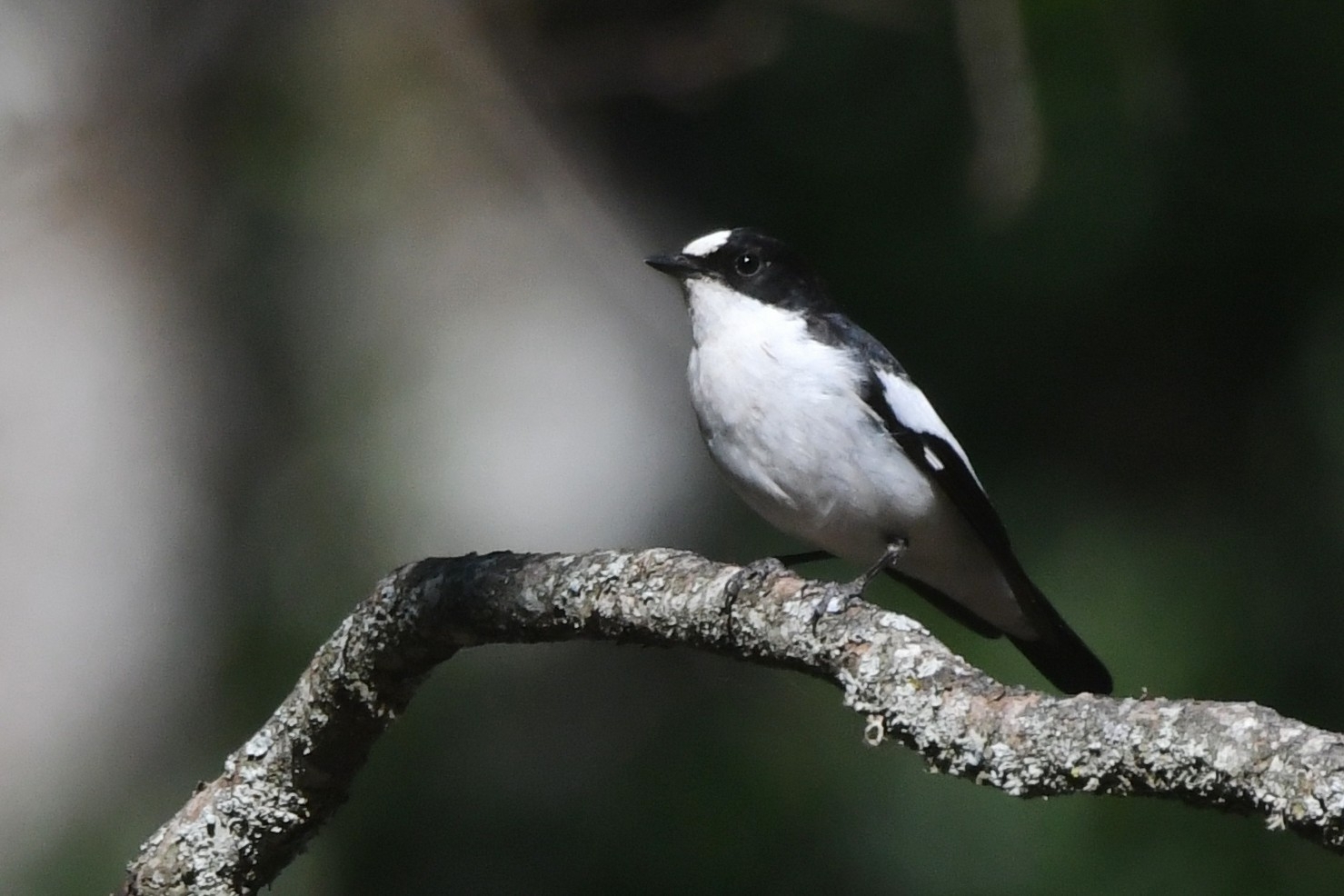
12–13 cm. Compact and short-tailed, perching upright, sallying for insects and returning while flicking wings and tail. The breeding male is deep, glossy black above, without a brown tinge, and pure white below. The white forehead patch is large, usually a single broad block. The white wing patch is large and extends as a long wedge far over the base of the primaries, much further than in European Pied Flycatcher; the tertials have broad white fringes. Some males show a faint pale nape spot, but never a complete white collar. The female is grey-brown above and off-white below, with a white wing patch and a pale spot at the primary base; in the field she is hardly separable from a female European Pied Flycatcher.
Confusion species
European Pied Flycatcher (Ficedula hypoleuca), a common spring migrant through the same mountains, is the hardest: the male is often browner black, with a smaller, often divided forehead patch and little or no white at the primary base. Collared Flycatcher (Ficedula albicollis) has a complete white collar and a white rump; Semicollared Flycatcher (Ficedula semitorquata) a half collar and a second white wing bar. Females and young birds cannot be safely separated; breeding birds in the mountain forests can be taken as this species.
Habitat
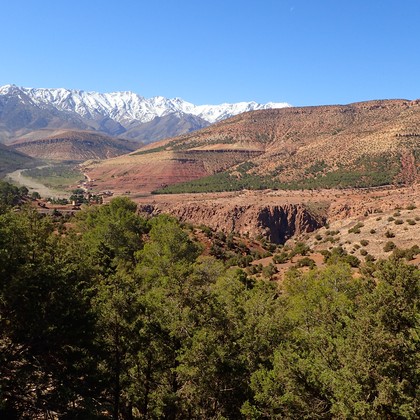
Mountain forest above about 800 m: cedar forest, holm-oak and cork-oak woodland and mixed forest with old trees full of cavities; in Tunisia also large parks next to forest. Nests in woodpecker holes and natural cavities and readily takes to nest boxes. On passage also in oases and gardens on the edge of the Sahara.
Where the bird is most at home, classified by the habitats of North Africa and the Middle East.

Range and movements
Breeds in Morocco in the Rif, the Middle Atlas (around Ifrane and Azrou among other places) and locally in the High Atlas; in northern Algeria in the Tell Atlas, Kabylia (Djurdjura, Babors) and the Aurès; and in northwestern Tunisia in the Kroumirie around Aïn Draham. Not in Libya. Crosses the Sahara in April and August – September, when it may turn up in the oases of southern Morocco and Algeria. Winters in West Africa south of the Sahara; the winter range is poorly known, with only a few confirmed records, including from Ivory Coast.
- Summer visitor (c. Apr–Sep)
- Passage (Mar–Apr, Oct–Nov)
- dark = core range, pale = thinly spread
How and when to look
Visit the cedar forests around Ifrane and Azrou in the Middle Atlas or the cork-oak woods near Aïn Draham in Tunisia in May and listen for the short, hammering song from a dead branch halfway up the canopy. Males sing most in the first weeks after arrival.
Conservation status
Assessed globally as not threatened, although the GBIF Red List still lists it as not evaluated because it has only recently been recognised as a species. Vulnerable because of its small range: the mountain forests of the Maghreb suffer from logging, overgrazing, drought and forest fires, and the loss of old trees with cavities limits nest sites.
Scientific name
Ficedula speculigera | (Bonaparte, 1850)
Bonaparte described the species in 1850 as M[uscicapa] speculigera; because it was later moved to another genus, the author and year stand in brackets. The genus Ficedula was introduced in 1760 by Brisson. Ficedula is Latin for a small fig-eating bird, from ficus 'fig'; it was believed to turn into the blackcap in winter. speculigera is Latin for 'mirror-bearing', from speculum 'mirror' and gerere 'to bear', after the white wing patch. The specimen the first description was based on came from Algiers.