All species › Passerines › Chats and flycatchers › Eversmann's Redstart
Eversmann's Redstart | Phoenicurus erythronotus
Eversmanns roodstaart | Colirrojo de Eversmann
Eversmann's Redstart is a Central Asian redstart that reaches the Persian Gulf in small numbers. In the Emirates and northern Oman it is a scarce but almost annual winter visitor, elsewhere in eastern Arabia a rarity. A slightly larger, robust redstart that often perches conspicuously in the open on a bush or wire.

Voice
The call is a hoarse, croaking krr-krr or gre-er and a soft tsit. The song, a short, varied twitter, is rarely heard in the winter quarters.
Recording: Patrick Franke — CC BY-NC-SA 3.0 · converted to mono · xeno-canto
Identification
14–15 cm. Slightly larger and fuller than Black Redstart, with the typical redstart posture and quivering tail. The male has a grey crown and nape, a black mask, orange-red mantle, throat and breast and a broad white stripe across the wing-coverts; rump and tail are rufous with a dark central pair. In winter the fresh feathers have pale fringes, so the crown and mantle look greyish brown and the pattern is less crisp. The female is grey-brown with a pale eye-ring, two pale wing-bars and a rufous tail; the pale wing panel is lacking in females of the other redstarts. First-winter males resemble a dull male.
Confusion species
Male Common Redstart (Phoenicurus phoenicurus) has a grey back and black throat, and the female lacks pale wing-bars. Black Redstart (Phoenicurus ochruros) of the eastern forms is also rufous-bellied, but has a black throat and upperparts without a rufous mantle. Moussier's Redstart (Phoenicurus moussieri) also has a white wing patch, but occurs only in the Maghreb. Females are the hardest: check the wing-bars and eye-ring.
Habitat
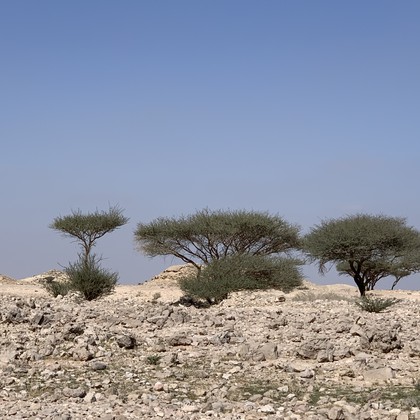
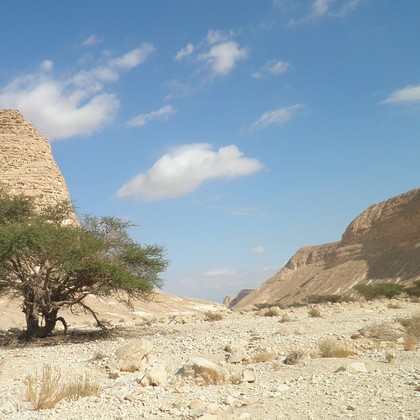
In winter in dry, open country with scattered trees and bushes: acacia scrub, wadis at the foot of the mountains, parks, gardens and golf courses. Hunts insects on the ground from a low perch and is often site-faithful for the whole winter.
Where the bird is most at home, classified by the habitats of North Africa and the Middle East.

Range and movements
Scarce winter visitor to the United Arab Emirates, where most records come from, and to northern Oman. Rare in Kuwait and Qatar; fewer than ten records in Saudi Arabia, mainly in the Eastern Province and near Riyadh. Not recorded farther west or in Yemen. Beyond the region it breeds in the mountains of Central Asia, from the Altai and Tien Shan to the Pamirs, and winters from Iran and Afghanistan to Pakistan and north-west India.
- Winter visitor (c. Apr–Sep)
- dark = core range, pale = thinly spread
How and when to look
In winter in the Emirates and northern Oman, search well-vegetated parks, the edges of golf courses and acacia scrub at the foot of the Hajar Mountains. Once found, a bird often stays at the same spot for weeks.
Conservation status
Not globally threatened. In the region a scarce winter visitor at the western edge of its winter range; numbers vary from winter to winter.
Scientific name
Phoenicurus erythronotus | (Eversmann, 1841)
Eversmann described the species in 1841 as Sylvia Erythronota; because it was later moved to another genus, the author and year stand in brackets. The genus Phoenicurus was introduced in 1817 by Forster. Phoenicurus is Greek, from phoinix 'red' and -ouros '-tailed'. erythronotus is Greek for 'red-backed', from eruthros 'red' and nōtos 'back'. The specimen the first description was based on came from the Altai Mountains.