All species › Passerines › Chats and flycatchers › Moussier's Redstart
Moussier's Redstart | Phoenicurus moussieri
Diadeemroodstaart | Colirrojo diademado
Moussier's Redstart is an endemic breeding bird of the Maghreb and for many birders one of the first target species in Morocco. A small, compact and exceptionally colourful redstart that shows itself without much fuss on a shrub or stone in open, scrubby country.

Voice
The call is a soft whit and a scratchy trrr. The song is a short, fast and rather scratchy twittering phrase, somewhat like that of a stonechat, given from a perch.
Recording: Stanislas Wroza — CC BY-NC-SA 4.0 · converted to mono · xeno-canto
Identification
12–13 cm. Smaller, rounder and shorter-tailed than the other redstarts. The male is unmistakable: black head and upperparts with a broad white band running from the forehead over the supercilium onto the neck side, a white wing patch and warm orange-red underparts from throat to undertail-coverts; rump and tail are orange-red. The female is grey-brown above and warm orange-buff below, with a faint pale eye-ring, sometimes a small pale wing patch and a rufous tail. Both often perch low and flick the tail.
Confusion species
Male Black Redstart (Phoenicurus ochruros) is dark grey without a white head band and with dark underparts. Female Common Redstart (Phoenicurus phoenicurus) is larger, slimmer and longer-tailed, paler below and lacks the warm orange over the whole underparts. European Stonechat (Saxicola rubicola) has a similar posture, but the male has a black throat and the tail is dark.
Habitat
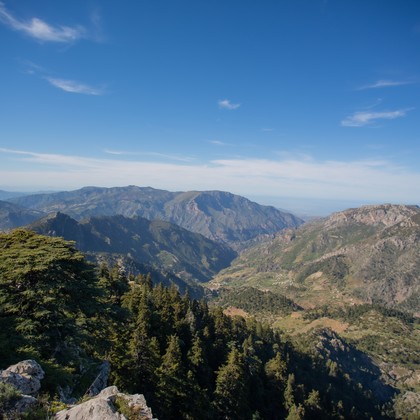
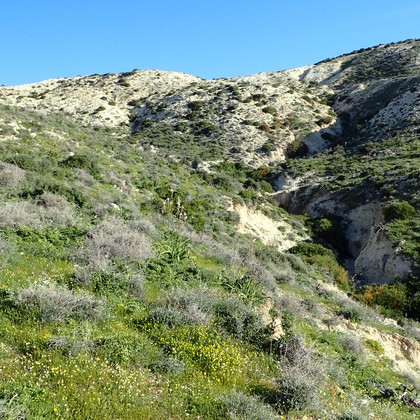
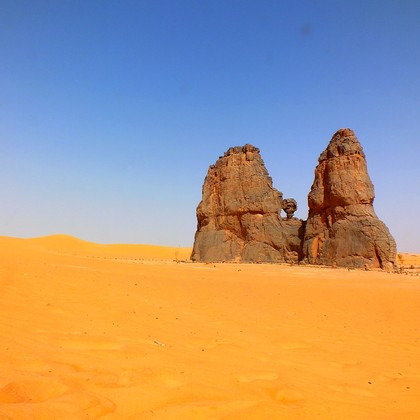
Open, scrubby country from sea level to above 2,500 m: maquis and garrigue, open oak and juniper woodland, slopes with dwarf shrubs, field edges and alfa steppe. In winter also in lowland areas, along the coast and on the northern edge of the Sahara.
Where the bird is most at home, classified by the habitats of North Africa and the Middle East.
Range and movements
Endemic to north-west Africa. Widespread in Morocco, from the Rif and the Atlantic coastal plain to the High Atlas and Anti-Atlas; also in northern Algeria, in the Tell and the Saharan Atlas, and in northern and central Tunisia. Very scarce and local in north-west Libya. In winter birds disperse to lower ground and the edges of the Sahara, rarely into Western Sahara. Beyond the region a rare vagrant to southern Europe.
- Resident
- Summer visitor (c. Apr–Sep)
- Winter visitor (c. Oct–Mar)
- Passage (Mar–Apr, Oct–Nov)
- dark = core range, pale = thinly spread
How and when to look
In Morocco seen almost anywhere in open scrub, for example around Ifrane and Azrou in the Middle Atlas, on the Tizi-n-Test and at Oukaimeden; in winter also on the coastal plain near Agadir and Oued Massa. The male likes to perch on the top of a low shrub.
Conservation status
Not globally threatened. A common breeding bird over most of its small range.
Scientific name
Phoenicurus moussieri | (Olphe-Galliard, 1852)
Olphe-Galliard described the species in 1852 as Erythacus Moussieri; because it was later moved to another genus, the author and year stand in brackets. The genus Phoenicurus was introduced in 1817 by Forster. Phoenicurus is Greek, from phoinix 'red' and -ouros '-tailed'. moussieri honours Jean Moussier (1795–1850), a surgeon in the French army and amateur naturalist. The specimen the first description was based on came from Algeria.