All species › Passerines › Chats and flycatchers › Black Redstart
Black Redstart | Phoenicurus ochruros
Zwarte roodstaart | Colirrojo tizón
In winter the Black Redstart is one of the most widespread songbirds of the region: from the Moroccan coast to the Emirates it perches on walls, rocks and roofs. As a breeding bird it is tied to the higher mountains. Several forms meet in the region, including rufous-bellied eastern birds that look very different from European ones.

Voice
The call is a short tsip and, when alarmed, a ticking tek-tek. The song, often given before dawn from a rock or roof, is a short, shrill phrase with a characteristic crackling, scrunching middle part, like crumpling paper.
Recording: Stanislas Wroza — CC BY-NC-SA 4.0 · converted to mono · xeno-canto
Identification
13–14.5 cm. A slim, dark redstart with a rufous rump and tail (dark central pair) that is constantly quivered. Males of the western forms (gibraltariensis, and the even darker aterrimus in Morocco) are slate-grey with a black face and breast and a white wing patch. The Levant form semirufus has a black throat and breast and a rufous belly reaching onto the breast; the eastern winter visitors (ochruros and phoenicuroides) are also rufous-bellied, with greyer upperparts. Females and young birds are uniformly dark grey-brown, below too, with only the red tail for colour.
Confusion species
Female Common Redstart (Phoenicurus phoenicurus) is warmer brown with paler, orange-buff tinged underparts and a pale throat; the male has a grey back, a white forehead band and an orange breast. Rufous-bellied males can resemble Eversmann's Redstart (Phoenicurus erythronotus), which has a rufous mantle and white wing band, or Moussier's Redstart (Phoenicurus moussieri), which has a white band over the forehead and neck sides. Red-tailed Wheatear (Oenanthe chrysopygia) is paler grey-brown and has a black terminal band to the tail.
Habitat
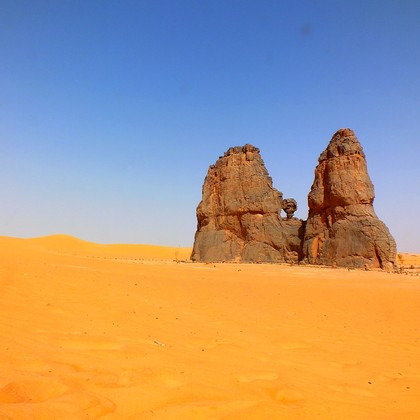
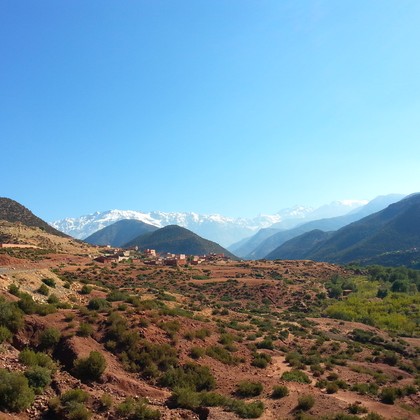
Breeds in rocky terrain in the mountains, from bare slopes and scree to above the tree line, and locally in villages. In winter also in the lowlands: rocky wadis, oases, ruins, quarries, villages and towns, parks and gardens, and coastal rocks.
Where the bird is most at home, classified by the habitats of North Africa and the Middle East.

Range and movements
Breeds in Morocco (form aterrimus) in the High and Middle Atlas and the Rif, and very locally in the mountains of northern Algeria. In the Levant semirufus breeds in the mountains of Lebanon and Syria, on Mount Hermon and locally in northern Israel; also in the mountains of Kurdistan in northern Iraq. In winter it is widespread and often common throughout the Maghreb, northern Libya, Egypt (especially Sinai and the Nile Valley), Israel, Jordan and Iraq, and on the Arabian Peninsula to the Emirates and northern Oman; scarcer in southern Saudi Arabia and Yemen. Beyond the region it breeds from western and central Europe to the Caucasus, Iran and Central Asia.
- Resident
- Summer visitor (c. Oct–Mar)
- Winter visitor (c. Apr–Sep)
- Passage (Mar–Apr, Oct–Nov)
- dark = core range, pale = thinly spread
How and when to look
In winter a regular visitor in the Hajar Mountains, on rocky ground in the Negev and the Arava and in almost every Moroccan village. For the rufous-bellied semirufus, look in spring on Mount Hermon or in the mountains of Lebanon.
Conservation status
Not globally threatened. In the region a common winter visitor; the breeding birds of the Atlas and the Levant are locally common in suitable mountain habitat.
Scientific name
Phoenicurus ochruros | (Gmelin, 1774)
Gmelin described the species in 1774 as Motacilla Ochruros; because it was later moved to another genus, the author and year stand in brackets. The genus Phoenicurus was introduced in 1817 by Forster. Phoenicurus is Greek, from phoinix 'red' and -ouros '-tailed'. ochruros is Greek, from okhros 'pale yellow' and -ouros '-tailed'. The specimen the first description was based on came from the mountains of Gilan, Iran.