All species › Passerines › Chats and flycatchers › Common Redstart
Common Redstart | Phoenicurus phoenicurus
Gekraagde roodstaart | Colirrojo real
In the region the Common Redstart is above all a passage migrant that moves in large numbers through the Sahara, the Nile Valley and the Middle East in spring and autumn. It also breeds in the cedar and oak forests of the Maghreb. In the east the form samamisicus (Ehrenberg's Redstart), with a white wing panel, predominates.

Voice
The call is a soft, rising hweet, often followed by a ticking tuc-tuc. The song starts with a fixed, melancholy opening (sree-troo-troo) and ends in a variable, often mimetic flourish.
Recording: João Ferreira Tomás — CC BY-NC-SA 4.0 · converted to mono · xeno-canto
Identification
13–14.5 cm. A slim redstart with an orange-red rump and tail (dark central pair) that is constantly quivered. The breeding male has a blue-grey crown and back, a white forehead band, a black face and throat and an orange-red breast that pales towards the belly; in autumn the pattern is muted by pale feather fringes. Males of samamisicus also show a striking white panel on the closed wing, formed by white-edged flight feathers. The female is grey-brown above, pale orange-buff below with a pale throat and a faint pale eye-ring.
Confusion species
Female Black Redstart (Phoenicurus ochruros) is darker and greyer, below as well. Female Moussier's Redstart (Phoenicurus moussieri) is smaller, more compact and warm orange over the whole underparts. Eversmann's Redstart (Phoenicurus erythronotus) has a rufous mantle and a white band across the wing-coverts; the female has pale wing-bars. Female Little Rock Thrush (Monticola rufocinereus) is greyer with an orange-tinged belly, but its tail has a dark terminal band.
Habitat
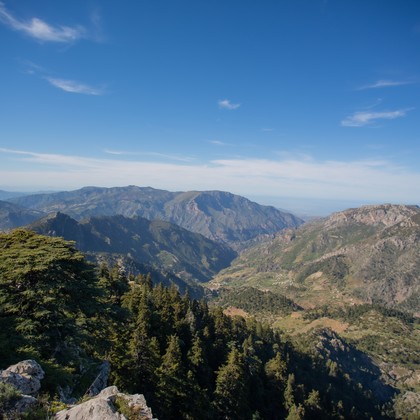
Breeds in open cedar, oak and juniper forest in the mountains, old orchards and parks with hollow trees. On migration in any terrain with trees or bushes: oases and palm groves, wadis with acacias, gardens, olive groves and field edges; in the desert at any spot with a little cover.
Where the bird is most at home, classified by the habitats of North Africa and the Middle East.


Range and movements
Breeds in the Maghreb in the Middle Atlas, the Rif and the High Atlas of Morocco, locally in the mountain forests of northern Algeria and very scarcely in north-west Tunisia. On passage, from March to May and August to October, common throughout the region: through the Maghreb and the Sahara, Libya, the Nile Valley and Sinai, through Israel and Jordan, and across the Arabian Peninsula, Iraq and the Gulf States, where mainly samamisicus passes. That form winters partly in Yemen and south-west Saudi Arabia; elsewhere a few birds linger in winter. Beyond the region the species breeds from Europe to central Siberia, Turkey and Iran, and winters in the Sahel and East Africa.
- Resident
- Summer visitor (c. Oct–Mar)
- Winter visitor (c. Apr–Sep)
- Passage (Mar–Apr, Oct–Nov)
- dark = core range, pale = thinly spread
How and when to look
In April and September migrants can be seen in every oasis and garden, for example at Eilat, in Sinai and in the Moroccan oases near Merzouga. Look for breeding birds in the cedar forests around Ifrane and Azrou in the Middle Atlas.
Conservation status
Not globally threatened. After a steep decline in the 1960s and 1970s, mainly due to drought in the Sahelian winter quarters, the European population is fairly stable. In the Maghreb breeding habitat is lost through logging and overgrazing of the mountain forests.
Scientific name
Phoenicurus phoenicurus | (Linnaeus, 1758)
Linnaeus described the species in 1758 as Motacilla Phoenicurus; because it was later moved to another genus, the author and year stand in brackets. The genus Phoenicurus was introduced in 1817 by Forster. Phoenicurus is Greek, from phoinix 'red' and -ouros '-tailed'. The specific epithet repeats the genus name. The specimen the first description was based on came from Sweden.