All species › Passerines › Chats and flycatchers › Little Rock Thrush
Little Rock Thrush | Monticola rufocinereus
Kleine rotslijster | Roquero chico
The Little Rock Thrush is an African rock thrush that in the region occurs only in the highlands of south-west Arabia. Small, slender and with the behaviour of a redstart: it quivers its tail and catches insects from a rock or branch. One of the species that give the Asir Mountains and Yemen their African character.

Voice
The call is a soft chuk and a fine, thin whistle. The song is a quiet, melodious series of whistles and twittering phrases, somewhat recalling a redstart, given from a high perch.
Recording: Abdulrahman Alenezi — CC BY-NC-SA 4.0 · converted to mono · xeno-canto
Identification
15–16 cm. The smallest rock thrush, with the build and posture of a large redstart. The male has a blue-grey head, throat, upper breast and upperparts and orange-red underparts, sharply demarcated from the grey. The tail is orange-red with a dark central pair and a dark terminal band, together forming an inverted T. The female is duller: grey-brown head and upperparts, a paler throat and orange-buff underparts, with the same tail pattern.
Confusion species
Rufous-tailed Rock Thrush (Monticola saxatilis) is larger and shorter-tailed; in breeding plumage it has a white back patch and the tail lacks a dark terminal band; females are scaly. Blue Rock-Thrush (Monticola solitarius) is larger, longer-billed and lacks the red tail. Female Common Redstart (Phoenicurus phoenicurus) is smaller and slimmer and has no dark terminal band to the tail.
Habitat
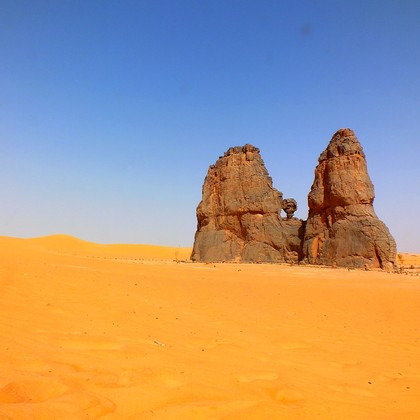
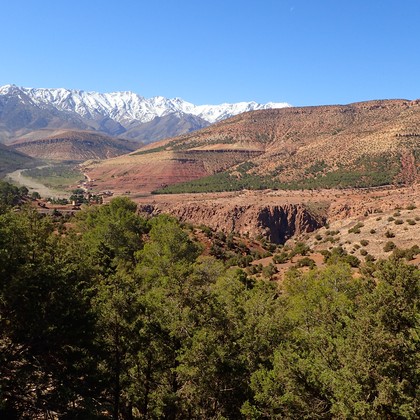
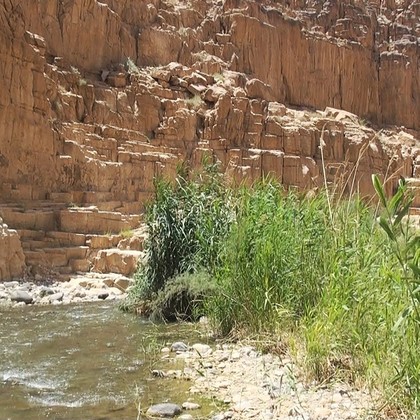
Rocky mountain slopes, cliffs and gorges with scattered trees, especially juniper woodland and open acacia woodland, and locally orchards, terraces and village edges. In Arabia mainly between about 1,500 and 3,000 m.
Where the bird is most at home, classified by the habitats of North Africa and the Middle East.
Range and movements
In the region only in the mountains of the south-west of the Arabian Peninsula: in Saudi Arabia in the Asir Mountains, from around Taif south via Al Baha and Abha to the Yemeni border, and in the western highlands of Yemen. Reports from Oman are not confirmed. Beyond the region in the highlands of Eritrea, Ethiopia and Somalia and south to Kenya and northern Tanzania.
- Resident
- Summer visitor (c. Oct–Mar)
- Winter visitor (c. Apr–Sep)
- Passage (Mar–Apr, Oct–Nov)
- dark = core range, pale = thinly spread
How and when to look
Easy to see in the juniper woodland and on the rocky slopes around Abha, for example at Al Soudah and the Raydah escarpment, and in the mountains around Al Baha. Look for a small rock thrush quivering its tail like a redstart.
Conservation status
Not globally threatened. Fairly common in suitable habitat in the Asir Mountains, although the juniper woodlands are under pressure from dieback, felling and development.
Scientific name
Monticola rufocinereus | (Rüppell, 1837)
Rüppell described the species in 1837 as Saxicola rufocinerea; because it was later moved to another genus, the author and year stand in brackets. The genus Monticola was introduced in 1822 by Boie. Monticola is Latin for 'mountain-dweller', from mons, montis 'mountain' and colere 'to dwell'. rufocinereus is Latin for 'rufous and ash-grey', from rufus 'red' and cinereus 'ash-grey'. The specimen the first description was based on came from the Simien region of northern Ethiopia.