All species › Waterfowl › Ducks, geese and swans › Barnacle Goose
Barnacle Goose | Branta leucopsis
Brandgans | Barnacla cariblanca
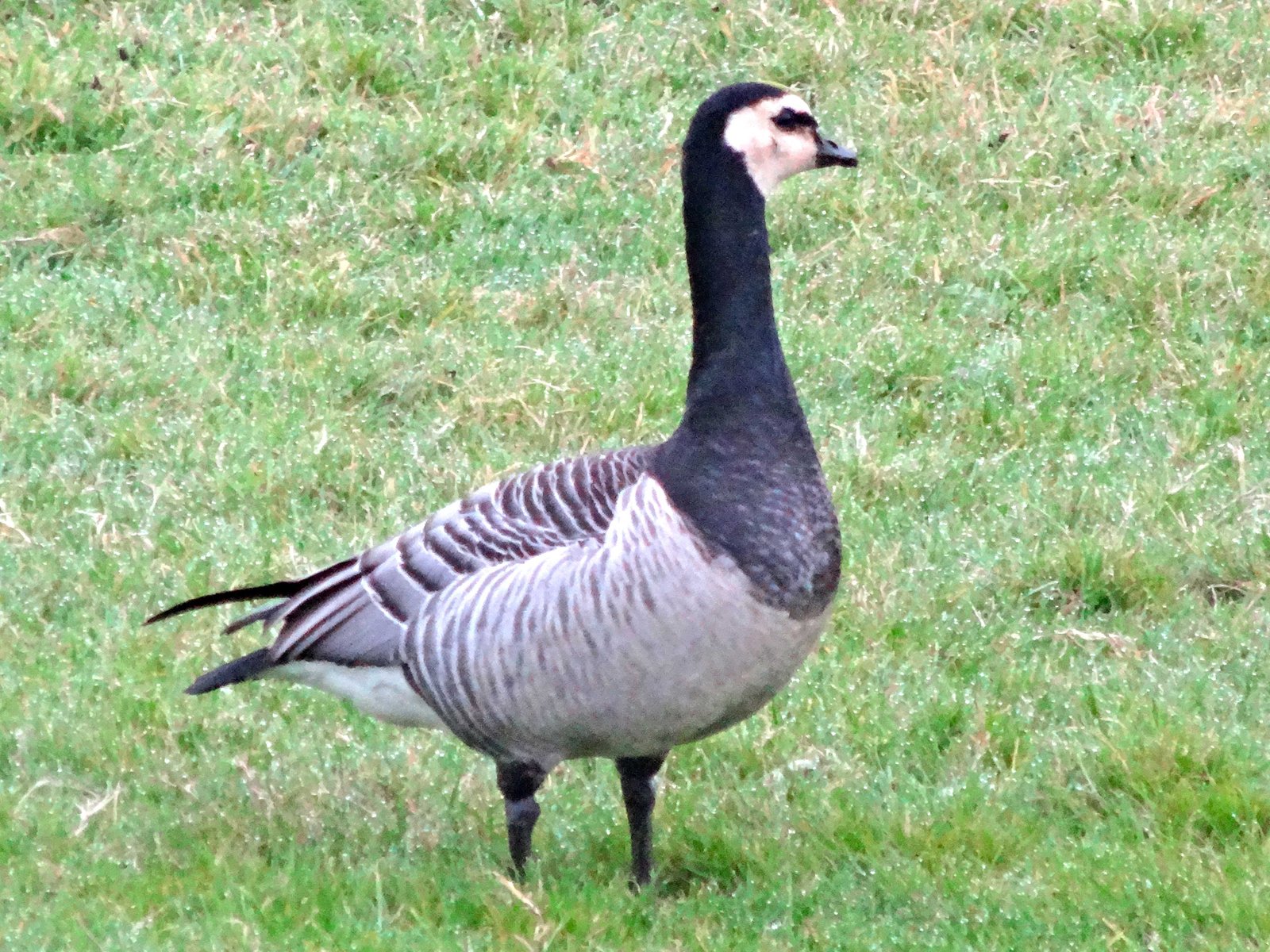
A medium-sized silvery-grey goose with a white face and a black neck and breast. Barnacle Goose winters in north-west Europe and is a very rare vagrant to the region; with every record the question arises whether the bird escaped from a collection.
Voice
A short, barking kaw or gak, like the yapping of a small dog; flocks produce a loud, constant yelping.
Recording: Kévin Westeel — CC BY-NC-SA 4.0 · converted to mono · xeno-canto
Identification
Head with a creamy-white face and black crown, nape, neck and breast; the black breast is sharply demarcated from the white belly. The back is blue-grey barred black and white, giving the upperparts a fine scaled pattern. The bill is small and black, the legs black. In flight the black forequarters, silver-grey wings and white rear stand out. Juveniles are duller, with less regular barring and some grey in the white face.
Confusion species
Brant (Branta bernicla) is smaller and darker, with a black head lacking a white face. Red-breasted Goose (Branta ruficollis) is smaller, with rusty red on neck and breast. Canada Goose (Branta canadensis), a familiar escape, is much larger and brown, with only a white chin strap.
Habitat
Winters on coastal grassland, saltmarsh and polders with short grass, roosting on tidal flats and lakes. In the region seen on coastal flats, lagoons and fields, sometimes among other geese.
Where the bird is most at home, classified by the habitats of North Africa and the Middle East.


Range and movements
In Morocco a few winter records on the Atlantic coast; elsewhere in North Africa and the Middle East at most exceptional, and there escape from captivity is hard to rule out. Breeds in Greenland, Svalbard and Novaya Zemlya and increasingly around the Baltic and in the Netherlands, wintering in north-west Europe, mainly Scotland, Ireland, the Netherlands and Germany.
How and when to look
The chance is greatest after severe winters or stormy weather in north-west Europe, on the Atlantic coast of Morocco. With any sighting, check for rings, undamaged wings and behaviour: wild birds are wary and join other geese.
Conservation status
Very rare vagrant, with a small number of records in Morocco; not established with certainty as a wild bird elsewhere in the region. Not globally threatened and strongly increased thanks to protection on the wintering grounds.
Scientific name
Branta leucopsis | (Bechstein, 1803)
Bechstein described the species in 1803 as Anas leucopsis; because it was later moved to another genus, the author and year stand in brackets. The genus Branta was introduced in 1769 by Scopoli. Branta is a Latinised form of Old Norse brandgás, 'burnt goose', that is, black goose. leucopsis is Greek, from leukos 'white' and opsis 'face': 'white-faced'. The specimen the first description was based on came from Germany.