All species › Passerines › Shrikes › Bay-Backed Shrike
Bay-Backed Shrike | Lanius vittatus
Bruinrugklauwier | Alcaudón dorsicastaño
The Bay-backed Shrike is a small, pied shrike of South Asia, from Iran and Afghanistan to India. The region lies on the extreme western edge of its range: in northern Oman and the Emirates it is a rare visitor that occasionally breeds, and further west a vagrant.

Voice
A harsh, grating chur-r or chek. The song is a pleasant, rambling warble with much mimicry of other birds.
Recording: Jelle Scharringa — CC BY-NC-SA 4.0 · shortened to the first 60 s, mono · xeno-canto
Identification
17 cm. A small, long-tailed shrike with a black forehead and broad black mask, a grey crown and nape and a deep chestnut back and scapulars. The rump is whitish, the wings are black with a small white primary patch and the tail is black with white sides and tips. Underparts white with warm buff to ochre flanks. The female is duller, with a browner mask and less black on the forehead. Juveniles are greyish-brown, finely barred above and below, and already show a white primary patch and a long white-edged tail.
Confusion species
Red-backed Shrike (Lanius collurio) also has a grey head and rufous back, but lacks the black forehead, has a grey rump, no white primary patch and less white in the tail. Long-tailed Shrike (Lanius schach) is larger, with a longer tail, a grey mantle and rufous rump and flanks. Juveniles can resemble young Masked Shrikes (Lanius nubicus) or Woodchat Shrikes (Lanius senator) but have a warmer, rufous back.
Habitat
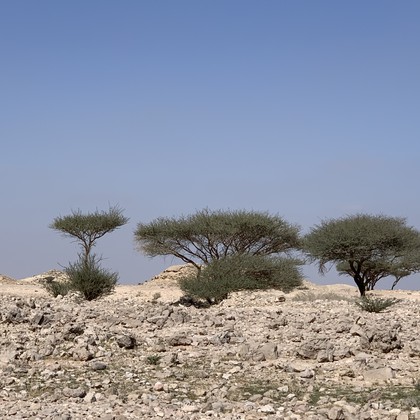
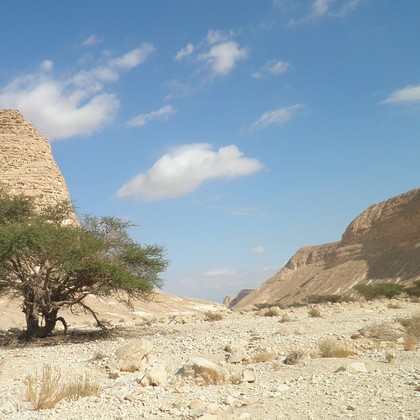
Dry, open country with scattered bushes and small trees: acacia scrub on plains and in wadis, mountain terraces with bushes and small fields, and the edges of villages and oases in the mountains.
Where the bird is most at home, classified by the habitats of North Africa and the Middle East.

Range and movements
In the region mainly in northern Oman and the eastern Emirates, where it is a rare passage migrant and scarce winter visitor; it has bred a few times, in Musandam (Ar Rowdah, 2004) and in Wadi Masafi in the Emirates (2010). Further west there are single records from Bahrain (2020) and Kuwait (2020), and it has been mentioned for Qatar without a certain record. Beyond the region it is resident or a short-distance migrant from Turkmenistan, Iran and Afghanistan through Pakistan and Nepal to almost all of India.
- Resident
- Passage (Mar–Apr, Oct–Nov)
- dark = core range, pale = thinly spread
How and when to look
The best chance is in spring in the wadis and on the mountain terraces of the Hajar Mountains in the Emirates and Musandam, such as around Masafi and in the wadis near Fujairah. Check every small shrike with a black forehead and chestnut back, and report a sighting to the national records committee.
Conservation status
Not globally threatened and common in South Asia. In the region so rare that there is no established population; the breeding records in Oman and the Emirates fit a slight westward range expansion.
Scientific name
Lanius vittatus | Valenciennes, 1826
Valenciennes described the species in 1826 and placed it straight away in the genus where it still stands. The genus Lanius was introduced in 1758 by Linnaeus. Lanius is Latin for 'butcher', from shrikes' habit of impaling prey on thorns and barbed wire. vittatus is Latin for 'banded', for the black eye mask. The specimen the first description was based on came from Puducherry, India.