All species › Passerines › Shrikes › Iberian Grey Shrike
Iberian Grey Shrike | Lanius meridionalis
Iberische klapekster | Alcaudón real
The Iberian Grey Shrike is a grey shrike of the Iberian Peninsula and southern France which, after the rearrangement of the grey shrikes, remained the only form of the former Southern Grey Shrike to keep species rank. It is largely sedentary; in the region it is a rare vagrant that may reach northern Morocco across the Strait of Gibraltar.

Voice
The call is a dry, nasal shree or chek; also a repeated whistled twee-ee. The song is a subdued twittering with whistled notes, heard less often than in Great Gray Shrike.
Recording: Sven Normant — CC BY-NC-SA 4.0 · converted to mono · xeno-canto
Identification
24–25 cm. A dark grey shrike: the upperparts are dark slate-grey, with a narrow but distinct white supercilium above the black mask. The throat is white, breast and flanks strikingly washed vinous pink. The wings are black with a small white primary patch and narrow white scapular edges; the tail is long and black with white sides. Sexes nearly alike. Juveniles are browner, with less pink and faint barring.
Confusion species
The North African form algeriensis of Great Gray Shrike (Lanius excubitor) is just as dark but has grey, not pink, breast and flanks and usually hardly any white supercilium; this is the key feature for confirming a vagrant. Lesser Gray Shrike (Lanius minor) also has a pink breast but is smaller and shorter-tailed, with a black forehead and no supercilium.
Habitat
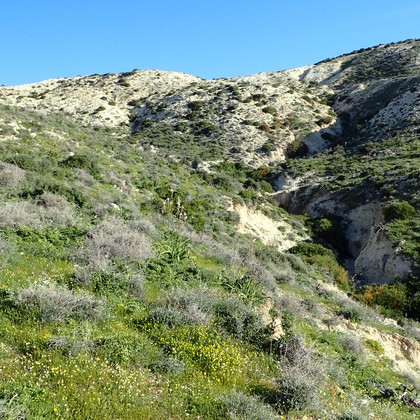
In its breeding range open, warm and dry country with bushes and low trees: garrigue, dehesa with scattered oaks, old olive groves, vineyards and field margins with hedges. A vagrant in northern Morocco is to be expected in similar semi-open farmland and coastal scrub.
Where the bird is most at home, classified by the habitats of North Africa and the Middle East.

Range and movements
In the region only as a vagrant: there are a few reports from northern Morocco, near the Strait of Gibraltar and Tangier, whose identification is often hard to confirm. No certain records are known from other countries in the region. Beyond it the species breeds in Spain, Portugal and southern France; it is almost sedentary, with a small proportion moving to southern Spain in winter.
How and when to look
A grey shrike in the Tangier area or on the peninsula near Ceuta in autumn deserves a careful look at breast and supercilium: a pink breast and white supercilium point to this species, grey flanks to the local algeriensis. Take photographs and document such a sighting carefully.
Conservation status
Vulnerable. The Iberian population has declined steeply since the 1990s, mainly through agricultural intensification, the loss of hedges and fallow land, and the decline of large insects through pesticides. In the region the species is of no real significance; vagrants are exceptional.
Scientific name
Lanius meridionalis | Temminck, 1820
Temminck described the species in 1820 and placed it straight away in the genus where it still stands. The genus Lanius was introduced in 1758 by Linnaeus. Lanius is Latin for 'butcher', from shrikes' habit of impaling prey on thorns and barbed wire. meridionalis is Latin for 'southern'. The specimen the first description was based on came from Provence.