All species › Passerines › Crows and jays › Alpine Chough
Alpine Chough | Pyrrhocorax graculus
Alpenkauw | Chova piquigualda
A slender, glossy black crow of high mountains with a short yellow bill. In the region it is mainly a bird of the highest parts of the Atlas, with small, isolated outposts in the mountains of Lebanon and Kurdistan. Flocks tumble skilfully along cliffs and scavenge at ski resorts and mountain huts.

Voice
A high, rolling prreep and a thin, whistled sweeeoo, very different from the shrill chee-ow of Red-billed Chough; a rolling churr in alarm and soft twittering from resting flocks.
Recording: Adrien Peillon — CC BY-NC-SA 4.0 · converted to mono · xeno-canto
Identification
37–39 cm. All black with a faint gloss, a short, slightly curved lemon-yellow bill and coral-red legs. Juveniles are duller, with a dull yellow bill and brownish-black legs. In flight a long, rounded tail projecting well beyond the wings, and wings with a curved trailing edge and less deeply fingered tips than Red-billed Chough; it glides and dives in the updraughts along cliffs.
Confusion species
Red-billed Chough (Pyrrhocorax pyrrhocorax) has a long, decurved red bill and in flight broader, rectangular wings with deeply fingered tips and a shorter, square-cut tail; beware young Red-Billed Choughs, whose bill is shorter and orange-yellow. Eurasian Jackdaw (Coloeus monedula) has a grey nape, a pale iris and a black bill and legs.
Habitat
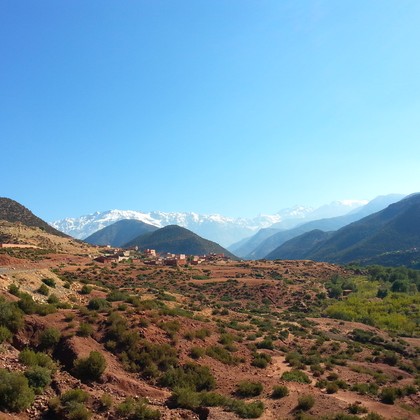
High mountains above the tree line: cliffs, scree slopes, alpine grassland and high plateaus; in the Atlas it breeds from about 2,900 to 3,900 m, higher than elsewhere in its range. Nests in rock crevices and caves. Feeds on insects and larvae from the turf, in autumn and winter many juniper berries and scraps around huts, villages and ski areas. In hard winters flocks drop to the valleys.
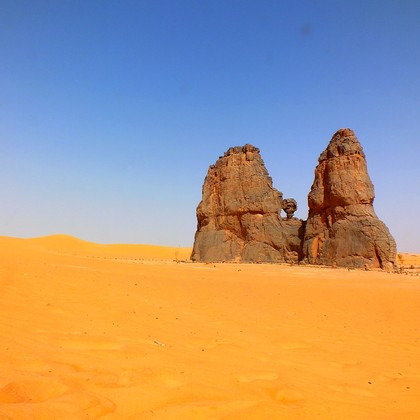
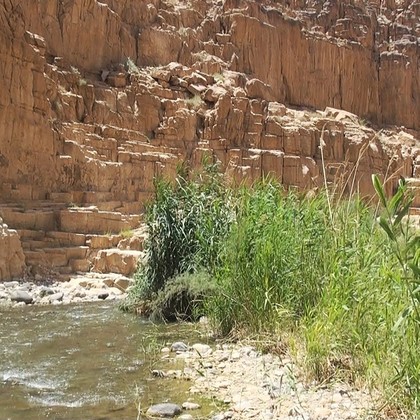
Where the bird is most at home, classified by the habitats of North Africa and the Middle East.
Range and movements
In Morocco in the High Atlas (including the Toubkal massif, Oukaïmeden and the M'Goun massif) and locally on the highest peaks of the Middle Atlas. In Algeria in the Djurdjura (Kabylia). In the east scarce on the highest peaks of the Mount Lebanon and Anti-Lebanon ranges (Lebanon, Syria) and rare in the high mountains of Kurdistan in northern Iraq, along the borders with Turkey and Iran. Beyond the region from northern Spain, the Alps and the Balkans through Turkey, the Caucasus and Iran to Central Asia, the Himalaya and western China.
- Resident
- Summer visitor (c. Apr–Sep)
- Passage (Mar–Apr, Oct–Nov)
- dark = core range, pale = thinly spread
How and when to look
Oukaïmeden, an hour south of Marrakech, is the place: flocks scavenge between the chalets and in the car parks, often alongside Red-Billed Choughs, so the two can be compared side by side. They are also near-certain in the Imlil valley and at the Toubkal huts.
Conservation status
Not globally threatened. The North African and Levantine populations are small, isolated and confined to the highest peaks; climate warming, pushing the alpine zone upwards, is the main long-term threat. Locally it benefits from scraps left by tourists and skiers.
Scientific name
Pyrrhocorax graculus | (Linnaeus, 1766)
Linnaeus described the species in 1766 as Corvus Graculus; because it was later moved to another genus, the author and year stand in brackets. The genus Pyrrhocorax was introduced in 1771 by Tunstall. Pyrrhocorax is Greek, from purrhos 'flame-coloured' and korax 'raven', after the black crow relative with red bill and legs. graculus is Latin for 'jackdaw', the classical name of a black crow relative. The specimen the first description was based on came from the Swiss Alps.