All species › Passerines › Crows and jays › Red-Billed Chough
Red-Billed Chough | Pyrrhocorax pyrrhocorax
Alpenkraai | Chova piquirroja
A glossy black crow with a long, decurved red bill and red legs, common in the region in the Atlas and Anti-Atlas, where flocks play in the updraughts above gorges and kasbahs. Further east it is a scarce mountain bird of Kurdistan.

Voice
A loud, explosive, far-carrying chee-ow or kiaow, shriller and higher than Eurasian Jackdaw's call; flocks produce an excited chorus of such calls.
Recording: Paul Kelly — CC BY-NC-SA 4.0 · converted to mono · xeno-canto
Identification
37–41 cm. Glossy blue-black, with a long, thin, decurved coral-red bill and red legs. Juveniles are duller with a shorter, orange-yellow bill. In flight broad, rectangular wings with six deeply fingered primaries and a fairly short, square-cut tail; performs steep dives with folded wings.
Confusion species
Alpine Chough (Pyrrhocorax graculus) has a short yellow bill, narrower wings and a longer, rounded tail. Eurasian Jackdaw (Coloeus monedula) is smaller, with a grey nape, pale iris and black bill and legs. Carrion Crow (Corvus corone) and Northern Raven (Corvus corax) are larger, with heavy black bills.
Habitat
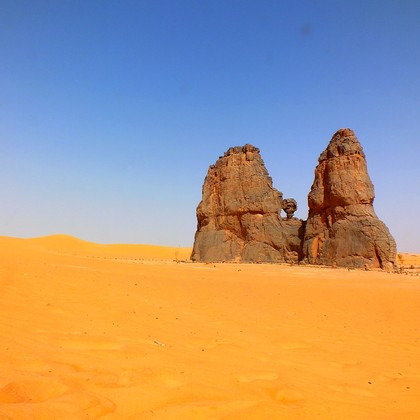
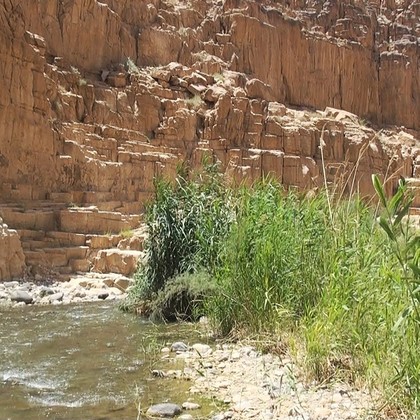
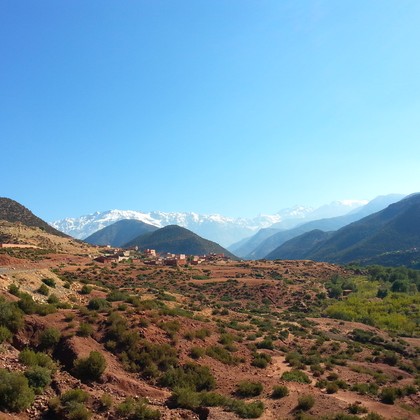
Bare mountain slopes with short grazed turf, cliffs, gorges and steep river valleys, in the Atlas from about 1,000 to above 3,500 m, lower in the Anti-Atlas and the gorges on the desert edge. Nests in rock crevices, caves and old buildings such as mud-brick kasbahs. Feeds by probing with its bill for larvae, ants and beetles in short vegetation and dung; depends on grazed grassland.
Where the bird is most at home, classified by the habitats of North Africa and the Middle East.
Range and movements
In Morocco common in the High Atlas, Middle Atlas and Anti-Atlas, including Jbel Saghro and the Dadès and Todra gorges; scarcer in the Rif. In Algeria in the northern mountains, including the Djurdjura and the Aurès. Only a few records from Tunisia. In the Middle East locally in the mountains of Kurdistan in northern Iraq and in northern Syria; rare in Lebanon. Beyond the region on the Atlantic coasts of Ireland, Britain and Brittany, in Iberia, the Alps and on La Palma, and from Turkey and the Caucasus to Central Asia, the Himalaya and China; an isolated population lives in the Ethiopian highlands.
- Resident
- Summer visitor (c. Apr–Sep)
- Winter visitor (c. Oct–Mar)
- Passage (Mar–Apr, Oct–Nov)
- dark = core range, pale = thinly spread
How and when to look
In the Todra and Dadès gorges they fly low along the walls and can be seen at close range, as on the Tizi n'Tichka pass. At Oukaïmeden they mix with Alpine Choughs, ideal for comparing bills and wing shape.
Conservation status
Not globally threatened. Declined in Europe through the loss of extensive grazing; still common in the Atlas, but there too it depends on traditional livestock farming with closely grazed pastures.
Scientific name
Pyrrhocorax pyrrhocorax | (Linnaeus, 1758)
Linnaeus described the species in 1758 as Upupa Pyrrhocorax; because it was later moved to another genus, the author and year stand in brackets. The genus Pyrrhocorax was introduced in 1771 by Tunstall. Pyrrhocorax is Greek, from purrhos 'flame-coloured' and korax 'raven', after the black crow relative with red bill and legs. The specific name repeats the genus name. The specimen the first description was based on came from England.