All species › Passerines › Larks › Bimaculated Lark
Bimaculated Lark | Melanocorypha bimaculata
Bergkalanderleeuwerik | Calandria bimaculada
Bimaculated Lark is the eastern, mountain-dwelling cousin of Calandra Lark. In this region its breeding range touches only the northern edge, in the mountains of the Levant and Kurdistan, but on migration it passes in small flocks through the whole Middle East to its winter quarters in north-east Africa and Arabia.

Voice
The song resembles that of Calandra Lark: a varied, scratchy and twittering series with much mimicry, given in song flight or from the ground. The call is a dry, rolling prrup or cherrp.
Recording: David Darrell-Lambert — CC BY-NC-SA 4.0 · converted to mono · xeno-canto
Identification
16–17 cm, a heavy, stocky lark with a thick, horn-coloured bill and a fairly short tail. Upperparts grey-brown with dark streaks, underparts white with a buff breast. A black patch on each side of the upper breast, sometimes joining into a broken band. The head shows a clear white supercilium and a dark eye-stripe. In flight the underwings are grey-brown, the wing lacks a white trailing edge and the tail has white tips rather than white sides. Sexes alike.
Confusion species
Calandra Lark (Melanocorypha calandra) has blackish underwings in flight, a white trailing edge to the secondaries and white tail sides, and a less strongly marked head. Greater Short-toed Lark (Calandrella brachydactyla) is much smaller and slimmer. Eurasian Skylark (Alauda arvensis) lacks the black breast patches and has a white trailing edge to the wing.
Habitat
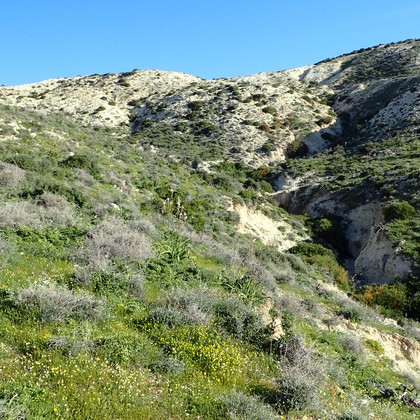
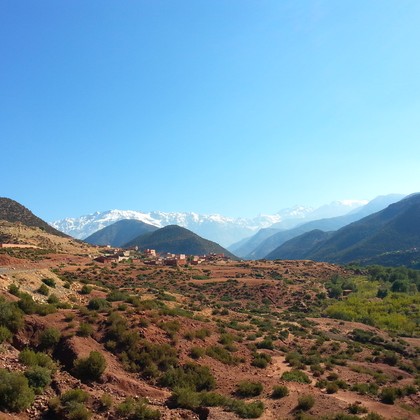
Breeds on stony, sparsely vegetated mountain slopes and plateaux with short grass, mostly between 1000 and 2000 m, also on fields and fallow land in the hills. On migration and in winter on steppe, fields, stubble and semi-desert.
Where the bird is most at home, classified by the habitats of North Africa and the Middle East.

Range and movements
Breeds in the mountains of Lebanon and the Anti-Lebanon, western Syria and northern Iraq. In Israel about 50 pairs bred in small colonies on the northern Golan until the late 1980s; no breeding has been recorded there since the early 2000s. A passage migrant through almost the whole Middle East, in Israel mainly in spring, and scarcer in Egypt (mainly Sinai) and the Gulf states. It winters in north-east Africa (Sudan, Eritrea, Ethiopia) and in Arabia; a rare winter visitor in the Arava. Beyond the region it breeds from Turkey through the Caucasus and Iran to Central Asia.
- Summer visitor (c. Oct–Mar)
- Winter visitor (c. Apr–Sep)
- Passage (Mar–Apr, Oct–Nov)
- dark = core range, pale = thinly spread
How and when to look
In Israel the best chance is in March and early April, on fields and steppe in the Negev and along the Arava. In flocks of Greater Short-Toed Larks look for a larger, heavier bird with dark breast patches and white tail tips.
Conservation status
Not threatened. In Israel it has disappeared as a breeder (regionally extinct) through the expansion of settlements, orchards and quarries on the Golan. Elsewhere in the region the breeding population is small and poorly known.
Scientific name
Melanocorypha bimaculata | (Ménétries, 1832)
Ménétries described the species in 1832 as Alauda bimaculata; because it was later moved to another genus, the author and year stand in brackets. The genus Melanocorypha was introduced in 1828 by Boie. Melanocorypha is Greek, from melas 'black' and koruphos, a bird of classical authors that can no longer be identified, here confused with korudos 'lark'. bimaculata is New Latin for 'two-spotted', after the dark patches on either side of the breast. The specimen the first description was based on came from the Talysh Mountains, Azerbaijan.