All species › Passerines › Larks › Calandra Lark
Calandra Lark | Melanocorypha calandra
Kalanderleeuwerik | Calandria común
Calandra Lark is the largest and heaviest lark of the cereal plains around the Mediterranean. In spring it hangs high above fields and steppe with slow, fluttering wingbeats and an endless, powerful song. In the region it breeds in the Maghreb and in the Levant east to Iraq; in winter it forms flocks that wander over stubble and steppe.

Voice
The song is a long, powerful and varied stream of rolling and shrill notes, richer and harsher than that of Eurasian Skylark and full of mimicry of other birds; it is given in a high, circling song flight with slow wingbeats or from a clod or post. The call is a dry, rolling trrlit or a hoarse kleetra.
Recording: Esperanza Poveda — CC BY-NC-SA 4.0 · shortened to the first 60 s, mono · xeno-canto
Identification
17–20 cm, a big, stocky lark with a heavy, yellowish horn-coloured bill and a fairly short tail. Upperparts grey-brown with dark streaks, underparts white with a buff wash across the breast. Striking is the large black patch on each side of the neck, which in some birds almost joins into a band. Clear white supercilium. In flight the blackish underwings, broad white trailing edge to the secondaries and white tail sides are diagnostic; the wings look broad and the flight is somewhat heavier than in other larks. Sexes alike.
Confusion species
Bimaculated Lark (Melanocorypha bimaculata) is slightly smaller, has a more strongly marked head, grey-brown underwings, no white trailing edge and white tail tips instead of white tail sides. Eurasian Skylark (Alauda arvensis) is smaller and slimmer, with a thinner bill and a streaked breast without black neck patches. Greater Short-toed Lark (Calandrella brachydactyla) is much smaller and has only a small dark neck mark. Corn Bunting (Emberiza calandra) can confuse at a distance, but has a streaked breast and no white wing edge.
Habitat
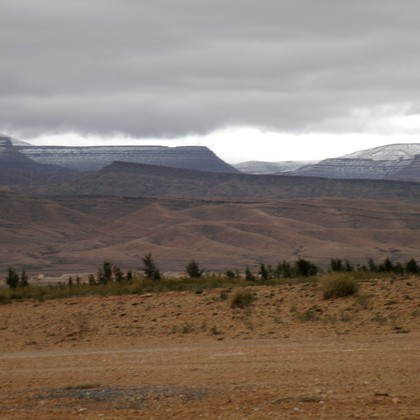
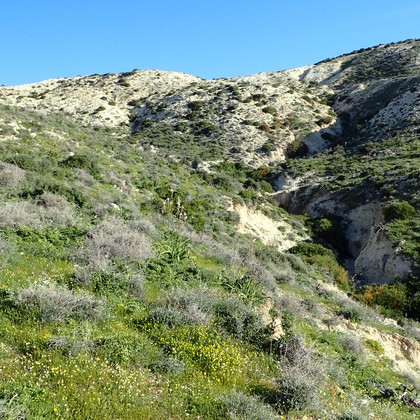
Open, flat to rolling country with short vegetation: cereal fields, fallow and pasture, herbaceous steppe and grassy plateaux, in the Levant also on basalt plateaux. Avoids trees and true desert. In winter in flocks on stubble, fallow and steppe.
Where the bird is most at home, classified by the habitats of North Africa and the Middle East.

Range and movements
In the Maghreb a widespread breeder of the cereal plains and plateaux from northern and eastern Morocco through northern Algeria (the Tell and the High Plateaux) to northern and central Tunisia, and in northern Libya (Tripolitania and Cyrenaica). In the Levant it breeds in Syria, the Beqaa in Lebanon, northern and western Jordan and in Israel mainly on the Golan, in eastern Galilee, on the slopes of Mount Gilboa and in eastern Samaria; until the 1980s also in the northern Negev, the Shephelah and the northern valleys. It also breeds in northern and central Iraq. In winter flocks move south: into the northern Negev, scarcely to northern Egypt and Sinai, and to Kuwait and northern Saudi Arabia. Beyond the region it breeds from southern Europe and Turkey through the Caucasus and Iran to Central Asia.
- Resident
- Summer visitor (c. Apr–Sep)
- Winter visitor (c. Oct–Mar)
- Passage (Mar–Apr, Oct–Nov)
- dark = core range, pale = thinly spread
How and when to look
In Israel it can be heard in March–May over the grasslands of the Golan; in Morocco and Tunisia over cereal fields on the plateaux. In flight the black underwings and white trailing edge give it away at once, also in mixed lark flocks in winter.
Conservation status
Not threatened. Even so, the species is declining in much of its range through agricultural intensification, pesticide use, overgrazing and afforestation. On the Israeli Red List it is listed as Endangered: its range and numbers there have shrunk markedly since the 1980s.
Scientific name
Melanocorypha calandra | (Linnaeus, 1766)
Linnaeus described the species in 1766 as Alauda calandra; because it was later moved to another genus, the author and year stand in brackets. The genus Melanocorypha was introduced in 1828 by Boie. Melanocorypha is Greek, from melas 'black' and koruphos, a bird of classical authors that can no longer be identified, here confused with korudos 'lark'. calandra goes back through Mediaeval Latin to Greek kalandros, the name of this lark. The specimen the first description was based on came from the Pyrenees.