All species › Sandgrouse › Sandgrouse › Black-Bellied Sandgrouse
Black-Bellied Sandgrouse | Pterocles orientalis
Zwartbuikzandhoen | Ganga ortega
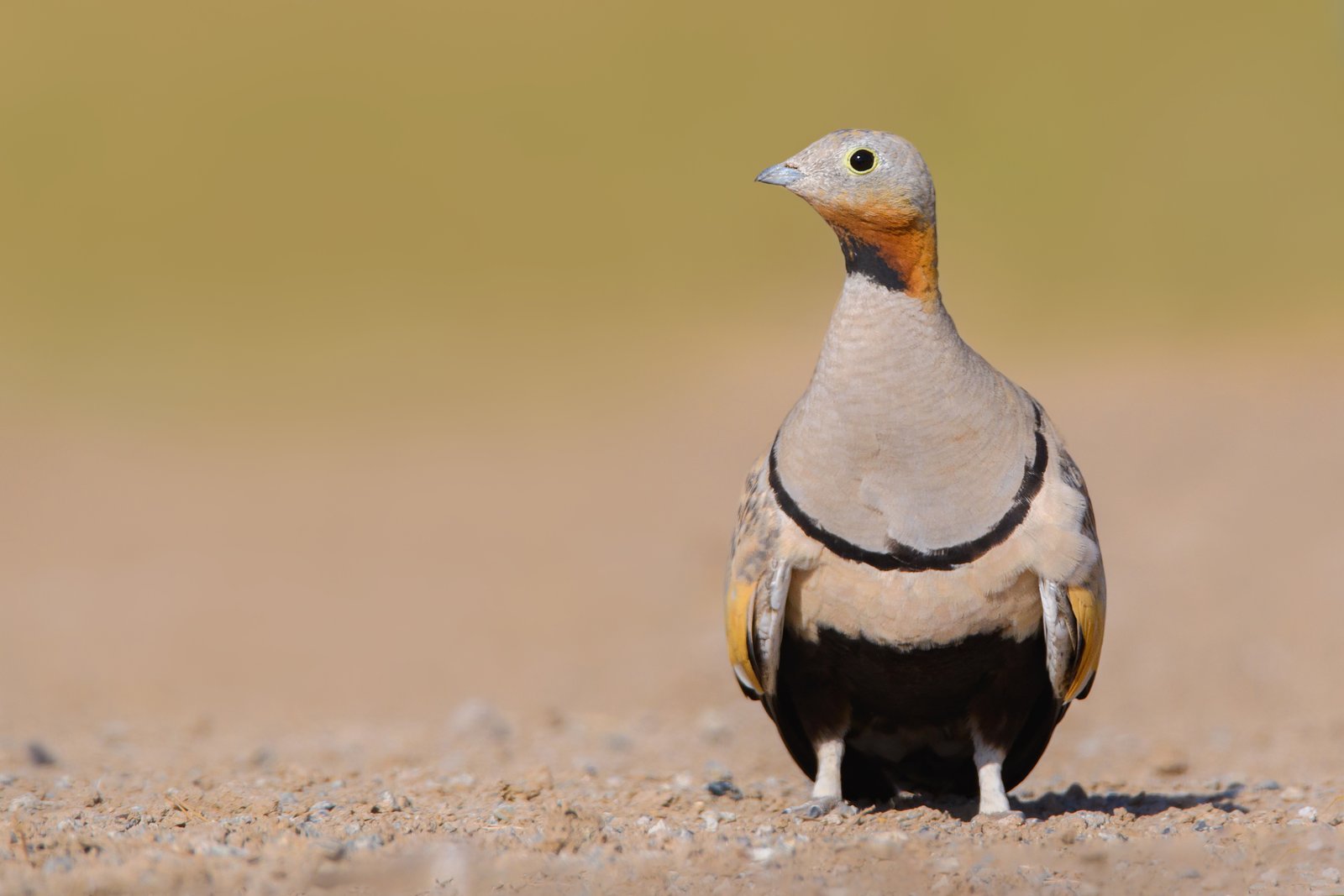
The largest and heaviest sandgrouse of the region, a bird of the high plateaus and steppes on the northern edge of the desert. The black belly beneath a plain grey or spotted breast and the short, blunt tail make it the easiest sandgrouse to identify in flight; its rolling call carries for kilometres across the plain.
Voice
A deep, rolling, bubbling churrrr-rr-ue or gurrr-ooh, repeated in flight and carrying far, with a characteristic trilled r. Lower and softer in tone than the hoarse katar of Pin-tailed Sandgrouse.
Recording: SonoNatura — CC BY-NC-SA 4.0 · converted to mono · xeno-canto
Identification
Large and stocky, with a short tail without pins and broad wings. The male has a grey head and breast, a chestnut throat patch with a small black triangle beneath, a narrow black band separating the grey breast from a pale creamy breast band, and an all-black belly. The back is ochre-yellow with grey and brown spots. The female is sandy brown, densely spotted and streaked black on head, breast and back, with the same narrow black breast line and black belly. In flight: black belly and black flight feathers contrasting sharply with white underwing coverts.
Confusion species
Pin-tailed Sandgrouse (Pterocles alchata) often shares the same steppe but is slimmer, with tail pins, a white belly and an all-white underwing. Chestnut-bellied Sandgrouse (Pterocles exustus) has a dark belly but also dark underwing coverts and tail pins, and lives further south. Lichtenstein's Sandgrouse (Pterocles lichtensteinii) is much smaller, finely barred all over and lives in rocky desert wadis.
Habitat
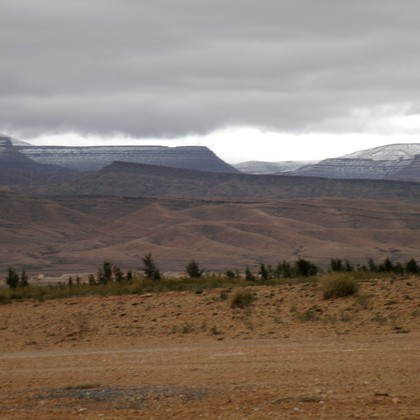
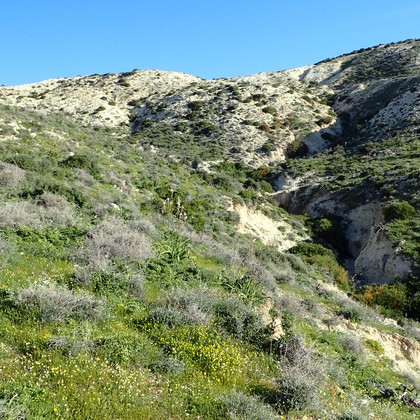
Open, dry steppe and high plateau with short vegetation: alfa steppe, herbaceous steppe, dry grassland, cereal fields, fallow and stubble, also on hilly or slightly stony ground and higher than Pin-tailed Sandgrouse, locally above 1500 metres. Avoids bare desert. Eats mainly seeds of legumes and other herbs. Usually drinks in the morning, in smaller flocks than Pin-tailed Sandgrouse.
Where the bird is most at home, classified by the habitats of North Africa and the Middle East.

Range and movements
In the Maghreb on the high plateaus and steppes of eastern and central Morocco (the Moulouya plain, the Missour and Midelt area and the plateau east of the Middle Atlas), northern Algeria and central Tunisia; scarce in north-western Libya and Cyrenaica. In the east it breeds in Syria, northern Iraq and locally in Jordan and Israel (mainly the northern Negev and the Golan). In winter flocks appear in Iraq, Kuwait and northern Saudi Arabia, and rarely in Sinai and the Gulf states. Beyond the region in Spain and Portugal, on Fuerteventura and Lanzarote, and from Turkey through Iran to Central Asia and north-west China; northern birds winter as far as Pakistan and north-west India.
- Resident
- Summer visitor (c. Oct–Mar)
- Winter visitor (c. Apr–Sep)
- Passage (Mar–Apr, Oct–Nov)
- dark = core range, pale = thinly spread
How and when to look
In spring in eastern Morocco, on the plains between Midelt and Missour or around Tendrara: drive slowly and listen for the rolling call of passing pairs and small flocks, then scan stubble and fallow fields. A bird on the ground is barely visible; only when it flushes does the black belly show.
Conservation status
Not globally threatened, but clearly declining in the western Palearctic. In North Africa and the Levant steppe is disappearing to ploughing, irrigated farming and overgrazing, and the species is hunted. In Israel it is now only a scarce breeder; recent data are lacking for Libya, Syria and Iraq.
Scientific name
Pterocles orientalis | (Linnaeus, 1758)
Linnaeus described the species in 1758 as Tetrao orientalis; because it was later moved to another genus, the author and year stand in brackets. The genus Pterocles was introduced in 1815 by Temminck. Pterocles is Greek, from pteron 'wing' and -klēs 'notable, splendid'. orientalis is Latin for 'eastern', after the eastern part of the range. The specimen the first description was based on came from Anatolia.