All species › Waders, gulls and terns › Sandpipers and snipes › Black-Tailed Godwit
Black-Tailed Godwit | Limosa limosa
Grutto | Aguja colinegra
A large, slender wader with long legs and a long, straight bill. For the region it is mainly a migrant: hundreds of thousands of western European Black-Tailed Godwits pass through Morocco in spring, where many winter on the rice fields and marshes of the Gharb, while eastern birds pass through the Levant, Egypt and Iraq.
Voice
In flight a loud, nasal wicka-wicka-wicka or kee-wee; feeding flocks give a soft chattering. The well-known grutto-grutto song of the breeding grounds is hardly heard in the region.
Recording: Jens Schöller — CC BY-NC-SA 4.0 · converted to mono · xeno-canto
Identification
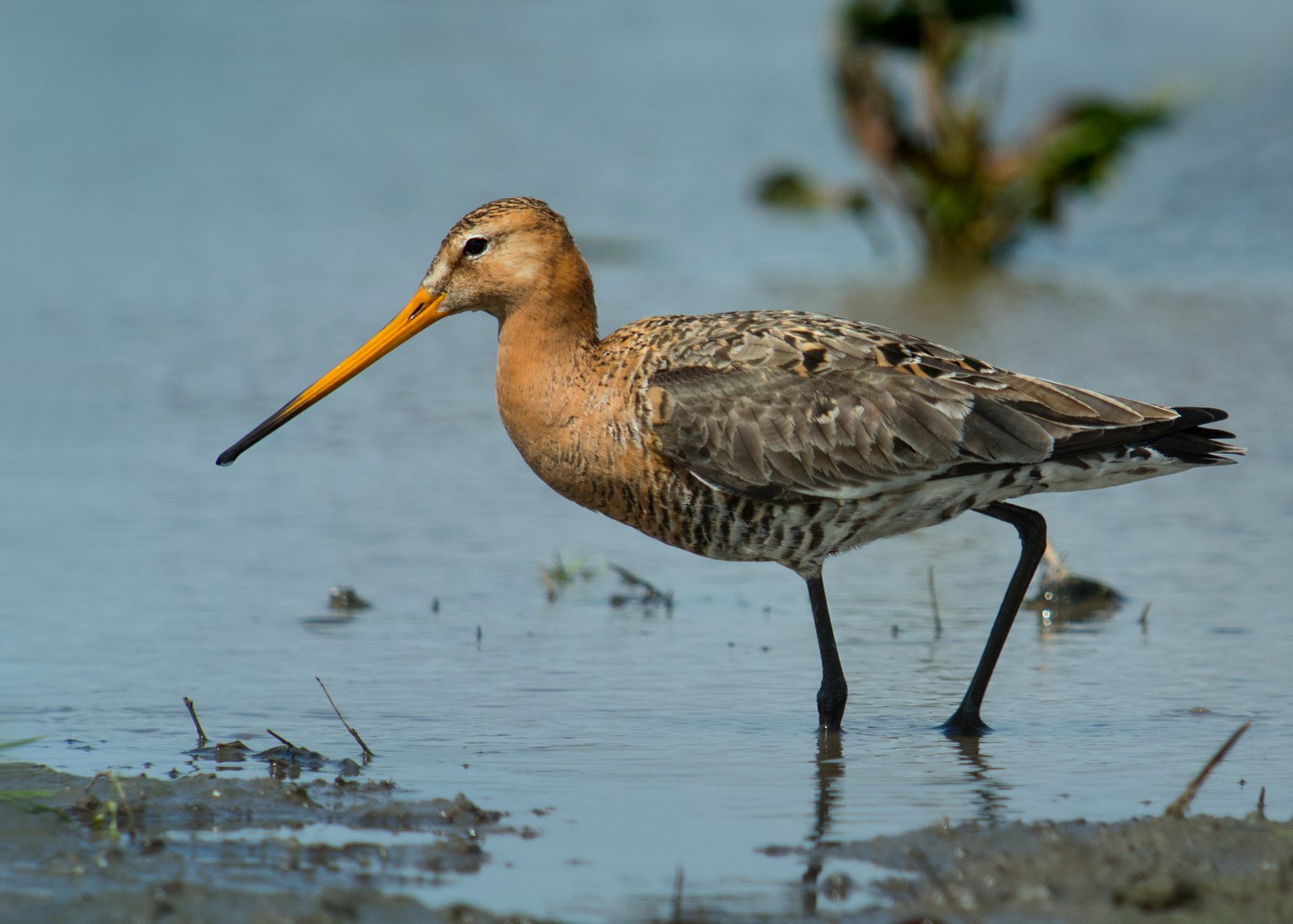
In winter plumage plain grey-brown above and pale grey below, with a short pale supercilium. In breeding plumage neck and breast orange-red, the belly white with black barring. The bill is long, almost straight and pink at the base. In flight unmistakable with its broad white wingbar, white rump and black tail band; the long legs project well beyond the tail. Birds of the Icelandic form islandica are shorter-billed and deeper red.
Confusion species
Bar-tailed Godwit (Limosa lapponica) has shorter legs, a slightly upturned bill, streaked upperparts in winter and no wingbar. Long-billed Dowitcher (Limnodromus scolopaceus) is smaller and stockier, with shorter legs and a white wedge on the back. In breeding plumage a distant bird can recall a Ruff (Calidris pugnax), which however has a short bill.
Habitat
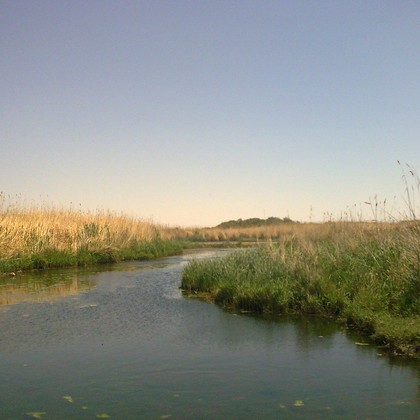
Freshwater marshes, flooded grassland, rice fields, fish ponds, reservoirs and sewage ponds; less on mudflats and in lagoons than Bar-tailed Godwit, although Icelandic birds also winter on the coast. Roosts in large flocks in shallow water.
Where the bird is most at home, classified by the habitats of North Africa and the Middle East.


Range and movements
In Morocco a numerous winter visitor and passage migrant: tens of thousands winter at Merja Zerga, the Loukkos marshes and the rice fields of the Gharb, joined in spring passage (January to March) by migrants from West Africa. In Algeria and Tunisia a migrant and scarce winter visitor on the northern wetlands (Lac Tonga, Ichkeul). In Egypt, Israel and Jordan a common migrant in March–April and August–October, with wintering birds on the fish ponds of the Hula and Bet She'an valleys and on the Egyptian delta lakes. In Iraq a migrant and winter visitor in the Mesopotamian marshes; on the Arabian Peninsula a migrant and scarce winter visitor in the Gulf states, Oman and Yemen, often at sewage ponds. Beyond the region it breeds from Iceland and western Europe to eastern Siberia and winters in western Europe, West Africa south of the Sahara, South Asia and Australia.
- Resident
- Summer visitor (c. Oct–Mar)
- Winter visitor (c. Apr–Sep)
- Passage (Mar–Apr, Oct–Nov)
- dark = core range, pale = thinly spread
How and when to look
In January and February the rice fields and marshes around Moulay Bousselham and Merja Zerga hold thousands of godwits; in the Levant the fish ponds of the Hula and the Bet She'an valley are the best sites during migration. In the Emirates they regularly appear at Al Wathba and the Al Warsan sewage ponds.
Conservation status
Near Threatened. The western European breeding population has declined steeply through intensive grassland farming; rice fields and wetlands along the flyway are also of great importance. In the region threatened by drainage, drying out of marshes and hunting.
Scientific name
Limosa limosa | (Linnaeus, 1758)
Linnaeus described the species in 1758 as Scolopax Limosa; because it was later moved to another genus, the author and year stand in brackets. The genus Limosa was introduced in 1760 by Brisson. Limosa is Latin for 'muddy', from limus 'mud'. The specific name repeats the genus name. The specimen the first description was based on came from Sweden.