All species › Waders, gulls and terns › Sandpipers and snipes › Bar-Tailed Godwit
Bar-Tailed Godwit | Limosa lapponica
Rosse grutto | Aguja colipinta
A godwit of tidal flats, with a long, slightly upturned bill and shorter legs than Black-tailed Godwit. It breeds on the tundra and winters in large numbers on the Atlantic coast of Morocco and Western Sahara and above all on the coast of Oman, where Barr al Hikman ranks among the most important intertidal sites in western Asia.

Voice
Mostly silent outside the breeding season; in flight a nasal kee-kee or kirrik, in flocks also a barking wik-wik.
Recording: bert de bruin — CC BY-NC-SA 4.0 · converted to mono · xeno-canto
Identification
In winter plumage grey-brown with dark shaft streaks on the upperparts, giving a streaked, curlew-like look, and a pale supercilium. The bill is long, pink with a dark tip and slightly upturned. Males in breeding plumage are entirely deep rufous below; females are larger, longer-billed and paler. In flight no wingbar, a white wedge on the back and a finely barred tail; the legs project only a little beyond the tail.
Confusion species
Black-tailed Godwit (Limosa limosa) has longer legs, a straighter bill, a broad white wingbar and a black tail with a white base; in winter plumage it is plainer grey. Whimbrel (Numenius phaeopus) has a downcurved bill and head stripes. Asian Dowitcher (Limnodromus semipalmatus), a vagrant, is smaller with an all-black, straight bill.
Habitat
Tidal flats with soft mud and sand, coastal lagoons, bays and estuaries, less on salt pans and sebkhas. It feeds in the water up to the belly, probing deep into the mud; at high tide it roosts in dense flocks.
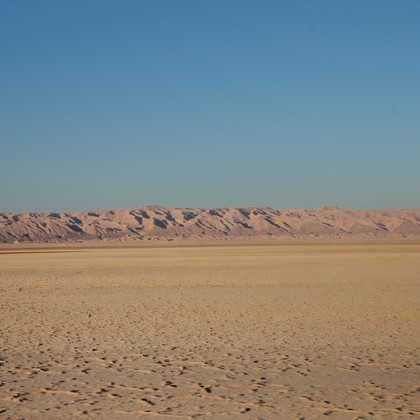
Where the bird is most at home, classified by the habitats of North Africa and the Middle East.

Range and movements
Along Morocco's Atlantic coast a common winter visitor and passage migrant, with the largest numbers at Merja Zerga, the Khnifiss lagoon and Dakhla Bay (Western Sahara), close to the huge concentrations on the Banc d'Arguin in Mauritania. Scarce along the Mediterranean; in Tunisia mainly in the Gulf of Gabès, in Egypt on the delta lakes and at Port Said. Scarce along the Red Sea. In Oman very numerous: Barr al Hikman and Masirah Island hold tens of thousands in winter. Also common along the Persian Gulf, from Kuwait and Bahrain to the Emirates, and on the coast of Yemen. Beyond the region it breeds on the tundra from Lapland to Alaska and winters on the coasts of western Europe, Africa, South Asia and Australasia.
- Resident
- Summer visitor (c. Oct–Mar)
- Winter visitor (c. Apr–Sep)
- Passage (Mar–Apr, Oct–Nov)
- dark = core range, pale = thinly spread
How and when to look
Barr al Hikman in Oman holds large winter flocks of Bar-Tailed Godwits, Eurasian Curlews and small waders. In Morocco they are easy to see at Dakhla Bay and at Merja Zerga near Moulay Bousselham, ideally around high tide.
Conservation status
Near Threatened. The species is declining globally because of the loss of intertidal flats along the Yellow Sea, which mainly affects the East Asian populations. In the region threatened by coastal development and land reclamation in the Gulf and by disturbance at high-tide roosts.
Scientific name
Limosa lapponica | (Linnaeus, 1758)
Linnaeus described the species in 1758 as Scolopax lapponica; because it was later moved to another genus, the author and year stand in brackets. The genus Limosa was introduced in 1760 by Brisson. Limosa is Latin for 'muddy', from limus 'mud'. lapponica means 'of Lapland', the northern breeding range of the species. The specimen the first description was based on came from Lapland.