All species › Waders, gulls and terns › Sandpipers and snipes › Eurasian Curlew
Eurasian Curlew | Numenius arquata
Wulp | Zarapito real
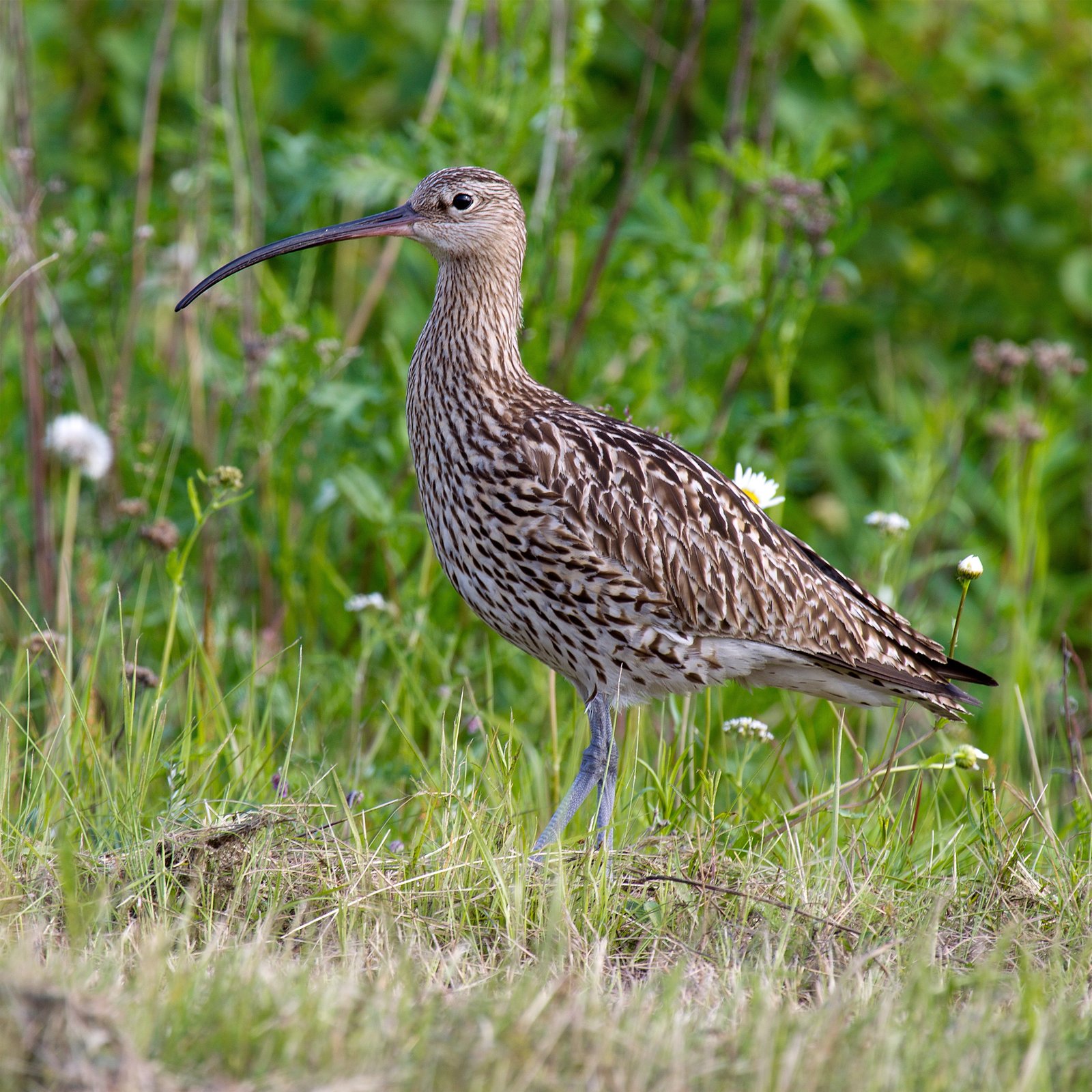
The largest wader in the region, with a very long, curved bill and a wistful call. It does not breed in North Africa or the Middle East, but winters along Morocco's Atlantic coast, the Mediterranean and above all the Persian Gulf and the Arabian Sea.
Voice
A melodious, rising coor-lee, which gives it its name, and a whistled tloo-ee; in alarm a rapid tyu-tyu-tyu. The bubbling display song is rarely heard in the region, sometimes in spring before departure.
Recording: Lars Edenius — CC BY-NC-SA 4.0 · converted to mono · xeno-canto
Identification
Large and grey-brown, densely streaked on head, neck and breast, with an almost plain head without obvious crown stripes. The bill is very long and evenly curved, longest in females; young birds in autumn have a distinctly shorter bill. In flight a white wedge on back and rump; the pale inner wing contrasts with the dark primaries. The eastern form orientalis, which winters in Arabia, has whiter underwing and rump and less streaked flanks.
Confusion species
Whimbrel (Numenius phaeopus) is smaller, with a shorter bill curved mainly at the tip and a head with dark crown sides and a pale central stripe; its call is a rapid trill. Godwits have straight or slightly upturned bills. The almost certainly extinct Slender-billed Curlew (Numenius tenuirostris), formerly a winter visitor to Morocco, was smaller and paler, with a thinner bill and round or heart-shaped flank spots.
Habitat
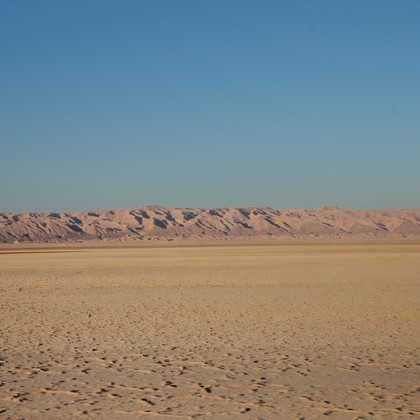
Tidal flats, coastal lagoons, mangroves, salt pans and sebkhas, also beaches and rocky shores; in North Africa sometimes on wet grassland and fields near the coast. At high tide it roosts in flocks on sandbanks and bunds.
Where the bird is most at home, classified by the habitats of North Africa and the Middle East.


Range and movements
In Morocco a common winter visitor along the Atlantic coast, with the largest numbers at Merja Zerga, the Loukkos estuary and the Khnifiss lagoon, and south to Dakhla Bay. Scarcer along the Mediterranean in Algeria, Tunisia (Gulf of Gabès), Libya and the Nile Delta; in Israel and Lebanon a fairly scarce winter visitor. Along the Persian Gulf (Kuwait, Bahrain, Qatar, the Saudi east coast, the Emirates) and the coasts of Oman a common winter visitor; Barr al Hikman and the Khor Kalba mangroves hold large flocks. Scarcer along the Red Sea and in Yemen. In southern Iraq in the marshes and on the Shatt al-Arab. Beyond the region it breeds from western Europe to central Siberia and winters in western Europe, Africa and South and East Asia.
- Resident
- Summer visitor (c. Apr–Sep)
- Winter visitor (c. Oct–Mar)
- Passage (Mar–Apr, Oct–Nov)
- dark = core range, pale = thinly spread
How and when to look
In the Gulf states curlews are easy to see at low tide on the mudflats of Al Jahra and Sulaibikhat (Kuwait), on Bahrain at Tubli Bay and in the Emirates at Khor Al Beida and Ras Al Khor. In Morocco flocks feed on the mudflats of Merja Zerga, often alongside Bar-Tailed Godwits.
Conservation status
Near Threatened. Breeding populations in Europe and Russia are declining through agricultural intensification, drainage and predation. In the region threatened by the loss of mudflats and mangroves to coastal development, especially in the Gulf, and locally by hunting.
Scientific name
Numenius arquata | (Linnaeus, 1758)
Linnaeus described the species in 1758 as Scolopax Arquata; because it was later moved to another genus, the author and year stand in brackets. The genus Numenius was introduced in 1760 by Brisson. Numenius is Greek, from neos 'new' and mēnē 'moon', after the bill that recalls a crescent moon; noumēnios is the name of a bird in Hesychius. arquata is the Medieval Latin name for this bird, from arcuatus 'bow-shaped', again after the curved bill. The specimen the first description was based on came from Sweden.