All species › Passerines › Chats and flycatchers › Black Wheatear
Black Wheatear | Oenanthe leucura
Zwarte tapuit | Collalba negra
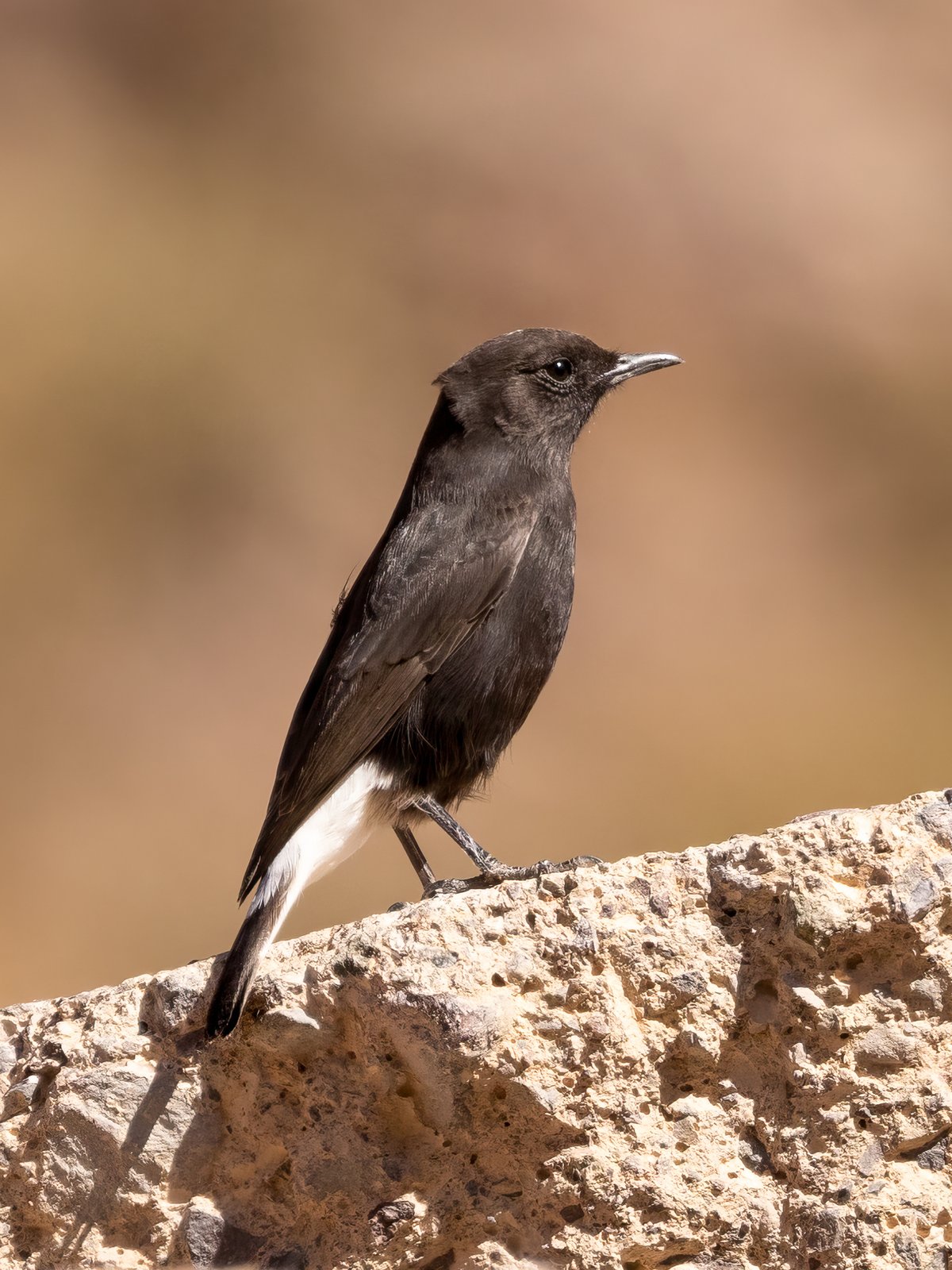
Black Wheatear is the largest and heaviest wheatear of the Maghreb, an all-black bird with a white rump and tail base. It is a resident of cliffs, gorges and stony slopes from Morocco to Tripolitania and, uniquely, carries piles of small stones to its nest.
Voice
The song is a loud, clear and somewhat thrush-like phrase of whistles with scratchy notes in between, from a ledge or in an undulating song flight along the cliff; from as early as January. The call is a clear pee-pee and, in alarm, a dry chak-chak.
Recording: Stanislas Wroza — CC BY-NC-SA 4.0 · shortened to the first 60 s, mono · xeno-canto
Identification
16–18 cm. Large and bulky, with a long tail and a stout black bill. The male is all sooty black with a slight gloss; the female is dark chocolate-brown and duller, but patterned the same. Rump, undertail-coverts and tail base pure white; the tail shows a black inverted T of broad terminal band and black central feathers, so in flight the white is abruptly cut off by the black tip. Juveniles are brownish-black with the same tail pattern.
Confusion species
White-crowned Wheatear (Oenanthe leucopyga) is slimmer and longer-billed; adults have a white crown and an almost wholly white tail with black only in the centre and at the tips, without a continuous terminal band; beware first-year White-Crowned Wheatears without a white crown, which can be told only by the tail. The basalt form of Mourning Wheatear (Oenanthe lugens) is also black, but occurs only in north-eastern Jordan and southern Syria. Black Redstart (Phoenicurus ochruros) is much smaller and has a rufous tail. Blue Rock-Thrush (Monticola solitarius) lacks the white rump.
Habitat
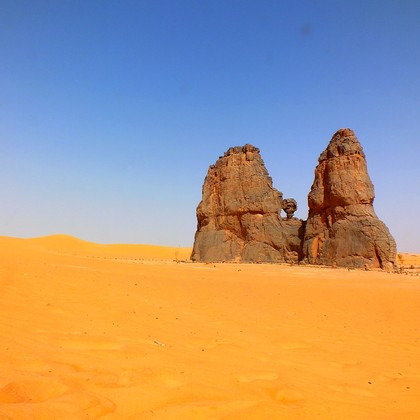
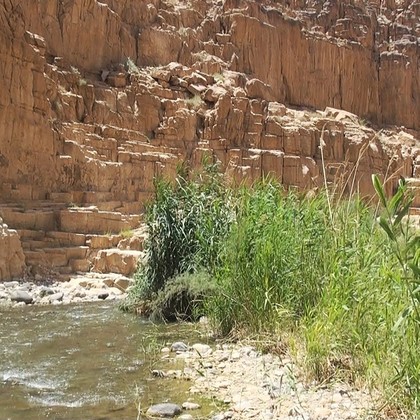
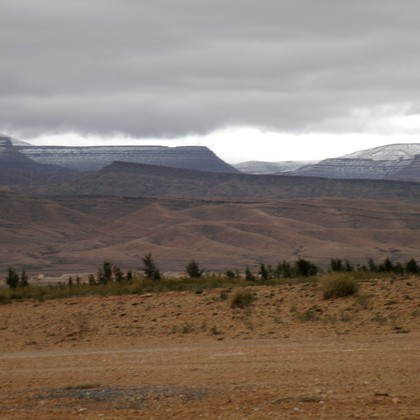
Cliffs, gorges, steep scree and stony mountain slopes with some vegetation, also quarries and old walls; from the coast to above 2,000 m in the Atlas, and on rocky hamadas at the desert edge. Nests in rock crevices and cavities, building a platform of hundreds of small stones.
Where the bird is most at home, classified by the habitats of North Africa and the Middle East.
Range and movements
Resident in north-west Africa: widespread in Morocco, from the Rif and the Middle and High Atlas to the Anti-Atlas and the northern edge of the Sahara, but not on the Atlantic lowlands; in northern Algeria, from the Tell Atlas to the Saharan Atlas and further south in the rocky mountains of the northern Sahara; in northern and central Tunisia and, scarcely, in the Jebel Nafusa in Tripolitania (Libya). Beyond the region only on the Iberian Peninsula; it has disappeared from southern France.
- Resident
- Summer visitor (c. Oct–Mar)
- Winter visitor (c. Apr–Sep)
- Passage (Mar–Apr, Oct–Nov)
- dark = core range, pale = thinly spread
How and when to look
In Morocco common in the Todra and Dades gorges and along the cliffs of the Anti-Atlas. The male often sings high on a ledge and then flies in an undulating flight along the wall; the white rump can be seen from afar.
Conservation status
Not globally threatened. Fairly common in suitable rocky terrain in the Maghreb and little threatened; it has declined strongly at the northern edge of its range in Europe.
Scientific name
Oenanthe leucura | (Gmelin, 1789)
Gmelin described the species in 1789 as Turdus leucurus; because it was later moved to another genus, the author and year stand in brackets. The genus Oenanthe was introduced in 1816 by Vieillot. Oenanthe was used by Aristotle for a bird that can no longer be identified; the word comes from the Greek oinos, oinoē 'wine, vine' and anthos 'flower, bloom'. leucura comes from Greek leukouros 'white-tailed', from leukos 'white' and oura 'tail', after the white tail set against the otherwise black plumage. The specimen the first description was based on came from Gibraltar.