All species › Passerines › Chats and flycatchers › Mourning Wheatear
Mourning Wheatear | Oenanthe lugens
Rouwtapuit | Collalba núbica
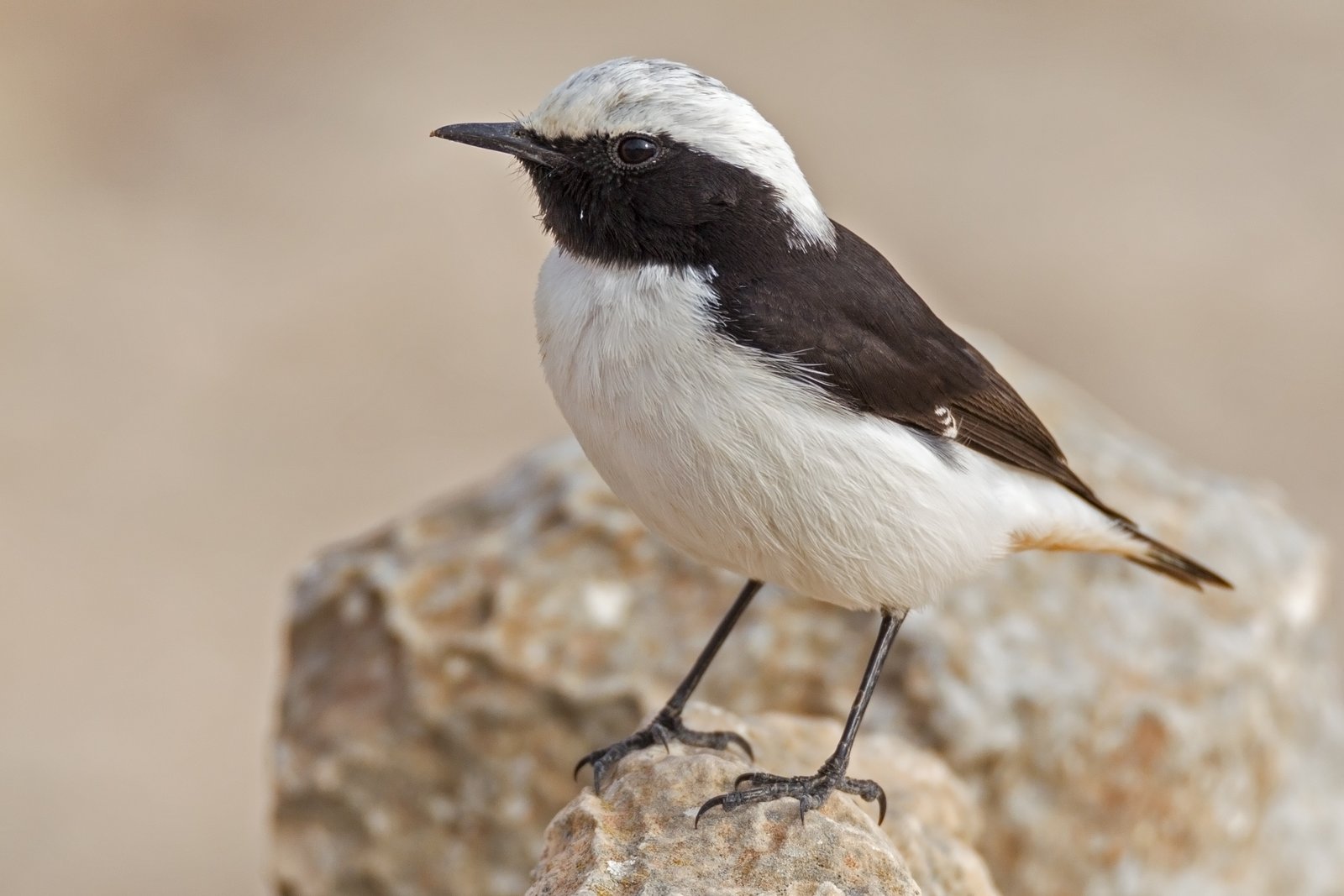
Mourning Wheatear is a small, contrasting black-and-white wheatear of rocky gorges and wadis, found from the northern edge of the Sahara in the Maghreb to the Levant and Iraq. It lives at low densities, is very sedentary and gives itself away by the warm orange-buff under the tail, a soft splash of colour on an otherwise stark black-and-white bird.
Voice
The song is a short, plaintive phrase of clear whistles with some dry, rattling notes, given from a rock pinnacle or in a short song flight, mostly from January to May. The call is a hard chak and a thin hweet; when alarmed a rapid series of ticks.
Recording: Arjan Boonman — CC BY-NC-SA 4.0 · converted to mono · xeno-canto
Identification
14–15.5 cm. Small and upright. The male has a pure white crown and nape; lores, ear-coverts, throat and upper breast are black and join without a break a black mantle, scapulars and wings. Underparts and rump white, undertail-coverts orange-buff to rusty-buff: the best feature. The tail is white with black central feathers and a black terminal band, the familiar inverted T. In flight a pale panel across the flight feathers stands out, especially from below. In the nominate form the female closely resembles the male, only duller and browner black; in the North African form halophila the female is grey-brown with a paler throat, but with the same orange-buff under the tail. In the basalt desert of north-eastern Jordan and southern Syria lives the almost entirely black form warriae (Basalt Wheatear), with white only on rump and tail.
Confusion species
Pied Wheatear (Oenanthe pleschanka) has a greyish-white crown that fades towards the rear, pure white undertail and a narrower terminal band; in the region it is a passage migrant only. Hooded Wheatear (Oenanthe monacha) is larger and longer-tailed, with a hood reaching the mantle, a black breast and an almost wholly white tail. Finsch's Wheatear (Oenanthe finschii) has a white mantle and back. White-crowned Wheatear (Oenanthe leucopyga) is larger and has an all-black belly. Arabian Wheatear (Oenanthe lugentoides) of the south-west Arabian highlands has a dark crown. The basalt form resembles Black Wheatear (Oenanthe leucura), but that species occurs only in the Maghreb.
Habitat
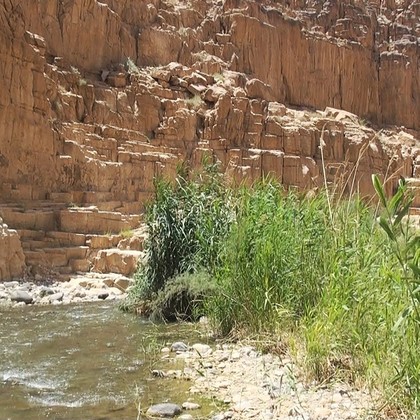
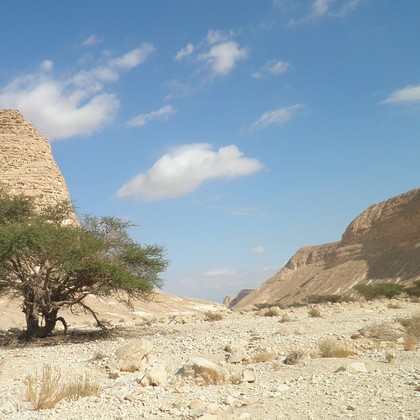
Rocky gorges, steep wadis, scree slopes and the edges of hamada and stony desert with some shrubs, often also at old walls and ruins; the basalt form in black lava fields. From lowlands to about 1,500 m. Nests in rock crevices and holes in walls.
Where the bird is most at home, classified by the habitats of North Africa and the Middle East.

Range and movements
In North Africa (form halophila) along the northern edge of the Sahara: eastern Morocco (from the High Plateaux and Figuig to the Tafilalt), the Saharan Atlas and northern Algerian Sahara, southern Tunisia, Tripolitania and Cyrenaica in Libya and the north-west coast of Egypt. Further, the nominate in the Eastern Desert of Egypt and Sinai, in Israel (Negev, Judean Desert, Dead Sea), Jordan, Syria, western Iraq and north-western Saudi Arabia. Birds of the Iranian form persica winter scarcely in Iraq, Kuwait and further around the Gulf to the Emirates and northern Oman. Beyond the region in Iran.
- Resident
- Winter visitor (c. Apr–Sep)
- Passage (Mar–Apr, Oct–Nov)
- dark = core range, pale = thinly spread
How and when to look
In Israel easily found in the gorges around Mitzpe Ramon and Ein Gedi; in Morocco on the rocky hamadas around Erfoud and Figuig. For the basalt form, head to the lava fields around Azraq and Safawi in north-eastern Jordan. Pairs hold their territory all year, so a site where you once saw them often stays occupied for years.
Conservation status
Not globally threatened. Everywhere at low densities and thinly spread; locally sensitive to overgrazing and disturbance of rocky terrain, but there is no evidence of a marked decline. Some handbooks treat the North African birds (halophila) and the basalt form (warriae) as separate species; this guide follows AviList and includes them in Mourning Wheatear.
Scientific name
Oenanthe lugens | (Lichtenstein, 1823)
Lichtenstein described the species in 1823 as Saxicola lugens; because it was later moved to another genus, the author and year stand in brackets. The genus Oenanthe was introduced in 1816 by Vieillot. Oenanthe was used by Aristotle for a bird that can no longer be identified; the word comes from the Greek oinos, oinoē 'wine, vine' and anthos 'flower, bloom'. lugens, genitive lugentis, is Latin for 'mourning', after the black-and-white plumage. The specimen the first description was based on came from Deram, Nubia.