All species › Birds of prey › Hawks, eagles and kites › Black-Winged Kite
Black-Winged Kite | Elanus caeruleus
Grijze wouw | Elanio común
The Black-winged Kite is a small, pale raptor with deep red eyes that hovers like a kestrel over fields and fallow land. In North Africa and the Middle East it is a bird of the irrigated farming plains: the Atlantic lowlands of Morocco, the Nile valley and delta, and the valleys of northern Israel, where it has spread markedly in recent decades.

Voice
Mostly silent. At the nest and when disturbed a soft, whistled wheeeh and a high, grating kreet-kreet; young beg with a squeaky tchee-eh.
Recording: Tony Rinaud — CC BY-NC-SA 4.0 · shortened to the first 60 s, mono · xeno-canto
Identification
31–36 cm, compact with a large head and a short, square-cut white tail. Upperparts pale grey, underparts white, with a striking black shoulder patch that is obvious even on a perched bird. The eye is deep red, with a narrow black mask in front of it. In flight white below with black primaries, grey above with black shoulders. Flies on soft, rather owl-like beats, hovers frequently and glides with the wings raised in a V. The juvenile has a brownish-grey back with pale fringes, a rusty wash on the breast and a brownish eye. Likes to perch upright on wires and posts, flicking its tail.
Confusion species
At a distance a male Hen Harrier (Circus cyaneus) or Pallid Harrier (Circus macrourus) can look similar, grey with black wingtips, but these are far slimmer and longer-tailed, hunt low over the ground and lack the black shoulder patch. The Common Kestrel (Falco tinnunculus) also hovers, but is rufous with a long tail. A gull or tern over water has long, narrow wings and a quite different flight.
Habitat
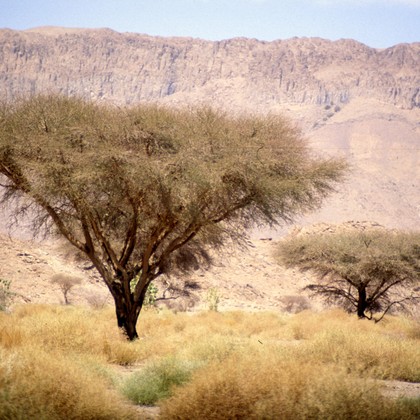
Open farmland with scattered trees: cereal fields, alfalfa and irrigated crops, olive and citrus orchards, and lines of eucalyptus along roads and canals; in Arabia also acacia savanna in the lowlands and foothills. Hunts mainly mice and voles, also lizards and large insects. Nests in a loose stick platform high in a tree; numbers fluctuate strongly with rodent abundance.
Where the bird is most at home, classified by the habitats of North Africa and the Middle East.


Range and movements
In Morocco fairly common in the north-western lowlands (Gharb, Loukkos, Saïs and the Atlantic coast south to the Souss), scarcer in northern Algeria and Tunisia. In Egypt common in the Nile valley and delta and locally in the oases. In Israel it breeds in the Hula, Jezreel and Beit She'an valleys and on the coastal plain, and also occurs in the Jordan valley of Jordan and in Lebanon and Syria. In Arabia a scarce resident in the Tihama and foothills of south-western Saudi Arabia and Yemen; rare in Iraq, Oman and the Gulf states. Beyond the region in Iberia, sub-Saharan Africa and South and South-East Asia.
- Resident
- Summer visitor (c. Apr–Sep)
- Winter visitor (c. Oct–Mar)
- Passage (Mar–Apr, Oct–Nov)
- dark = core range, pale = thinly spread
How and when to look
Drive the roads through the farmland plains near Larache and Kenitra, through the Nile delta or through the fishpond valleys of northern Israel: it sits conspicuously on wires and pylons and hovers over fallow fields in the afternoon. In winter dozens may gather at shared roosts in eucalyptus trees in Israel.
Conservation status
Not threatened. It benefits from irrigated agriculture and tree planting in open country and has spread in Morocco and the Levant. Vulnerable to rodenticides, widely used in arable farming, and to the felling of windbreaks.
Scientific name
Elanus caeruleus | (Desfontaines, 1789)
Desfontaines described the species in 1789 as Falco caeruleus; because it was later moved to another genus, the author and year stand in brackets. The genus Elanus was introduced in 1809 by De Savigny. Elanus comes from Greek elanos, the name of a kite. caeruleus is Latin for 'blue', for the blue-grey plumage. The specimen the first description was based on came from Algiers.