All species › Waders, gulls and terns › Pratincoles and coursers › Black-Winged Pratincole
Black-Winged Pratincole | Glareola nordmanni
Steppevorkstaartplevier | Canastera alinegra
The darkest pratincole, a breeder of the steppes between the Black Sea and Kazakhstan that takes its entire world population to southern Africa and back. That migration crosses the east of the region, where in spring and late summer flocks of tens to hundreds of birds hunt over pivot fields and grassland.

Voice
A dry, hard kik-kik and a rattling kirrik, mostly in flight; slightly lower than in Collared Pratincole, but not a reliable field mark.
Recording: Daniel Danckwerts — CC BY-NC-SA 4.0 · converted to mono · xeno-canto
Identification
Darker and more uniform brown above than Collared Pratincole, with a creamy throat outlined in black, a red bill base and long black legs; the white eye-ring is absent or faint. At rest the tail tips do not reach the wingtips. In flight: white rump, black tail, no white trailing edge to the secondaries and an all-black underwing contrasting sharply with the white belly. The upperwing is uniformly dark, without contrast between arm and hand.
Confusion species
Collared Pratincole (Glareola pratincola) has a chestnut underwing, a narrow white trailing edge to the arm, a slightly paler brown back with darker primaries and a longer tail. Beware: in shade or against the light a chestnut underwing also looks black, so the trailing edge is the most reliable feature. Oriental Pratincole (Glareola maldivarum) also lacks the white trailing edge, but has a chestnut underwing and an orange wash on the breast.
Habitat
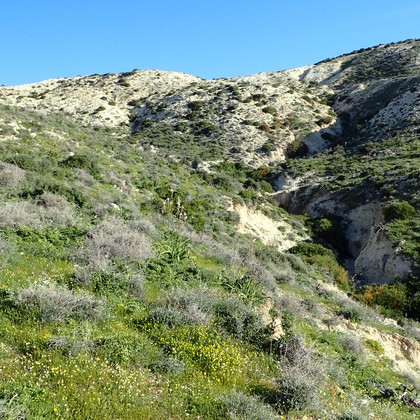
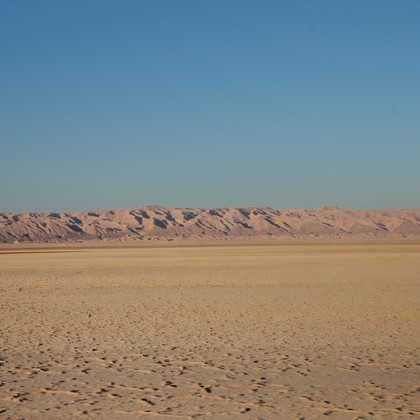
Breeds on saline steppe and dried-out lake shores. On passage in the region mainly over and on pivot fields and other irrigated farmland, wet and mown grassland, sewage pools, the edges of sebkhas and fishponds; hunts in flight for grasshoppers, beetles and other insects and rests on bare ground.
Where the bird is most at home, classified by the habitats of North Africa and the Middle East.

Range and movements
Passes mainly through the east of the region. In Israel a fairly common passage migrant in spring (April–May) and late summer (August–September), especially in the Jordan Valley, the Bet She'an and Hula valleys and the Arava. In Kuwait and eastern Saudi Arabia a fairly common spring migrant, with flocks of hundreds on the Sulaibiya pivot fields; scarcer in the rest of Saudi Arabia (including around Riyadh). Also on passage in Iraq. In the Emirates, Qatar and Bahrain a regular, locally fairly common migrant; scarce in Oman and Yemen, scarce to rare in Jordan, Syria and Lebanon. Scarce in Egypt, mainly in Sinai and along the Gulf of Suez; a vagrant to Morocco and elsewhere in North Africa. Beyond the region it breeds from Ukraine and southern Russia to Kazakhstan and south-western Siberia and winters in southern Africa.
- Passage (Mar–Apr, Oct–Nov)
- dark = core range, pale = thinly spread
How and when to look
In spring in Kuwait (Sulaibiya) or the Bet She'an Valley in Israel, and in late summer on pivot fields in the Emirates, Qatar and eastern Saudi Arabia: check every pratincole flock in flight, ideally with the sun behind you, and look for birds without a white trailing edge and with an evenly black underwing.
Conservation status
Near Threatened. The breeding population has declined sharply through ploughing and overgrazing of the steppes and loss of breeding sites, especially in Ukraine and Russia. On migration it is vulnerable to insecticides on farmland and the loss of temporary wetlands; the pivot fields of Arabia do provide new stopover sites.
Scientific name
Glareola nordmanni | Fischer von Waldheim, 1842
Fischer von Waldheim described the species in 1842 and placed it straight away in the genus where it still stands. The genus Glareola was introduced in 1760 by Brisson. Glareola is a Latin diminutive of glarea 'gravel', after the bare gravelly ground where pratincoles nest. nordmanni honours the Finnish-born zoologist and explorer Alexander von Nordmann (1803–1866). The specimen the first description was based on came from the steppes of southern Russia.