All species › Waders, gulls and terns › Pratincoles and coursers › Cream-Colored Courser
Cream-Colored Courser | Cursorius cursor
Renvogel | Corredor sahariano
The wader of the desert: a sand-coloured, long-legged bird that runs across bare gravel plains, stops abruptly and sprints on again. It occurs in almost the whole region, from the plains south of the Atlas to the gravel deserts of Oman, and in many countries is one of the characteristic birds of open, dry country.

Voice
Usually silent. In flight and when alarmed a short, sharp whistled kwit or kwit-kwit; in display a harsh, frog-like praak-praak that carries far across the plain.
Recording: Stanislas Wroza — CC BY-NC-SA 4.0 · converted to mono · xeno-canto
Identification
Slim and upright, warm sandy with a slightly paler belly. The hindcrown is blue-grey; a black eye-stripe and a white supercilium run back and meet in a V on the nape. The bill is black, short and slightly decurved; the long legs are creamy white. At rest nothing black shows on the wing, but in flight the primaries and the entire underwing are jet black. Juveniles are finely scaled dark and lack the crisp head pattern.
Confusion species
Eurasian Dotterel (Eudromias morinellus), which may share the same plains in winter, also has supercilia meeting on the nape, but is shorter-legged and dumpier, with a narrow white breast band and a dark crown. Eurasian Thick-Knee (Burhinus oedicnemus) is larger and streaked, with a large yellow eye and white wing bars, and is mainly active at dusk. Caspian Plover (Anarhynchus asiaticus) has a dark back, a broader breast band and a straight bill. In flight the all-black underwing separates the courser from every plover.
Habitat
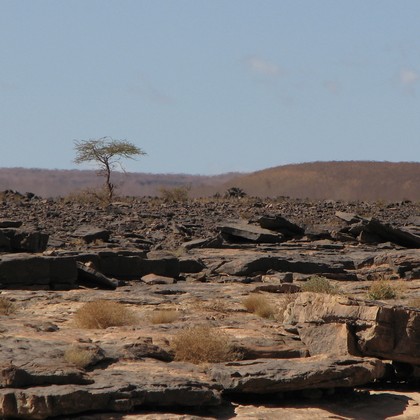
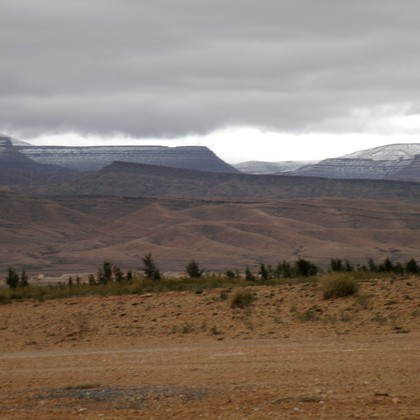
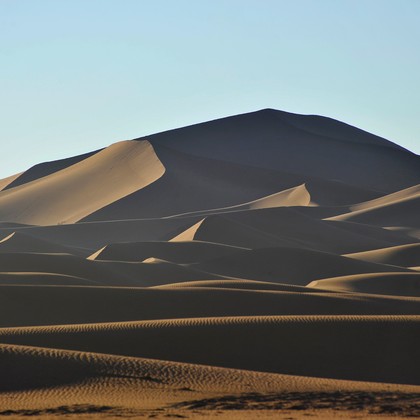
Flat, sparsely vegetated desert and semi-desert: gravel and stony plains (reg and hamada), hard sandy flats with dwarf shrubs, dry steppe and the edges of sand seas. Outside the breeding season also on bare farmland, short grass of racecourses and golf courses, around pivot fields and at airfields. Feeds by running and pecking at beetles, ants and grasshoppers; avoids dense scrub and built-up areas.
Where the bird is most at home, classified by the habitats of North Africa and the Middle East.
Range and movements
Widespread in the desert belt throughout the region. In Morocco it breeds mainly south and east of the Atlas (from Ouarzazate and the Tagdilt plain eastwards) and in Western Sahara, locally into the Atlantic coastal plain; in Algeria on the Hauts Plateaux and scattered through the Sahara, in Tunisia in the south. In Libya and Egypt scattered in the desert, including the Western Desert and Sinai. In the east it breeds in the Negev and the Arava (Israel, scarce, but more numerous on passage and in winter), in the eastern desert of Jordan, the Syrian steppe and the western desert of Iraq. On the Arabian Peninsula it is a locally fairly common resident in Saudi Arabia, supplemented by winter visitors, and breeds in Kuwait, Qatar, the northern Emirates, Oman (including the Jiddat al Harasis) and Yemen. Northern breeders (Morocco, Israel, Syria) partly move away; in Arabia it is more numerous in winter. Beyond the region it breeds in the Canary Islands, the Sahel, and from Turkey and Iran to western Pakistan and north-western India.
- Resident
- Summer visitor (c. Apr–Sep)
- Winter visitor (c. Oct–Mar)
- Passage (Mar–Apr, Oct–Nov)
- dark = core range, pale = thinly spread
How and when to look
Drive slowly across gravel plains early in the morning and watch for movement: a courser only stands out when it runs. In Morocco the Tagdilt plain near Boumalne Dadès and the plains around Aousserd in Western Sahara are classic; in Israel the Uvda Valley and the Nitzana area, in Oman the Jiddat al Harasis. In the Gulf states small groups appear outside the breeding season on mown grassland, pivot fields and airfield edges.
Conservation status
Not globally threatened, but it has declined in parts of the region. On the Arabian Peninsula the breeding population is probably falling because of development, conversion of desert to farmland, off-road driving, drought and hunting; in the Emirates the small breeding population is considered nationally threatened. In North Africa overgrazing and cultivation of the steppe play a role.
Scientific name
Cursorius cursor | (Latham, 1787)
Latham described the species in 1787 as Charadrius cursor; because it was later moved to another genus, the author and year stand in brackets. The genus Cursorius was introduced in 1790 by Latham. Cursorius comes from Latin cursor 'runner', from currere 'to run', after the habit of chasing insects on foot across dry open ground. cursor repeats the sense of the genus name: Latin for 'runner'. The specimen the first description was based on came from Kent, England.