All species › Passerines › Larks › Blanford's Lark
Blanford's Lark | Calandrella blanfordi
Blanfords kortteenleeuwerik | Terrera de Blanford
Blanford's Lark is a small, little-known lark of the highlands of south-western Arabia and the Horn of Africa. Arabian birds belong to the form eremica, which some classifications treat as a separate species, Rufous-capped Lark. It is hard to find and for many visitors to the Asir one of the trickiest species of the trip.

Voice
The call is a dry, short chirp, similar to that of Greater Short-toed Lark. The song, often in an undulating song flight, consists of short, repeated twittering phrases. Little has been published on its voice in Arabia.
Recording: Bram Piot — CC BY-NC-SA 4.0 · shortened to the first 60 s, mono · xeno-canto
Identification
About 14 cm, a compact short-toed lark with a short, conical bill. The best feature is the warm rufous crown, which in good light stands out as a cap against the pale supercilium. Upperparts grey-brown with dark streaks, underparts white with a buff breast and flanks and a small dark patch on each side of the neck. Sexes alike. Outside the breeding season the cap is duller and birds are harder to separate from Greater Short-Toed Larks.
Confusion species
Greater Short-toed Lark (Calandrella brachydactyla) is slightly larger and paler, with a less evenly rufous crown, longer tertials and a different song; it migrates in large numbers through the same area. Mediterranean Short-toed Lark (Alaudala rufescens) has a streaked breast and no neck patch. Singing Bush Lark (Mirafra javanica) has rufous wings and a thicker bill.
Habitat
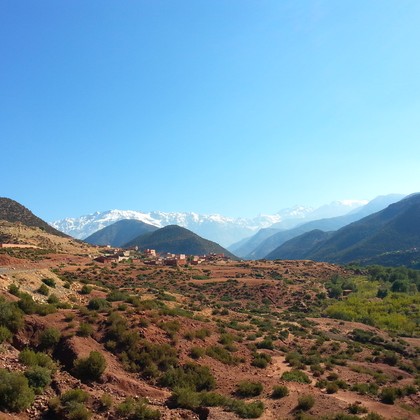
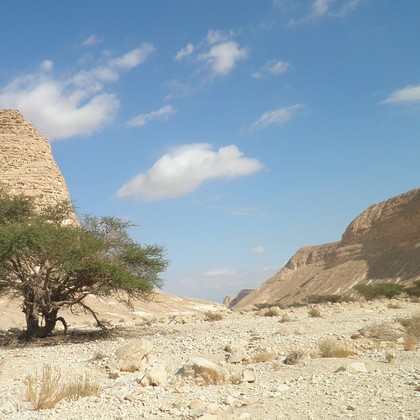
Open, stony or short-vegetated ground on plateaux and in broad highland wadis, bare field margins and grazed grassland, mostly between about 1800 and 2800 m. In dry periods it readily seeks out small wet patches.
Where the bird is most at home, classified by the habitats of North Africa and the Middle East.

Range and movements
In the region only in the highlands of south-western Saudi Arabia (Asir, including around Abha and in the Talea Valley) and the western highlands of Yemen; local and scarce. Outside the region in Eritrea and northern Ethiopia and, as daaroodensis, in north-eastern Ethiopia and northern Somalia.
- Resident
- Summer visitor (c. Oct–Mar)
- Winter visitor (c. Apr–Sep)
- Passage (Mar–Apr, Oct–Nov)
- dark = core range, pale = thinly spread
How and when to look
In summer in the Asir search bare, stony plateaux and field margins around Abha and in the Talea Valley, and check every short-toed lark for a rufous cap. In autumn flocks of dozens of birds may wander around.
Conservation status
Not threatened. Poorly known in Arabia; overgrazing, urbanisation of the highlands around Abha and changes in farming may have local effects.
Scientific name
Calandrella blanfordi | (Shelley, 1902)
Shelley described the species in 1902 as Tephrocorys blanfordi; because it was later moved to another genus, the author and year stand in brackets. The genus Calandrella was introduced in 1829 by Kaup. Calandrella is a diminutive of Greek kalandros, the calandra lark, so 'little calandra lark'. blanfordi honours William Thomas Blanford (1832-1905), British geologist and zoologist. The specimen the first description was based on came from Senafe, Eritrea.