All species › Passerines › Chats and flycatchers › Blue Rock-Thrush
Blue Rock-Thrush | Monticola solitarius
Blauwe rotslijster | Roquero solitario
The Blue Rock-Thrush is the dark thrush of cliffs, gorges and ruins, from the Moroccan coast to the mountains of Oman. Around the Mediterranean and in the Levant it is resident; in Arabia and Egypt it occurs mainly as a winter visitor. It often sits motionless on a rock ledge or wall, but its melancholy song carries far.

Voice
The call is a deep chak-chak and a high, whistled weet. The song is a calm, clear and rather wistful phrase of whistles, somewhat like a blackbird or Song Thrush, carrying far across gorges and between houses; sometimes in a short song flight.
Recording: Esperanza Poveda — CC BY-NC-SA 4.0 · converted to mono · xeno-canto
Identification
20–23 cm. A slender, long-billed thrush with a fairly long tail. The male is entirely dark slate-blue, in spring with a glossy blue head and breast and blackish wings and tail; in autumn the blue is finely scaled by pale and dark feather fringes. At a distance or in poor light it simply looks black. The female is dark grey-brown, sometimes with a bluish wash, with pale, darkly scaled throat and underparts and a dark tail. The eastern form longirostris, which winters in Arabia, is slightly paler blue and has a longer, thinner bill.
Confusion species
Common Blackbird (Turdus merula) is stockier, the male has a yellow bill, and it rarely lives on bare rock. Common Starling (Sturnus vulgaris) is shorter-tailed, sharp-winged and glossed green and purple. Female Rufous-tailed Rock Thrush (Monticola saxatilis) is paler, shorter-tailed and has a rufous tail. Blackstart (Oenanthe melanura) is much smaller and greyer.
Habitat
Steep, rocky terrain: sea cliffs, rocky coasts and islands, gorges and canyons, mountain walls, quarries, ruins and old buildings in villages and towns. In winter also in rocky wadis, on dams, quay walls and large buildings, even into the desert.
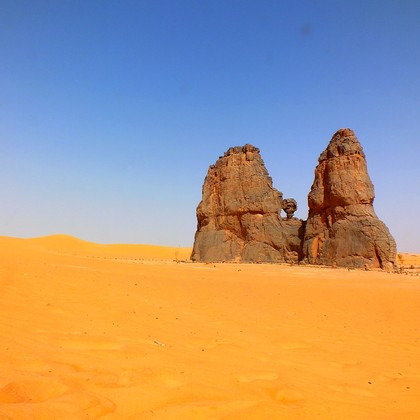
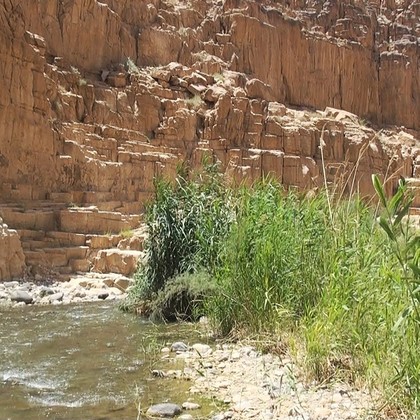
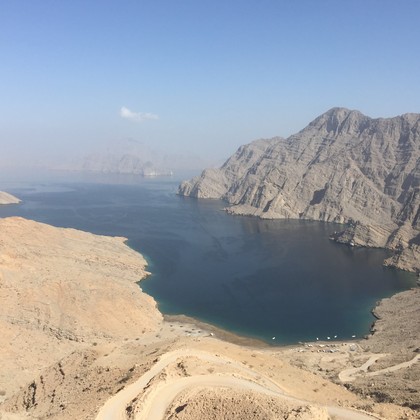
Where the bird is most at home, classified by the habitats of North Africa and the Middle East.
Range and movements
Resident throughout the Maghreb, from the Atlantic coast and the Rif of Morocco through the Atlas to the gorges on the edge of the Sahara (such as the Todra and Dadès gorges), in northern Algeria, Tunisia and northern Libya (Jebel Nafusa and Jebel Akhdar). In the east it breeds in Sinai, Israel, Jordan (including at Petra and Wadi Rum), Lebanon, Syria and the mountains of northern Iraq. In winter, from October to April, birds from Turkey, the Caucasus and Central Asia arrive: scattered in Egypt, including the Nile Valley, and across almost the entire Arabian Peninsula, most numerous in the Hajar Mountains of the Emirates and Oman and in the mountains of Yemen; in Saudi Arabia a rather scarce winter visitor and passage migrant that mostly avoids the coast. Beyond the region from southern Europe to Central Asia, and in East Asia another form with a chestnut belly.
- Resident
- Summer visitor (c. Oct–Mar)
- Winter visitor (c. Apr–Sep)
- Passage (Mar–Apr, Oct–Nov)
- dark = core range, pale = thinly spread
How and when to look
In Morocco in the Todra Gorge and along the rocky coast near Essaouira; in Israel and Jordan at Petra and in the gorges of the Negev. In winter on any rock face in the Hajar Mountains, for example at Jebel Hafeet and in the wadis around Hatta.
Conservation status
Not globally threatened. Widespread and locally common in the region; rocky breeding habitat is little threatened.
Scientific name
Monticola solitarius | (Linnaeus, 1758)
Linnaeus described the species in 1758 as [Turdus] solitarius; because it was later moved to another genus, the author and year stand in brackets. The genus Monticola was introduced in 1822 by Boie. Monticola is Latin for 'mountain-dweller', from mons, montis 'mountain' and colere 'to dwell'. solitarius is Latin for 'solitary', after the bird's habit of living alone or in pairs. The specimen the first description was based on came from Italy.