All species › Passerines › Chats and flycatchers › Whinchat
Whinchat | Saxicola rubetra
Paapje | Tarabilla norteña
In the region the Whinchat is exclusively a passage migrant: between its European and western Asian breeding grounds and the savannas of sub-Saharan Africa it crosses the entire region in spring and autumn. On migration it likes to perch on a tall plant, post or wire in open country and then catches the eye with its pale supercilium.

Voice
The call is a soft hyu, often combined with a ticking tek-tek: hyu-tek-tek. The song, sometimes heard on spring migration, is a short, fast mixture of scratchy and clear notes, often with mimicry.
Recording: MarekJas — CC BY-NC-SA 4.0 · converted to mono · xeno-canto
Identification
12–14 cm. Compact and short-tailed, with an upright stance. The spring male has a dark cheek, a broad white supercilium and a white moustachial stripe, streaked brown upperparts, a warm orange-buff throat and breast and a white patch on the inner wing-coverts. Females and autumn birds are duller, with a browner cheek and a buff supercilium. In all plumages the white bases to the outer tail feathers, visible in flight, and the pale supercilium are diagnostic.
Confusion species
Females and young of European Stonechat (Saxicola rubicola) and Siberian Stonechat (Saxicola maurus) have no or a weak supercilium and a dark tail without white bases; the latter has an unstreaked pale rump. Females of Moussier's Redstart (Phoenicurus moussieri) have a red tail and no streaking.
Habitat
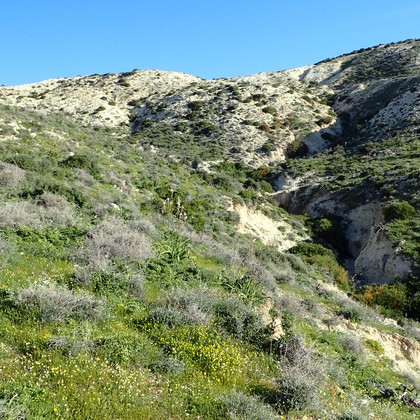
On migration in open country with a perch: fields and fallow land, meadows, grassy steppe, irrigated land with clover or alfalfa, oases, reed fringes and the edges of marshes; in the desert at any green spot.
Where the bird is most at home, classified by the habitats of North Africa and the Middle East.

Range and movements
Passes through the whole region in spring, from late March into May, and in autumn, from August to October: through the Maghreb and the Sahara, Libya and the Nile Valley, through Israel, Jordan, Syria, Lebanon and Iraq, and across the Arabian Peninsula, where it is scarcer in the east and in the Gulf States than in the west. In Israel and elsewhere the odd bird occasionally overwinters. Breeds in Europe and western Siberia to the Caucasus and north-west Iran, and winters in the savannas of sub-Saharan Africa.
- Summer visitor (c. Apr–Sep)
- Winter visitor (c. Oct–Mar)
- Passage (Mar–Apr, Oct–Nov)
- dark = core range, pale = thinly spread
How and when to look
In April and September in the fields around Eilat, in the Hula Valley, in the Nile Delta and in the irrigated farmland of Morocco and the Gulf States, such as Sun Farms in Sohar. Check the tops of thistles and umbellifers.
Conservation status
Not globally threatened, although the species has declined sharply in much of Europe through the intensification of grassland farming. Fairly common as a passage migrant in the region.
Scientific name
Saxicola rubetra | (Linnaeus, 1758)
Linnaeus described the species in 1758 as Motacilla Rubetra; because it was later moved to another genus, the author and year stand in brackets. The genus Saxicola was introduced in 1802 by Bechstein. Saxicola is Latin, from saxum 'stone, rock' and -cola 'dweller', from colere 'to inhabit': 'rock dweller', after the open stony ground these birds keep to. rubetra is a Latin name for a small bird. The specimen the first description was based on came from Sweden.