All species › Passerines › Chats and flycatchers › Bluethroat
Bluethroat | Luscinia svecica
Blauwborst | Pechiazul
The Bluethroat is a common winter visitor to reedbeds, marsh edges and wet fields across the region, from the Atlantic coast of Morocco to the marshes of Iraq and the coasts of the Gulf. It lives hidden low in vegetation, but often runs out with cocked tail over open mud or along a ditch.
Voice
The call is a hard tak or chak, often the first clue from the reeds, and a soft, whistled hweet. In spring migrants and wintering birds sometimes already sing: a varied, high-pitched phrase that starts with an accelerating ting-ting-ting and runs into rattles, bell-like notes and mimicry.
Recording: Stanislas Wroza — CC BY-NC-SA 4.0 · shortened to the first 60 s, mono · xeno-canto
Identification
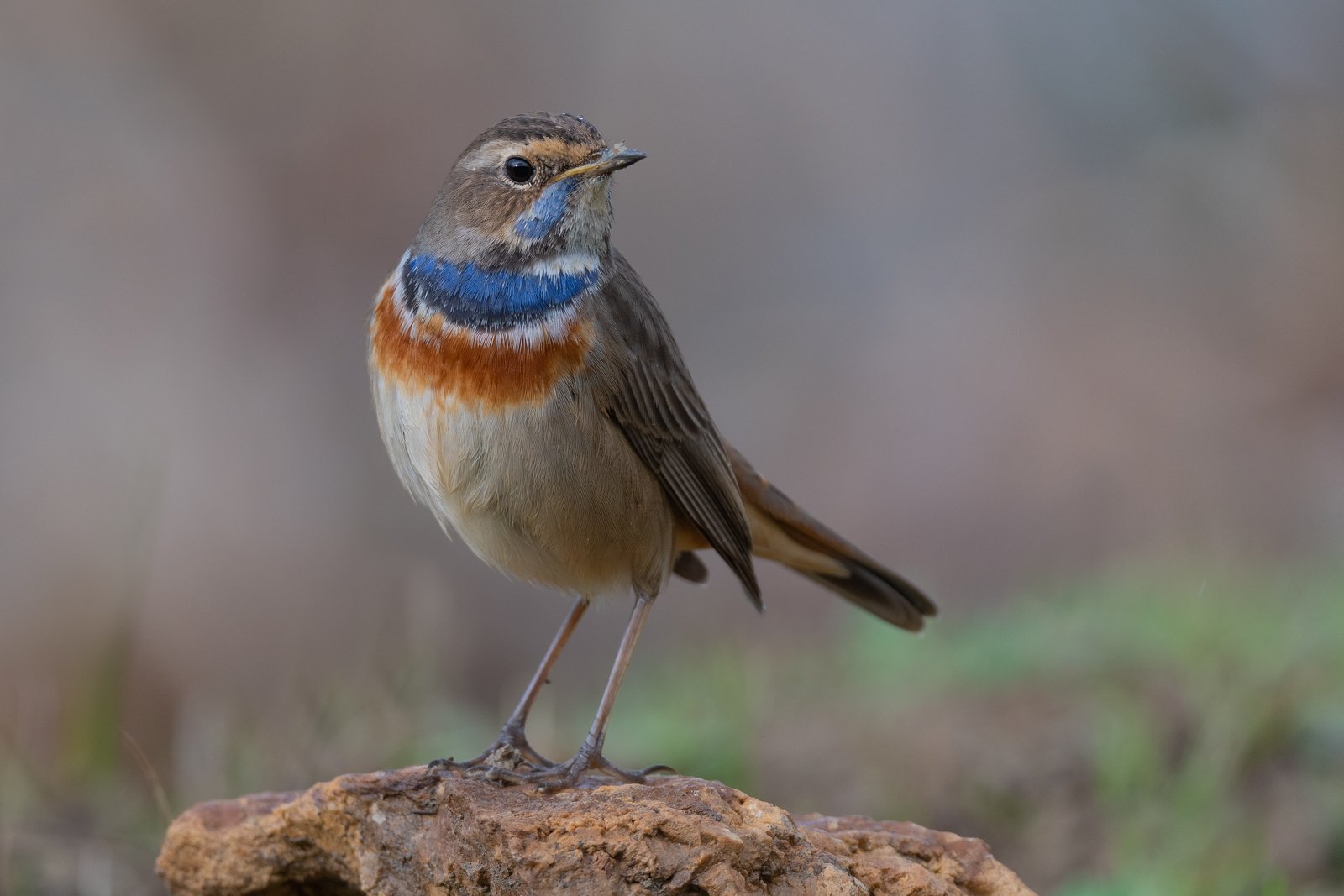
13–14 cm. A slender, long-legged chat with an upright stance and a tail that is often cocked and fanned. The key feature in all plumages is the rufous tail base with a broad dark terminal band, flashing as the bird flies off or dives into cover. Also a broad white supercilium and grey-brown upperparts. The male has a blue throat bordered by a black and a rufous band; in winter the blue is largely hidden by pale fringes, so often only a blue crescent and a black-and-rufous breast band show. The white-spotted form cyanecula has a white spot in the blue, the red-spotted svecica a rufous one; eastern birds (magna) often lack a spot. The female has a pale throat with a dark malar stripe and a dark necklace, sometimes with some blue or rufous. Juveniles are darker and spotted but already have the adult tail.
Confusion species
European Robin (Erithacus rubecula) has an orange face and breast, no supercilium and no red in the tail. Common Nightingale (Luscinia megarhynchos) and Thrush Nightingale (Luscinia luscinia) are larger, with an all-rufous tail without a dark band and no supercilium. Common Redstart (Phoenicurus phoenicurus) and Black Redstart (Phoenicurus ochruros) have an all-red tail with dark central feathers, perch upright and quiver the tail rather than cocking it. Rufous-tailed Scrub-Robin (Cercotrichas galactotes) is larger and sandy, with a long, fanned tail with black-and-white tips.
Habitat
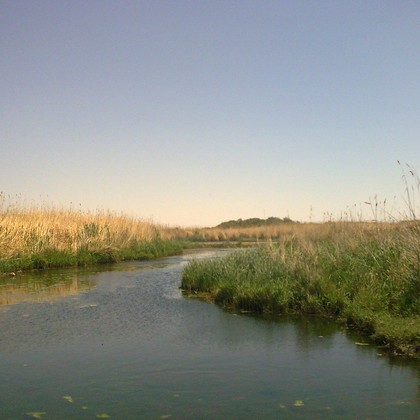
In winter mainly wet, dense vegetation with open patches: reed fringes, banks of pools and canals, irrigation ditches in fields and market gardens, saltmarsh edges with saltbush and tamarisk, fish ponds and sewage works; in Arabia also irrigated fodder crops and park lawns. On passage also oases. Eats insects, larvae and spiders, mostly picked up while running on the ground.
Where the bird is most at home, classified by the habitats of North Africa and the Middle East.


Range and movements
Winters in Morocco along the Atlantic coast (Merja Zerga, Souss-Massa) and at inland wetlands, in northern Algeria and Tunisia and along the coast of Libya. In Egypt common in the Nile Delta, the Nile Valley and the Faiyum. In the Levant common in Israel (Hula Valley, Beit She’an, the Arava) and the Jordan Valley, also in Syria and Lebanon. In Iraq in the southern marshes and along the Euphrates and Tigris. In Arabia a winter visitor to coasts and farmland in Kuwait, Saudi Arabia, Bahrain, Qatar, the UAE, Oman and Yemen. Beyond the region it breeds from western Europe across Siberia to western Alaska, and in the mountains of Central Asia; it also winters in the Sahel and South Asia.
- Resident
- Summer visitor (c. Oct–Mar)
- Winter visitor (c. Apr–Sep)
- Passage (Mar–Apr, Oct–Nov)
- dark = core range, pale = thinly spread
How and when to look
In winter, walk early in the morning along the edge of a reedbed or an irrigation ditch and wait for a bird to step out of cover onto open mud. In Israel the fish ponds of the Beit She’an Valley and the Hula Valley are classic, in Egypt the Nile Delta; in the UAE Al Wathba Wetland and the lawns of Al Ain. Watch for the red tail base as it dives away.
Conservation status
Not globally threatened. In the region it benefits from irrigation, fish ponds and sewage works, but suffers locally from wetland drainage, such as the Mesopotamian Marshes of Iraq, which have been partly restored since 2003.
Scientific name
Luscinia svecica | (Linnaeus, 1758)
Linnaeus described the species in 1758 as Motacilla svecica; because it was later moved to another genus, the author and year stand in brackets. The genus Luscinia was introduced in 1817 by Forster. Luscinia is the Latin word for 'nightingale'. svecica is Latin for 'Swedish', after Sweden, where the species breeds commonly in the north. The specimen the first description was based on came from Sweden and Lapland.