All species › Passerines › Chats and flycatchers › Collared Flycatcher
Collared Flycatcher | Ficedula albicollis
Withalsvliegenvanger | Papamoscas collarino
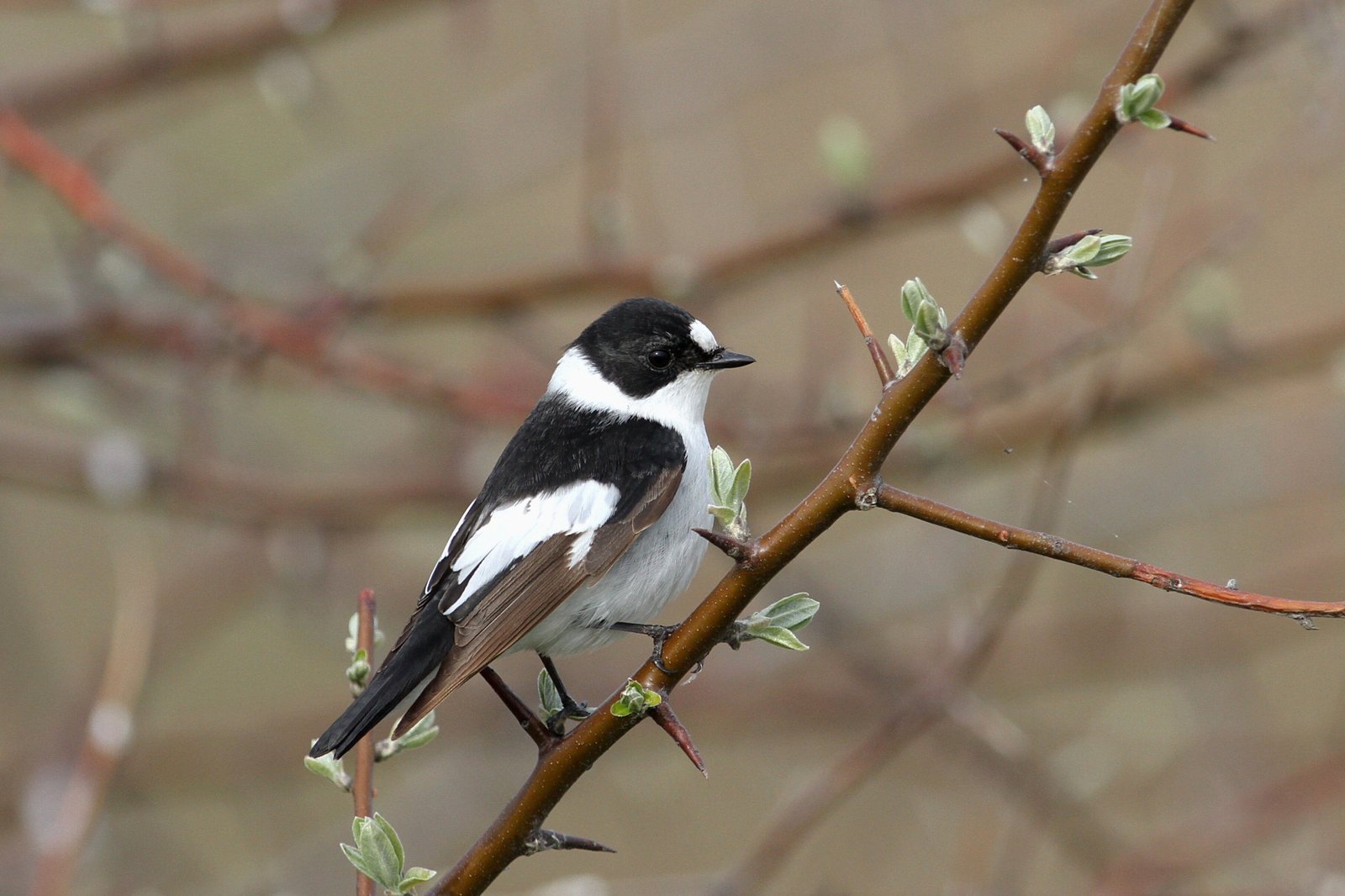
The Collared Flycatcher migrates between central Europe and southern Africa and crosses the region mainly in spring, over Libya, Egypt and the Levant. A breeding-plumaged male with its brilliant white collar is then one of the most conspicuous migrants in oases and kibbutz gardens.
Voice
Migrants give a thin, drawn-out, slightly falling seep, unlike the short bit of European Pied Flycatcher. The song, sometimes given by migrants in spring, is a slow phrase of high, squeezed, rather plaintive notes.
Recording: Walter Wallner — CC BY-NC-SA 4.0 · shortened to the first 60 s, mono · xeno-canto
Identification
12–13.5 cm. Slightly bulkier than European Pied Flycatcher, with the same habit of flicking wings and tail. The spring male is deep black above and white below, with a broad, complete white collar encircling the nape, a large white forehead patch, a large white rump conspicuous in flight and a large white wing patch extending far over the primary base. The female is grey-brown above and off-white below, often with a faintly paler neck side, a greyish rump and a distinct white patch at the primary base, larger than in European Pied Flycatcher. In autumn males resemble females but keep black wings.
Confusion species
Semicollared Flycatcher (Ficedula semitorquata) has only a half collar, a smaller greyish-white rump and a second white wing bar across the median coverts. European Pied Flycatcher (Ficedula hypoleuca) and Atlas Pied Flycatcher (Ficedula speculigera) lack a collar and have a black rump; especially in females and autumn birds the size of the white primary patch is decisive. Hybrids with European Pied and Semicollared Flycatchers occur.
Habitat
On passage in oases, date-palm gardens, olive and citrus orchards, kibbutz gardens, parks, riverine woodland and coastal tamarisk thickets; often also on small green spots in the desert after a night of headwinds. Outside the region it breeds in old deciduous woodland and parks with cavities and nest boxes.
Where the bird is most at home, classified by the habitats of North Africa and the Middle East.


Range and movements
In spring a regular and locally common passage migrant in Libya (mainly Cyrenaica and the Tripolitanian coast), Egypt (the Western Desert, the Nile Valley and Sinai) and Israel, where it is a common sight in late March and April; also in Jordan, Lebanon, Syria and the Palestinian territories. In Tunisia and Algeria a regular, in Morocco a scarce spring migrant. Scarce everywhere in autumn, when most birds cross the Mediterranean and the Sahara in one flight. Rare in Arabia: a few records at Tabuk in northwestern Saudi Arabia and in Kuwait, and a first record for the UAE in October 2015. Beyond the region it breeds from eastern France and Italy through central and eastern Europe to western Russia, also on Gotland and Öland, and winters in south-central Africa, from southern Congo to Zambia and Zimbabwe.
- Passage (Mar–Apr, Oct–Nov)
- dark = core range, pale = thinly spread
How and when to look
Visit Eilat, the Arava or the kibbutzim along the Dead Sea in late March and early April, or the oases of the Western Desert in Egypt: small groves may then hold several males at once. On every black-and-white male check the nape, and the rump as it flies off.
Conservation status
Not globally threatened. On the breeding grounds it depends on old deciduous woodland with cavities; nest boxes help. On migration it is vulnerable to drought in the Sahara and the loss of green stopover sites, and in parts of North Africa to trapping with nets and limesticks.
Scientific name
Ficedula albicollis | (Temminck, 1815)
Temminck described the species in 1815 as Muscicapa albicollis; because it was later moved to another genus, the author and year stand in brackets. The genus Ficedula was introduced in 1760 by Brisson. Ficedula is Latin for a small fig-eating bird, from ficus 'fig'; it was believed to turn into the blackcap in winter. albicollis is Latin albus 'white' and collum 'neck', after the male's white collar. The specimen the first description was based on came from Europe (not specified in the original description).