All species › Passerines › Reed warblers › Blyth's Reed Warbler
Blyth's Reed Warbler | Acrocephalus dumetorum
Struikrietzanger | Carricero de Blyth
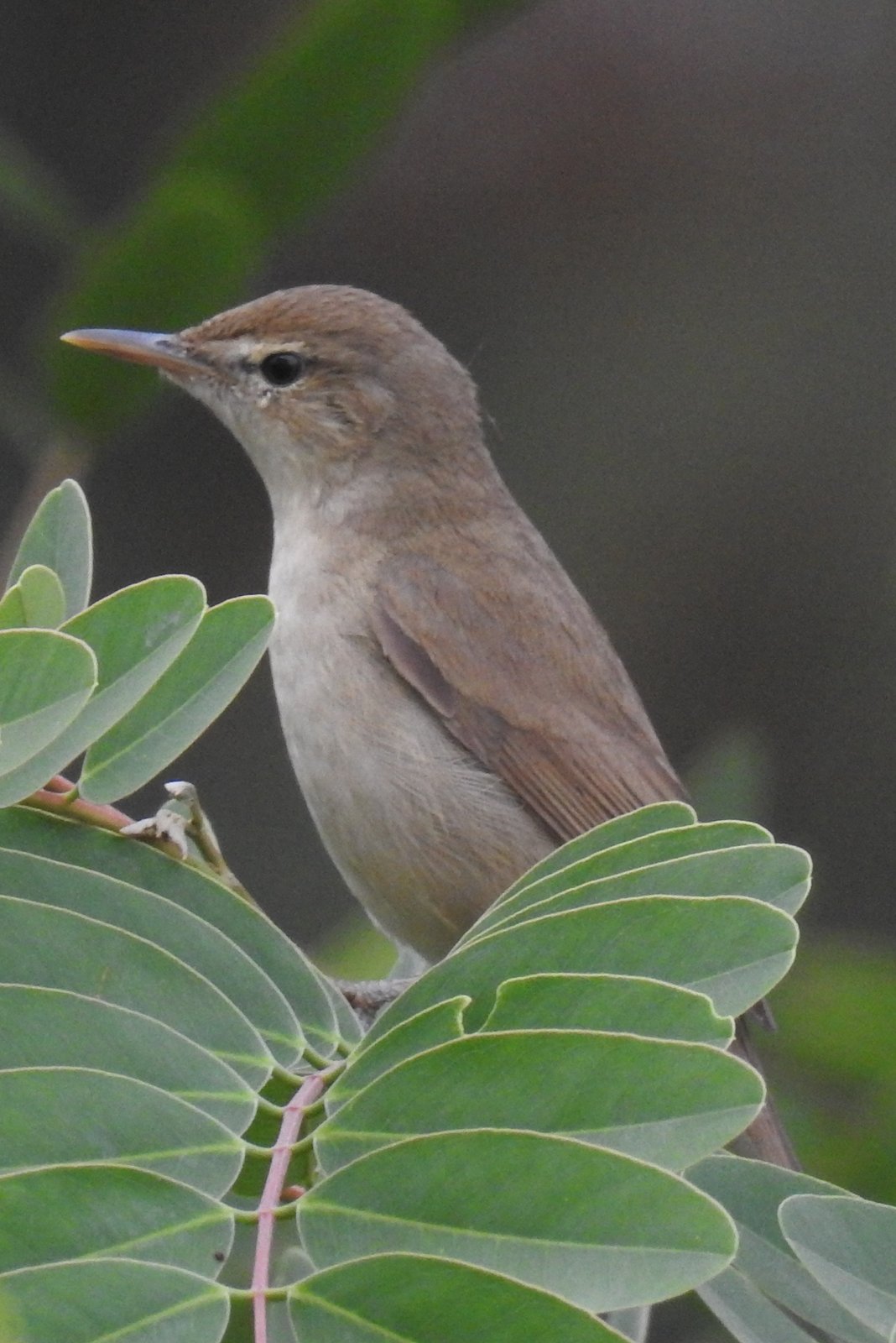
Blyth's Reed Warbler is a plain, grey-brown reed warbler of scrub and woodland edge, migrating from eastern Europe and Siberia to the Indian subcontinent. Its route touches only the east of the region: in Iraq, Kuwait, eastern Saudi Arabia and the Gulf states it is a scarce passage migrant, further west a rarity.
Voice
The song is slow and pure, with repeated, whistled motifs and mimicry, each interrupted by a dry chek: chek ... choo-choo-choo ... chek ... lu-lu-lu. The call is a characteristic soft chek or a smacking tak, harder and drier than that of Eurasian Reed Warbler.
Recording: Cedric Mroczko — CC BY-NC-SA 4.0 · shortened to the first 60 s, mono · xeno-canto
Identification
12.5–14 cm. Upperparts plain, cold olive-grey to grey-brown, without a warm tone on the rump. The supercilium is short but obvious in front of the eye and barely extends beyond it; the head looks rounded with a fairly steep forehead. Bill medium-length, with a dark tip to the lower mandible. Underparts off-white, flanks faintly greyish-buff. Wings plain, without pale fringes to the tertials; primary projection short. Legs dark grey-brown. Moves more calmly than Eurasian Reed Warbler and sometimes flicks its tail.
Confusion species
Eurasian Reed Warbler (Acrocephalus scirpaceus), including the eastern form fuscus, has a warmer rump, a flatter forehead, a longer primary projection and pale fringes to the tertials. Marsh Warbler (Acrocephalus palustris) is yellower olive-brown, with a long primary projection, pale tertial fringes and pale legs. Paddyfield Warbler (Acrocephalus agricola) is warmer brown, with a short bill and a broad supercilium extending behind the eye. Booted Warbler (Iduna caligata) and Sykes's Warbler (Iduna rama) are paler and sandier, with white edges to the outer tail feathers.
Habitat
On passage in bushes, tamarisks, gardens, parks, rank field edges and sewage works, less tied to true reeds than Eurasian Reed Warbler. Forages low in dense vegetation for insects.
Where the bird is most at home, classified by the habitats of North Africa and the Middle East.


Range and movements
Scarce but regular passage migrant in Iraq, Kuwait, Bahrain, Qatar, eastern Saudi Arabia, the United Arab Emirates and Oman, with most records in spring (April – May) and autumn (August – October). In Israel, Jordan, Syria and Egypt a vagrant; in the Maghreb not or hardly recorded. Breeds from eastern Fennoscandia and the Baltic states through Russia to central Siberia and Central Asia and winters in India, Sri Lanka and Myanmar.
- Passage (Mar–Apr, Oct–Nov)
- dark = core range, pale = thinly spread
How and when to look
In early May or late September at a ringing station or in a green garden with dense bushes in Kuwait or the Emirates. Look for a plain grey-brown reed warbler without a warm rump, with a short supercilium in front of the eye and a dry chek; certainty often comes only from the wing formula in the hand.
Conservation status
Not globally threatened and expanding strongly westwards in Europe. In the region a scarce migrant that is probably often overlooked or confused with Eurasian Reed Warbler.
Scientific name
Acrocephalus dumetorum | Blyth, 1849
Blyth described the species in 1849 and placed it straight away in the genus where it still stands. The genus Acrocephalus was introduced in 1811 by Naumann & Naumann. Acrocephalus is Greek, from akros 'topmost, pointed' and kephalē 'head'; the Naumanns, who introduced the genus, called these birds Spitzkopf 'pointed head', so they read akros as 'pointed'. dumetorum is Latin for 'of the thickets', the genitive plural of dumetum, 'thicket'. The specimen the first description was based on came from India.