All species › Birds of prey › Hawks, eagles and kites › Bonelli's Eagle
Bonelli's Eagle | Aquila fasciata
Havikarend | Águila perdicera
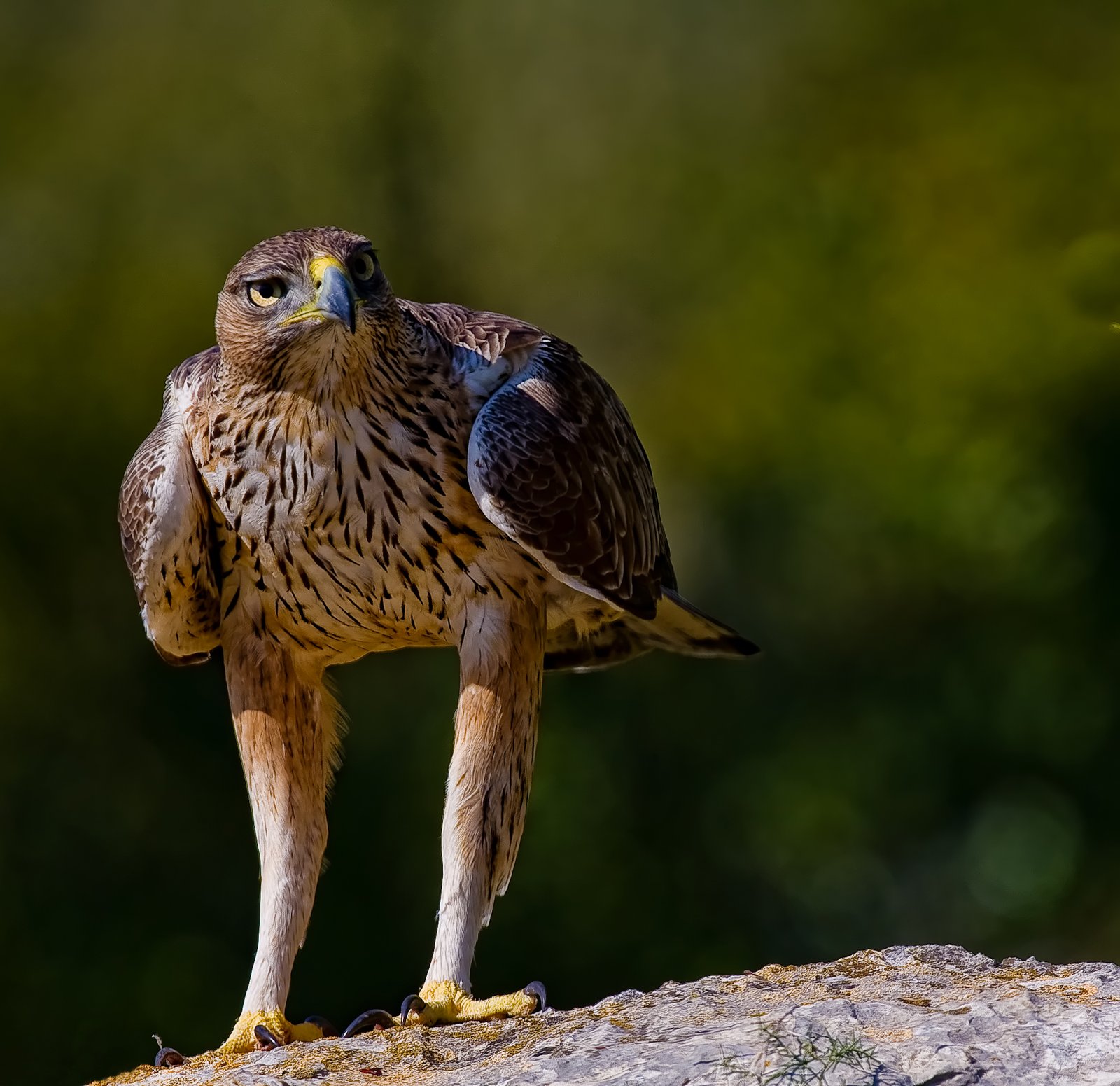
Bonelli's Eagle is a medium-sized, slim and fast eagle with a long tail, which hunts like a large goshawk for gamebirds, pigeons and rabbits. With an estimated two thousand pairs in the Maghreb, perhaps half of them in Morocco, it is the most numerous large eagle of North Africa, and it also lives in the mountains of the Middle East and Arabia.
Voice
Usually silent. At the nest a high, clear kee-kee-kee and melodious whistles.
Recording: SonoNatura — CC BY-NC-SA 4.0 · converted to mono · xeno-canto
Identification
55–65 cm, wingspan 145–170 cm. The adult has dark brown upperparts with a distinctive white patch on the mantle, and white underparts with fine dark streaks. In flight a dark band across the underwing coverts between a pale leading edge and pale grey, finely barred flight feathers, and a long grey tail with a broad black terminal band. The wings are fairly short and broad, with a straight trailing edge. The juvenile has rufous-buff to orange-brown underparts and underwing coverts, dark tips to the greater coverts forming a thin line, and a finely barred tail without a terminal band; adult plumage is acquired in three to four years.
Confusion species
Pale Booted Eagle (Hieraaetus pennatus) is smaller, with white underwing coverts and black flight feathers, and translucent inner primaries. Short-toed Snake-Eagle (Circaetus gallicus) has a large round head, yellow eyes and a pale, barred underwing without a dark covert band. Long-legged Buzzard (Buteo rufinus) has an unbarred pale tail and black carpal patches. A young Bonelli's Eagle may resemble a young Spanish Eagle (Aquila adalberti), but that is much larger, with pale wingbars.
Habitat
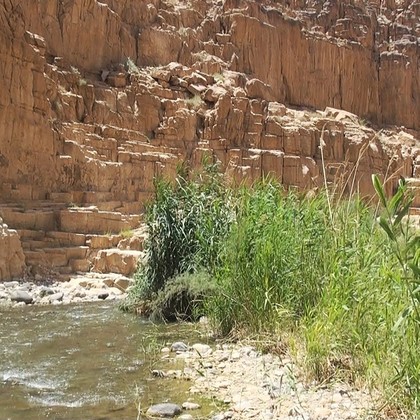
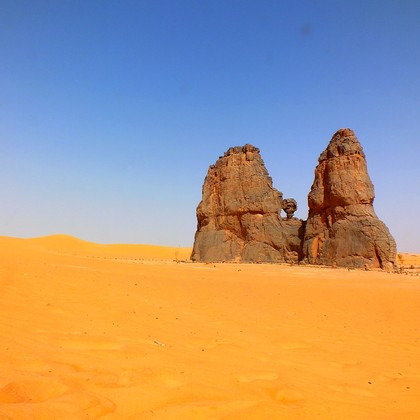
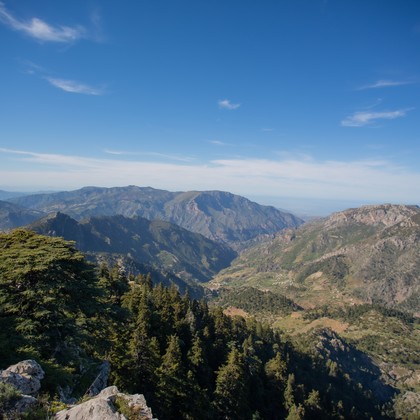
Rugged rocky mountains with gorges and cliffs in a Mediterranean to semi-arid climate, with maquis, garrigue or open woodland; in Arabia and on the desert fringe also rocky wadis and bare mountains. The nest is usually on a sheltered cliff ledge, sometimes in a tree. Hunts partridges, pigeons, rabbits, hares and lizards. Young birds wander in winter to prey-rich plains, farmland and fish ponds.
Where the bird is most at home, classified by the habitats of North Africa and the Middle East.
Range and movements
In Morocco widespread in the Rif, the Atlas and the Anti-Atlas, with perhaps about a thousand pairs; dispersing and wintering birds gather in hunting reserves in the north and in the Guelmim–Tan-Tan region. Also scattered across northern Algeria and Tunisia and in the Jebel Akhdar and Jebel Nafusa of Libya. In Egypt scarce in Sinai and the mountains of the Eastern Desert. A small population in Israel, mainly in the Judean Desert, the Negev and the north, and in Jordan, Lebanon, Syria and northern Iraq. In Arabia in the mountains of western Saudi Arabia (Hejaz and Asir), Yemen and Oman (Hajar Mountains and Dhofar), scarce in the Hajar Mountains of the UAE. Beyond the region in southern Europe, Turkey, Iran, South Asia and southern China to the Lesser Sundas.
- Resident
- Summer visitor (c. Oct–Mar)
- Winter visitor (c. Apr–Sep)
- Passage (Mar–Apr, Oct–Nov)
- dark = core range, pale = thinly spread
How and when to look
In Morocco there is a good chance in the Todra and Dades gorges and the Anti-Atlas, in Israel in the gorges along the Dead Sea. Look for a slim eagle hunting low along a slope with rapid wingbeats; the white patch on the back shows well on perched and flying birds.
Conservation status
Not threatened, but declined strongly over much of the Mediterranean in the twentieth century through habitat loss, disturbance, shooting and electrocution. In the Guelmim region almost fifty adults and young have been electrocuted since 2016. The species tolerates people better than other eagles and is less vulnerable to poisoned bait, as it rarely takes carrion.
Scientific name
Aquila fasciata | Vieillot, 1822
Vieillot described the species in 1822 and placed it straight away in the genus where it still stands. The genus Aquila was introduced in 1760 by Brisson. Aquila is Latin for 'eagle', possibly from aquilus 'dark in colour'. fasciata is Latin for 'banded', from fascia 'band', after the dark band across the tail tip. The specimen the first description was based on came from Montpellier, France.