All species › Birds of prey › Hawks, eagles and kites › Golden Eagle
Golden Eagle | Aquila chrysaetos
Steenarend | Águila real
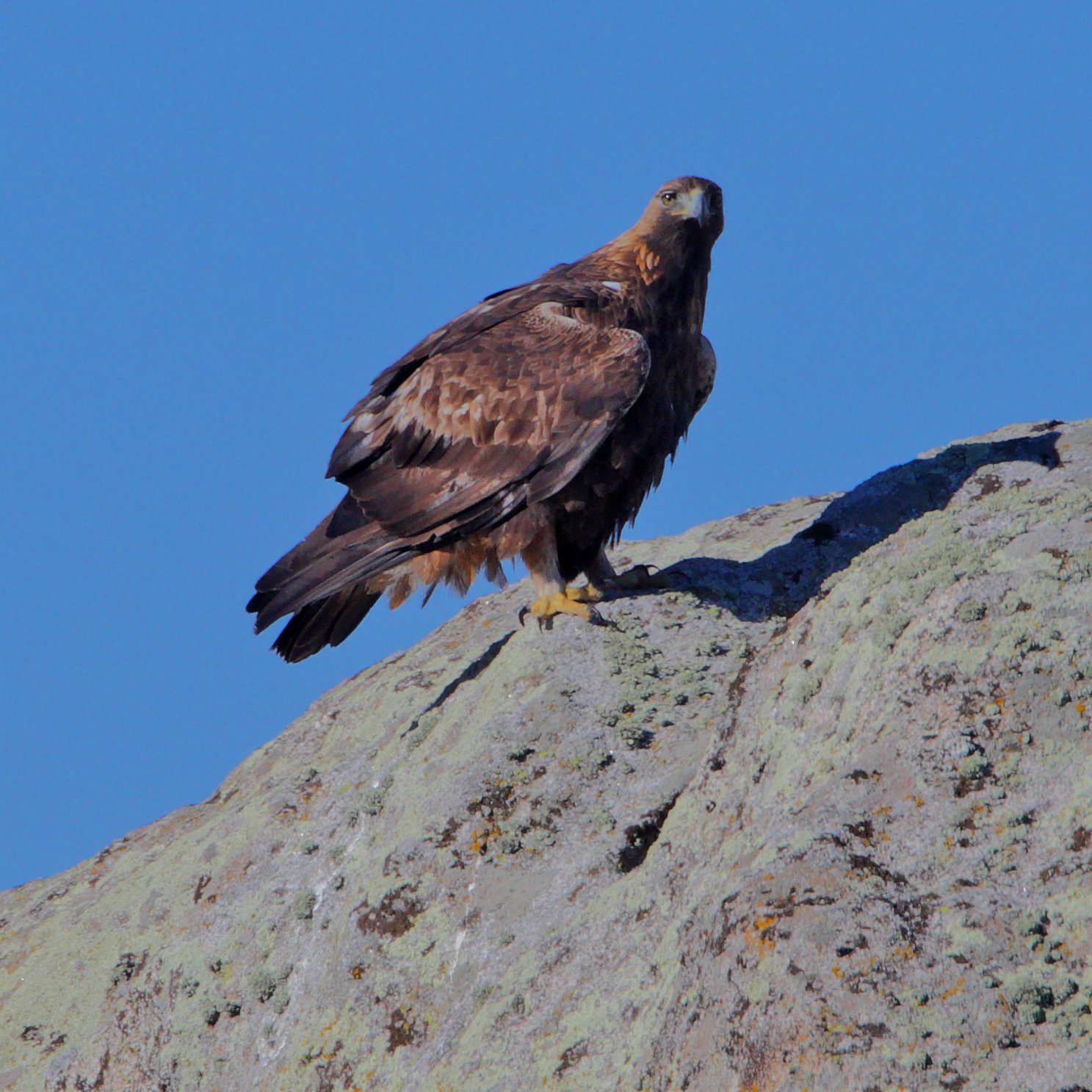
The Golden Eagle is the large, powerful eagle of mountains, gorges and rocky deserts, widespread but everywhere scarce throughout the region. In the deserts of North Africa and Arabia lives the somewhat smaller and paler form homeyeri, which besides hares and gamebirds also takes many spiny-tailed lizards and hedgehogs.
Voice
Usually silent. At the nest a high, whistled kyee-ah and a soft, barking kya-kya.
Recording: Vaslin Matthieu — CC BY-NC-SA 4.0 · converted to mono · xeno-canto
Identification
80–93 cm, wingspan 190–225 cm. Dark brown with a golden-buff crown and nape; the adult has a pale, tawny band across the upperwing coverts, greyish barred flight feathers and a grey tail with faint bars and a dark terminal band. In flight long wings that narrow towards the body, giving an S-curved trailing edge, and a long tail; soars with the wings in a shallow V. The juvenile is more uniformly dark, with large white patches at the base of the inner primaries and a white tail with a broad black terminal band; the white decreases over four to five years.
Confusion species
Imperial Eagle (Aquila heliaca) has a shorter tail, holds its wings flat and as an adult shows white scapular patches. Steppe Eagle (Aquila nipalensis) is smaller and shorter-tailed, and young birds show a white band across the underwing. Verreaux's Eagle (Aquila verreauxii) is jet black with a white back and has wings with a narrow base and a broad hand. A dark young Spanish Eagle (Aquila adalberti) lacks the white wing and tail patches.
Habitat
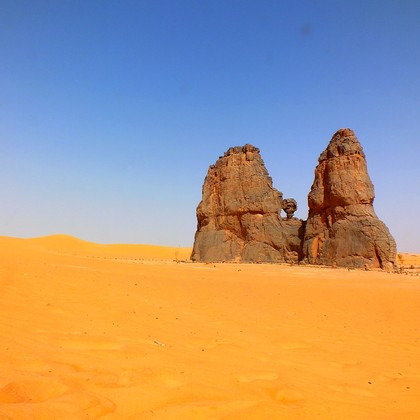
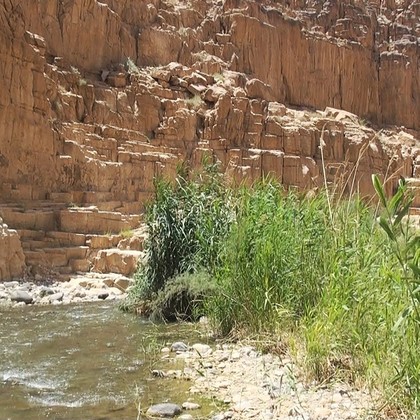
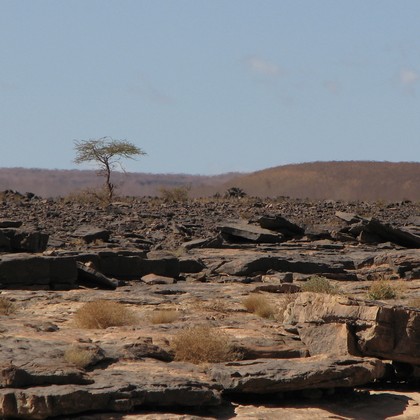
Mountains, gorges and cliffs, from the Atlas and Lebanon to the lava fields and mesas of the desert; in Arabia also bare stone desert and sandy plains with scattered trees. The nest is usually on a cliff ledge, in flat desert sometimes in a tree or on a pylon. Hunts low along slopes for hares, rock hyraxes, partridges, sandgrouse, hedgehogs and spiny-tailed lizards, and in winter also takes carrion.
Where the bird is most at home, classified by the habitats of North Africa and the Middle East.
Range and movements
In Morocco widespread in the Rif, the Middle and High Atlas, the Anti-Atlas and the east of the country, south into Western Sahara. In Algeria in the Tell and Saharan Atlas and in the Saharan mountains (Hoggar, Tassili n'Ajjer); in Tunisia in the mountains of the centre and south; in Libya in the Jebel Akhdar, the Jebel Nafusa and the southern mountains. In Egypt mainly in Sinai and the mountains of the Eastern Desert, scarce in the Western Desert. A small population in Israel (Negev, Judean Desert, Golan) and in Jordan, Lebanon, Syria and northern and western Iraq. In Arabia widespread in Saudi Arabia (Hejaz, Asir, northern lava fields and the interior), Yemen and Oman (Hajar Mountains, Dhofar and the central interior); scarce in the UAE and a winter visitor to Kuwait, Bahrain and Qatar. Beyond the region across much of Europe, Asia and North America.
- Resident
- Summer visitor (c. Apr–Sep)
- Winter visitor (c. Oct–Mar)
- Passage (Mar–Apr, Oct–Nov)
- dark = core range, pale = thinly spread
How and when to look
In the High Atlas, Wadi Rum and the Negev scan the ridges on clear mornings, when pairs circle high or dive in undulating display flights. The long tail and V-shaped posture are good features even at long range.
Conservation status
Not threatened and stable over its large range. In the region locally declining through poisoning, shooting, electrocution, disturbance of nest sites and, in Arabia, the loss of prey to hunting and overgrazing; in Morocco Golden Eagles are sometimes persecuted for allegedly taking lambs.
Scientific name
Aquila chrysaetos | (Linnaeus, 1758)
Linnaeus described the species in 1758 as Falco Chrysaëtos; because it was later moved to another genus, the author and year stand in brackets. The genus Aquila was introduced in 1760 by Brisson. Aquila is Latin for 'eagle', possibly from aquilus 'dark in colour'. chrysaetos is Greek for the golden eagle, from khrusos 'gold' and aetos 'eagle'. The specimen the first description was based on came from Sweden.