All species › Birds of prey › Hawks, eagles and kites › Spanish Eagle
Spanish Eagle | Aquila adalberti
Spaanse keizerarend | Águila imperial ibérica
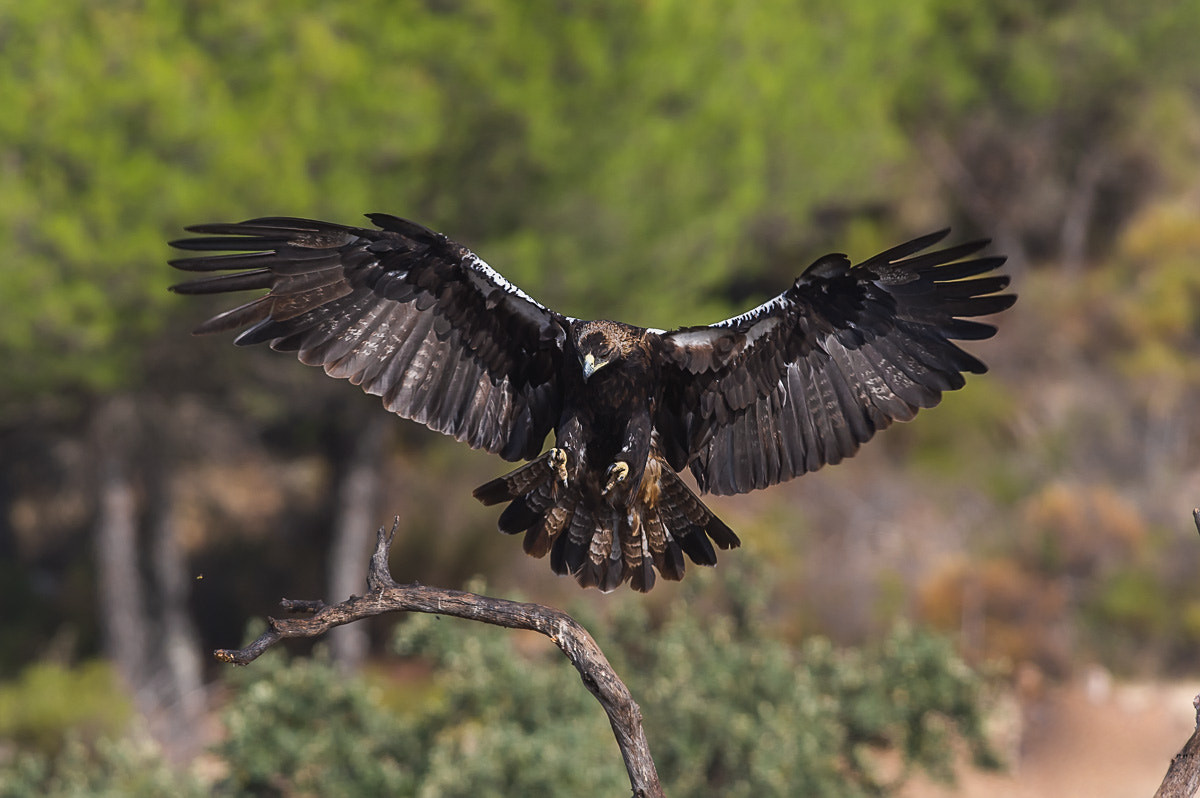
The Spanish Eagle is a large, dark eagle that breeds almost exclusively in the Iberian Peninsula. It formerly also bred in northern Morocco; today mainly young birds from Spain cross the Strait of Gibraltar and winter in Morocco, particularly on the plains around Guelmim and Tan-Tan.
Voice
Mostly silent away from the breeding grounds. A harsh, barking owk-owk-owk, mainly at the nest.
Recording: João Tomás — CC BY-NC-SA 4.0 · converted to mono · xeno-canto
Identification
72–85 cm, wingspan 180–210 cm. The adult is blackish-brown with a pale creamy-buff crown and nape, white scapular patches and a striking white leading edge to the wing, visible in flight as a white line along the arm. The tail is pale grey with a broad dark terminal band. In flight long, broad wings held flat and a fairly long, square tail. The juvenile is unstreaked warm rusty-brown to pinkish-sandy, with dark flight feathers, pale wingbars along the greater coverts, a pale window in the inner primaries and a pale lower back; over several years it becomes blotchy and darker.
Confusion species
Imperial Eagle (Aquila heliaca) lacks the white leading edge to the wing, and its juvenile is clearly streaked on the breast and coverts. Golden Eagle (Aquila chrysaetos) has a longer tail, holds its wings in a V and as a juvenile shows white patches in wing and tail. Juvenile Bonelli's Eagle (Aquila fasciata) is also rufous, but much slimmer and smaller, with a long, finely barred tail. The lost Moroccan Tawny Eagle (Aquila rapax) resembles a young Spanish Eagle, but is smaller and lacks the clear wingbars; some old Tawny Eagle reports may have referred to this species.
Habitat
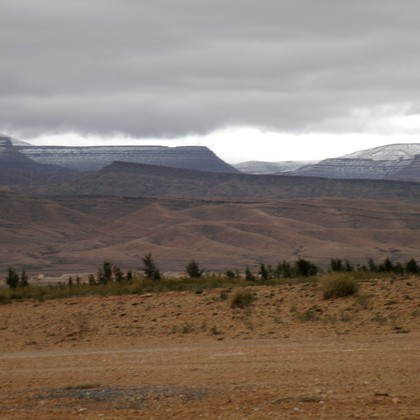
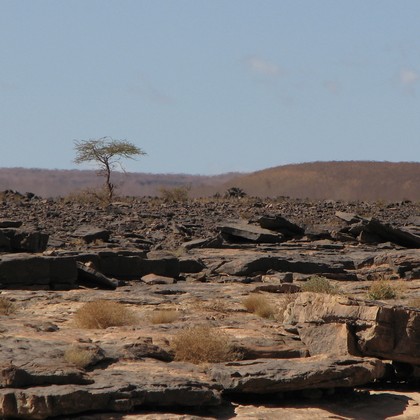
In Morocco open, dry plains with scattered trees or pylons: stony semi-desert and steppe, farmland and grazing land with plenty of rabbits, hares or rodents. Uses pylons as lookouts and roosts. In Spain it breeds in open cork and holm oak woodland (dehesa) and in flat farmland with scattered trees.
Where the bird is most at home, classified by the habitats of North Africa and the Middle East.

Range and movements
In Morocco the species bred in the north until the first half of the twentieth century; after that only breeding records from 1991 and 1995 are known. Until the 2000s it was considered a vagrant, but since 2008 young birds have crossed the Strait of Gibraltar almost every year, and since at least 2006 birds have regularly wintered in the north-western Sahara, especially between Guelmim and Tan-Tan. Satellite-tagged juveniles from Andalusia spread across the whole of Morocco; most return within a year, but birds two to three years old, old enough to breed, have also been seen. No recent records from Algeria or Tunisia. Beyond the region only in Spain and Portugal, with its core in south-western and central Spain.
- Resident
- dark = core range, pale = thinly spread
How and when to look
In winter scan the power-line poles on the plains between Guelmim and Tan-Tan. In autumn young birds may also turn up in the north after the crossing, around Jbel Moussa and Tangier. On every large rufous eagle check for unstreaked underparts and pale wingbars.
Conservation status
Vulnerable. After a low of a few dozen pairs in the 1960s the Spanish population has recovered strongly through protection. Electrocution is the greatest obstacle to the recolonisation of Morocco: a 2016 survey in south-western Morocco found at least four electrocuted Spanish Eagles. Low prey density and persecution also play a part.
Scientific name
Aquila adalberti | Brehm, 1861
Brehm described the species in 1861 and placed it straight away in the genus where it still stands. The genus Aquila was introduced in 1760 by Brisson. Aquila is Latin for 'eagle', possibly from aquilus 'dark in colour'. adalberti honours Prince Adalbert of Bavaria (1828–1875). The specimen the first description was based on came from Spain.