All species › Passerines › Finches › Brambling
Brambling | Fringilla montifringilla
Keep | Pinzón real
The Brambling is a northern finch that breeds in the taiga and winters in Europe in variable, at times huge numbers. The region lies at the far southern edge of its winter range: in the Levant small flocks appear in some winters, elsewhere it is a rarity.
Voice
The call is a nasal, questioning tchway or kweh, harsher and more wheezy than in the Chaffinch; in flight a short hard yek. The song, a monotonous buzzing rrrhooo, is hardly ever heard in the region.
Recording: bert de bruin — CC BY-NC-SA 4.0 · converted to mono · xeno-canto
Identification
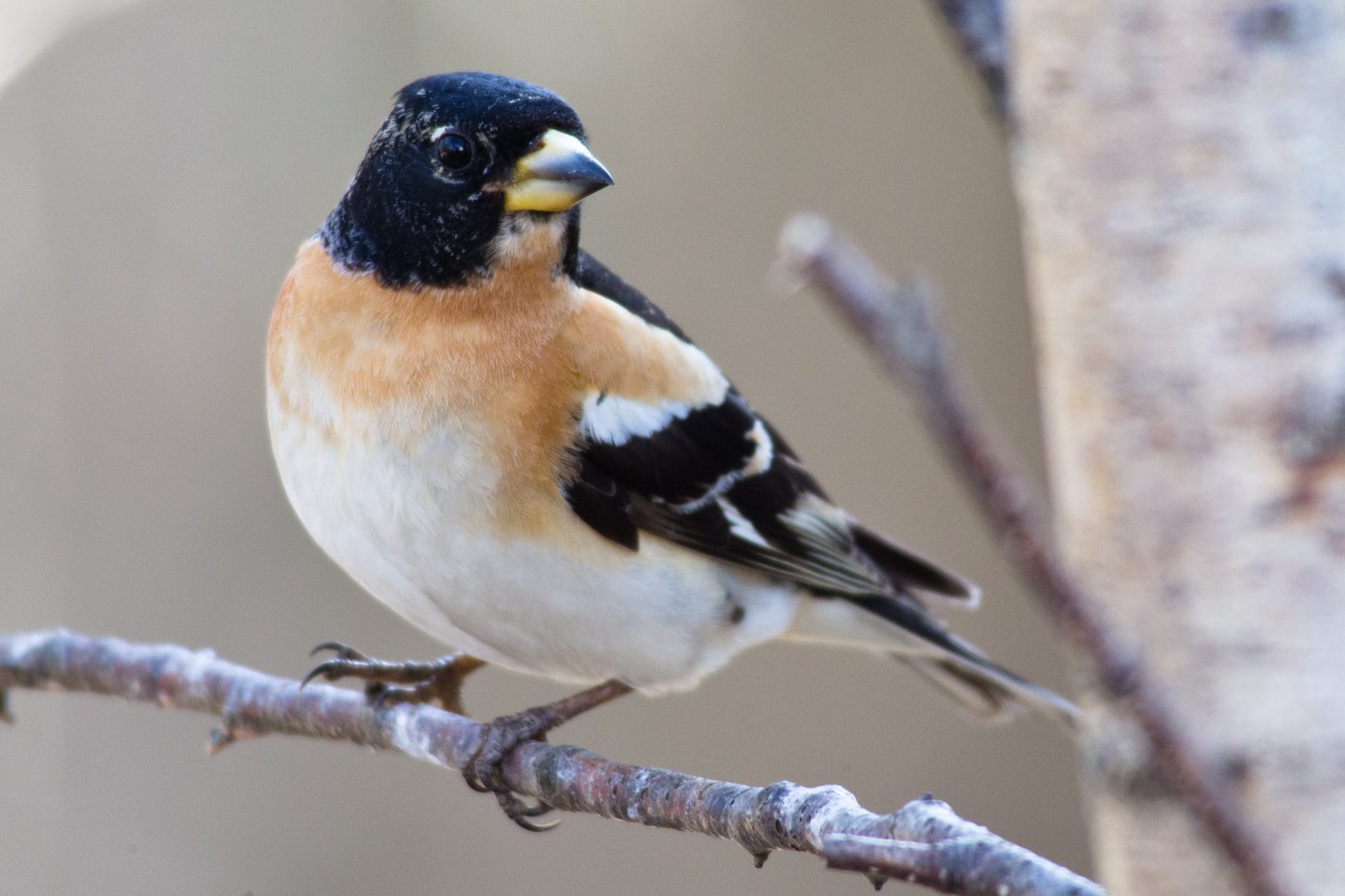
14–16 cm. A finch with orange breast and shoulders, a white belly with dark spots on the flanks and above all a narrow, elongated white rump that catches the eye at once in flight. The winter male has head and mantle feathers black, covered by grey-brown fringes, an orange breast and a yellow bill with a dark tip; by spring the fringes wear off and the head becomes glossy black. The female has a grey head with dark side stripes, a paler orange breast and a streaked brown back. The wing shows an orange-tinged wingbar and a small white patch at the base of the primaries.
Confusion species
Common Chaffinch (Fringilla coelebs) has a greenish rump, two pure white wingbars, much white in the tail and no orange on the shoulder. African Chaffinch (Fringilla spodiogenys) is moss-green above with a blue-grey head, lacking the orange and white rump of the Brambling.
Habitat
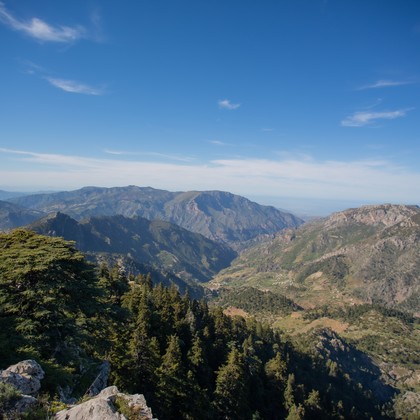
In winter in broadleaf and mixed woodland, orchards, field edges and parks, often among Common Chaffinches and other finches on the ground under trees, searching for seeds; in Europe strongly drawn to beechmast, which is largely absent from the region.
Where the bird is most at home, classified by the habitats of North Africa and the Middle East.

Range and movements
An irregular winter visitor to northern Israel (Hermon, Golan, Galilee), Lebanon and Syria, in larger numbers in invasion years; scarce in northern Iraq and Kuwait. In the Maghreb a rare and irregular winter visitor to northern Morocco, Algeria and Tunisia; a vagrant to Egypt, Saudi Arabia, Bahrain, Qatar, the United Arab Emirates and Oman. Breeds from Norway through the taiga of Russia and Siberia to Kamchatka and winters mainly in Europe, Asia Minor, Central Asia, China and Japan.
- Winter visitor (c. Oct–Mar)
- Passage (Mar–Apr, Oct–Nov)
- dark = core range, pale = thinly spread
How and when to look
In winter on the Golan and Mount Hermon, check finch flocks for a white rump as they flush and listen for the nasal call; outside the Levant any Brambling is a notable record worth documenting.
Conservation status
Not globally threatened and with a very large population. The number reaching the region depends on the seed crop in Europe: in years with little beechmast Bramblings move farther south.
Scientific name
Fringilla montifringilla | Linnaeus, 1758
Linnaeus described the species in 1758 and placed it straight away in the genus where it still stands. He introduced the genus Fringilla in that same work. Fringilla is the Latin word for 'finch'. montifringilla is Latin for 'mountain finch', from mons, montis 'mountain' and fringilla 'finch'. The specimen the first description was based on came from Sweden.