All species › Passerines › Finches › African Chaffinch
African Chaffinch | Fringilla spodiogenys
Afrikaanse vink | Pinzón magrebí
The African Chaffinch is the chaffinch of the Maghreb and Libya: a resident that ranges from the cedar forests of the Atlas to the olive groves and palm gardens of Tunisia. Long regarded as a subspecies of the Common Chaffinch, it differs clearly in plumage and voice.
Voice
The song resembles that of the Common Chaffinch, an accelerating series ending in a flourish, but usually sounds fuller and ends less emphatically. The call is a metallic chweet or chink, unlike the pink of the Common Chaffinch; in flight a soft tsup.
Recording: András Schmidt — CC BY-NC-SA 4.0 · converted to mono · xeno-canto
Identification
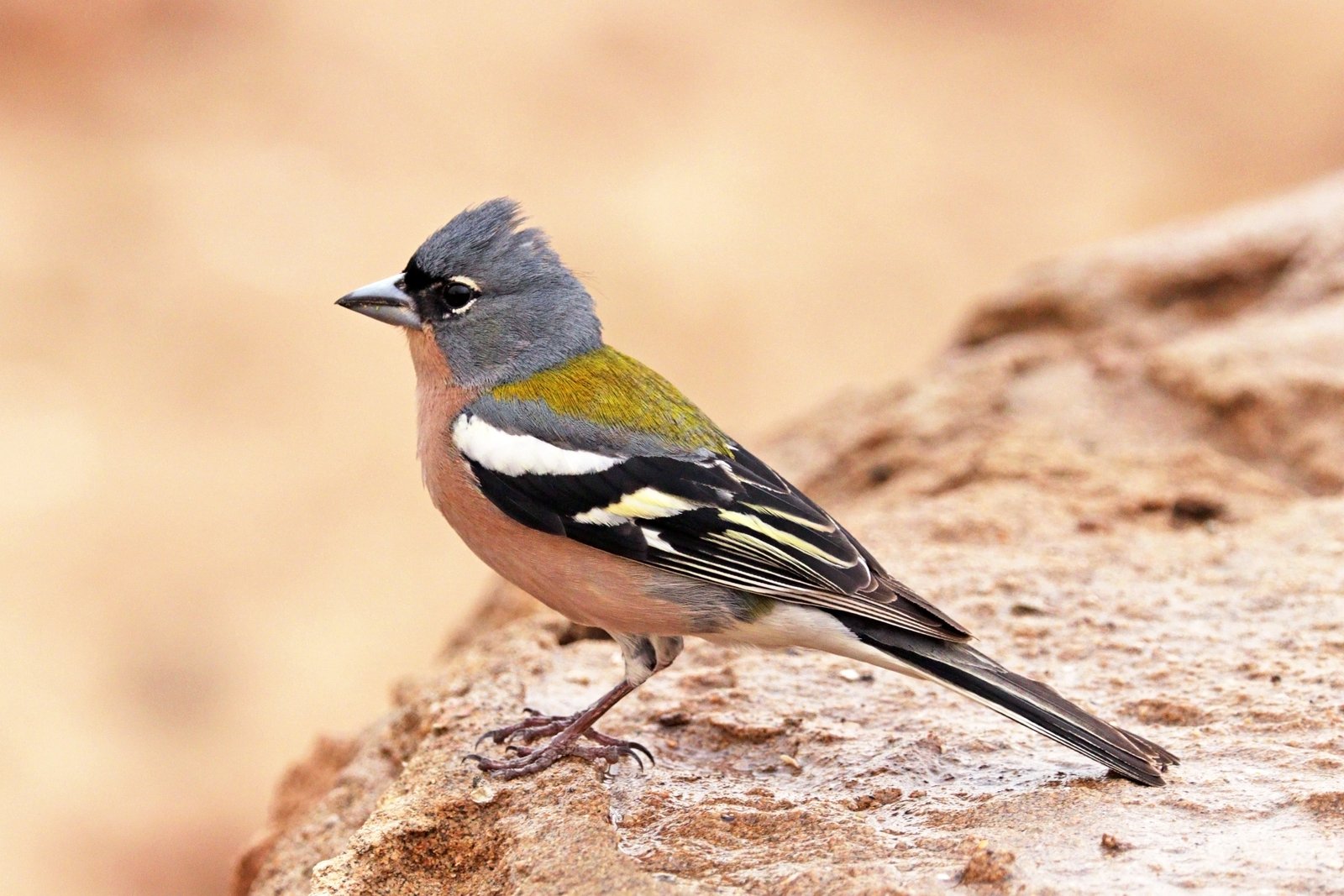
14–16 cm. The male has a blue-grey head and nape with a narrow black forehead band, black lores and a broken white eye-ring, a moss-green mantle and rump and a pale salmon-pink breast fading to white on the belly. The wing is black with a very broad white shoulder patch and wingbar; the outer tail feathers are white. The female is grey-brown with a greenish back, a grey head and the same broad white wing pattern. Towards the east (Tunisia, Libya) birds become paler and greyer below.
Confusion species
Common Chaffinch (Fringilla coelebs), numerous in the Maghreb in winter, has a chestnut-brown back and brick-pink breast and lacks the white eye-ring; females are browner on the head and back. Brambling (Fringilla montifringilla) has an orange breast and a white rump.
Habitat
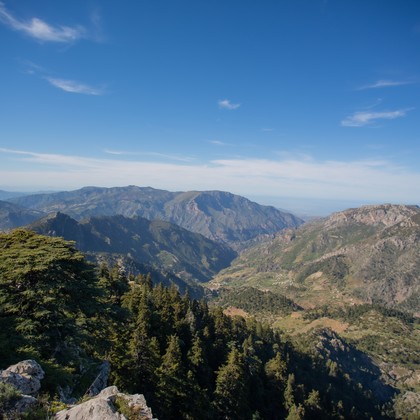
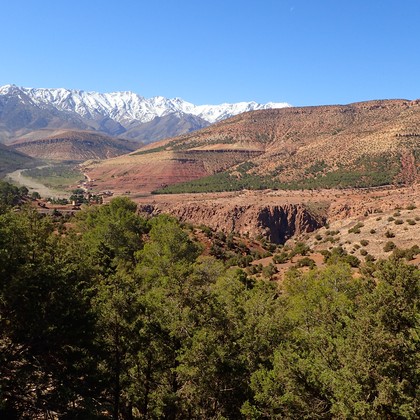
Montane forest of cedar, holm oak, cork oak, pine and juniper up to over 2500 m, plus olive groves, orchards, parks, gardens and, in Tunisia and Libya, oasis palm gardens. Feeds on seeds and insects on the ground and in trees.
Where the bird is most at home, classified by the habitats of North Africa and the Middle East.

Range and movements
Morocco (Rif, Middle and High Atlas, Anti-Atlas, the coastal plains and the north), northern Algeria, Tunisia south to the southern oases, and in Libya Tripolitania and, isolated, the Jebel Akhdar of Cyrenaica. Outside the region only on the Italian island of Pantelleria and, as a vagrant, Lampedusa.
- Resident
- Summer visitor (c. Oct–Mar)
- Winter visitor (c. Apr–Sep)
- Passage (Mar–Apr, Oct–Nov)
- dark = core range, pale = thinly spread
How and when to look
In the cedar forests of the Middle Atlas, for instance around Ifrane and Azrou, it is one of the most frequently heard songbirds; in Tunisia it occurs in every olive grove and oasis and is easy to see at close range.
Conservation status
Not assessed separately by the IUCN, as the species has only recently been recognised. Widespread and common over a large range and probably not threatened; loss of montane forest in the Atlas and deforestation in Cyrenaica are the main concerns.
Scientific name
Fringilla spodiogenys | Bonaparte, 1841
Bonaparte described the species in 1841 and placed it straight away in the genus where it still stands. The genus Fringilla was introduced in 1758 by Linnaeus. Fringilla is the Latin word for 'finch'. spodiogenys is Greek for 'ash-cheeked', from spodios 'ashy grey' and genys 'cheek'. The specimen the first description was based on came from Sfax, Tunisia.