All species › Passerines › Finches › Hawfinch
Hawfinch | Coccothraustes coccothraustes
Appelvink | Picogordo común
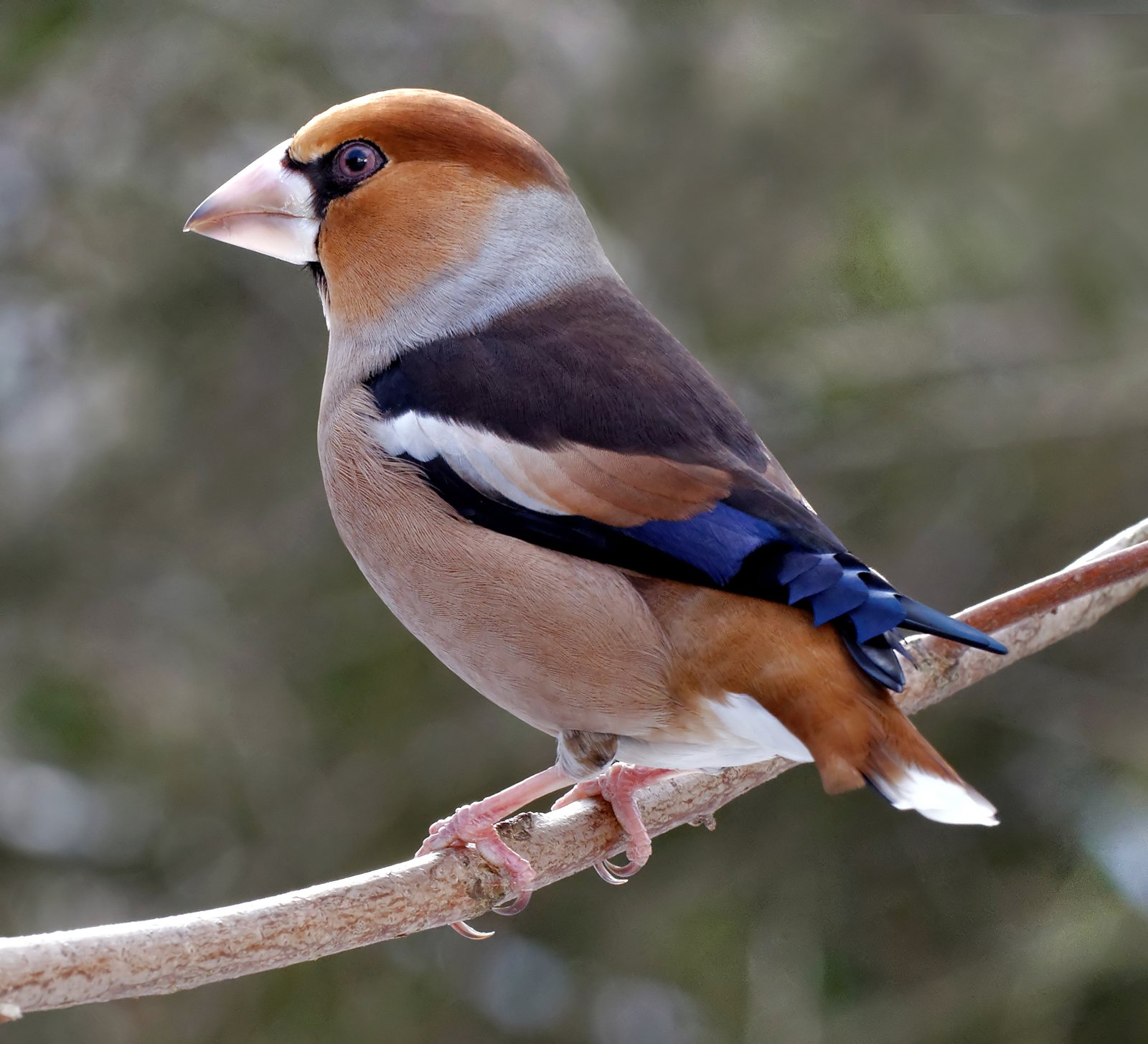
The Hawfinch is the bulkiest finch of the region, a stocky bird with a huge conical bill used to crack cherry and olive stones. A pale form of its own breeds in the mountain forests of the Maghreb; in the Middle East it is a scarce winter visitor.
Voice
The call is a short, hard, sharp tsik or pix, recalling a European Robin's call and often the first sign of its presence; also a thin tseeh. The song is quiet, halting and inconspicuous.
Recording: Lars Edenius — CC BY-NC-SA 4.0 · converted to mono · xeno-canto
Identification
16.5–18 cm. Large, short-tailed and heavily built, with a thick neck and a massive conical bill that is steel-blue in summer and horn-coloured in winter. The male is warm orange-brown on the head and cheeks, with a grey nape band, black chin and lores, a dark brown mantle and pinkish-buff underparts. The wings are blue-black with a broad white wingbar and oddly curled, glossy primaries; the short tail has a broad white tip. The female is duller with a greyish panel on the secondaries. In flight the broad white wingbar and white tail tip stand out. The North African form buvryi is paler than European birds.
Confusion species
In the region hardly confusable thanks to the combination of size, bill and short-tailed shape. Crimson-winged Finch (Rhodopechys sanguineus), found in the same mountains of the Atlas and the Levant, also has a heavy bill but is sandy brown with pink in the wing and rump and lacks the white wingbar.
Habitat
In the Maghreb mixed montane forest of cedar, oak and pine, plus orchards, olive groves and parks, especially with tall trees. Winter visitors in the Levant use oak woodland, orchards and parks with seed-rich trees such as hornbeam, maple and olive.
Where the bird is most at home, classified by the habitats of North Africa and the Middle East.


Range and movements
Breeds in Morocco (Rif, Middle and High Atlas), northern Algeria and north-western Tunisia. A scarce and irregular winter visitor to Israel (mainly Hermon, the Golan and Galilee), Lebanon, Syria and northern Iraq; rare to vagrant in Jordan, Egypt, Kuwait, Saudi Arabia and the Gulf states. Beyond the region it breeds from Europe across temperate Asia to Japan; northern birds move south in winter.
- Resident
- Summer visitor (c. Apr–Sep)
- Winter visitor (c. Oct–Mar)
- Passage (Mar–Apr, Oct–Nov)
- dark = core range, pale = thinly spread
How and when to look
In the cedar forests of the Middle Atlas listen for the hard tsik from the canopy; Hawfinches often sit motionless high in the crown and are heard before they are seen. In the Levant in winter it pays to watch drinking places in woodland.
Conservation status
Not globally threatened. Locally fairly common in montane forest in the Maghreb but vulnerable to the decline of cedar and oak forests.
Scientific name
Coccothraustes coccothraustes | (Linnaeus, 1758)
Linnaeus described the species in 1758 as Loxia coccothraustes; because it was later moved to another genus, the author and year stand in brackets. The genus Coccothraustes was introduced in 1760 by Brisson. Coccothraustes is Greek, from kokkos 'kernel, seed' and thrauo 'to break', after the heavy bill that cracks stones and pips. The specific name repeats the genus name. The specimen the first description was based on came from Italy.