All species › Passerines › Finches › Common Rosefinch
Common Rosefinch | Carpodacus erythrinus
Roodmus | Camachuelo carminoso
The Common Rosefinch breeds from eastern Europe to Kamchatka and winters in southern Asia, so its migration route runs mainly along the eastern edge of the region. The great majority of records concern brown first-winters in autumn, in gardens and oases along the Persian Gulf.
Voice
The call is a soft rising too-eek; the song, sometimes heard on passage in May, is a short whistled phrase rendered as pleased-to-meet-you, weeda-weeda-weedyoo.
Recording: Louis-Marie Gourmelon — CC BY-NC-SA 4.0 · converted to mono · xeno-canto
Identification
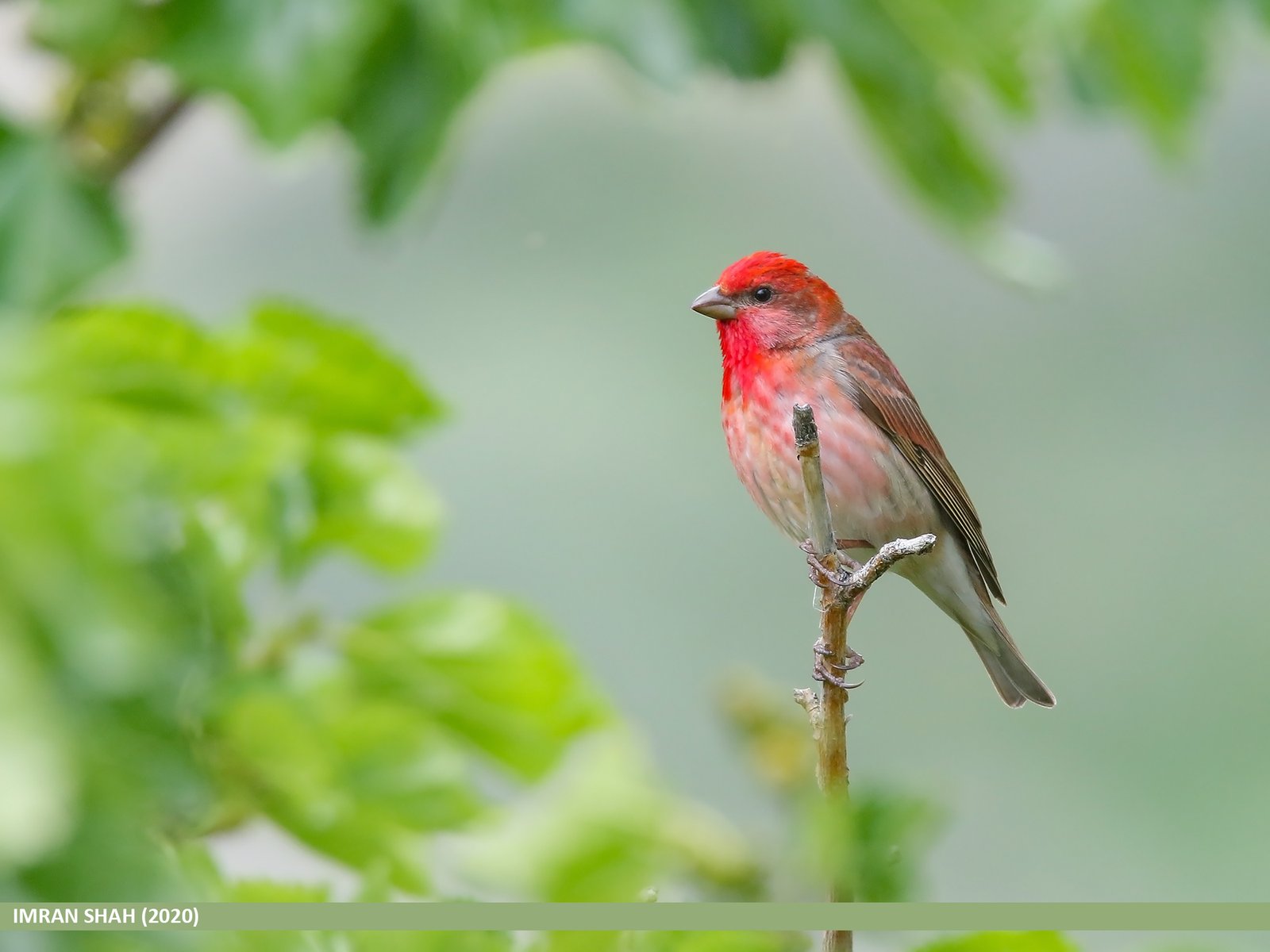
13.5–15 cm. A finch with a short, thick, strongly curved bill, a rounded head, a dark beady eye in a plain face and a slightly forked tail. The adult male has a crimson head, breast and rump and a brown back with a red wash. Females and most autumn birds are plain olive-brown, lightly streaked on breast and flanks, with two narrow pale wingbars and no distinct head pattern; that lack of pattern is itself a feature.
Confusion species
A female House Sparrow (Passer domesticus) has a pale supercilium, a streaked back and a less bulbous bill. Sinai Rosefinch (Carpodacus synoicus) lives in desert mountains, has a paler, unstreaked sandy plumage and in the male a pink face with silvery-white spots. Eurasian Linnet (Linaria cannabina) shows white in wing and tail and has a greyer head.
Habitat
On passage in built-up areas with greenery, parks, gardens, orchards, tamarisk scrub and oases, often in fruiting shrubs; it regularly sits still and unobtrusive among the leaves.
Where the bird is most at home, classified by the habitats of North Africa and the Middle East.


Range and movements
A scarce passage migrant in the east of the region, mainly in autumn: Kuwait, Iraq, eastern and central Saudi Arabia (Riyadh, Jubail, the Eastern Province), Bahrain, Qatar, the United Arab Emirates and Oman; now rare in Saudi Arabia. Rare in Israel, Jordan, Lebanon and Syria, a vagrant to Egypt and the Maghreb. Breeds from north-eastern Europe and Turkey through the Caucasus and Iran to Siberia and Kamchatka and winters in India and South-East Asia.
- Summer visitor (c. Oct–Mar)
- Passage (Mar–Apr, Oct–Nov)
- dark = core range, pale = thinly spread
How and when to look
In September in the Gulf states and Oman check gardens, parks and ringing stations for a plain brown finch with a beady eye and a thick bill; the soft rising call often gives it away.
Conservation status
Not globally threatened. The numbers passing through the region seem to be decreasing, but data are scarce.
Scientific name
Carpodacus erythrinus | (Pallas, 1770)
Pallas described the species in 1770 as Loxia erythrina; because it was later moved to another genus, the author and year stand in brackets. The genus Carpodacus was introduced in 1829 by Kaup. Carpodacus is Greek, from karpos 'fruit' and dakos 'biter'. erythrinus goes back to Greek eruthros 'red', after the carmine plumage of the male. The specimen the first description was based on came from the Volga and Samara rivers.