All species › Passerines › Finches › Sinai Rosefinch
Sinai Rosefinch | Carpodacus synoicus
Sinaïroodmus | Camachuelo del Sinaí
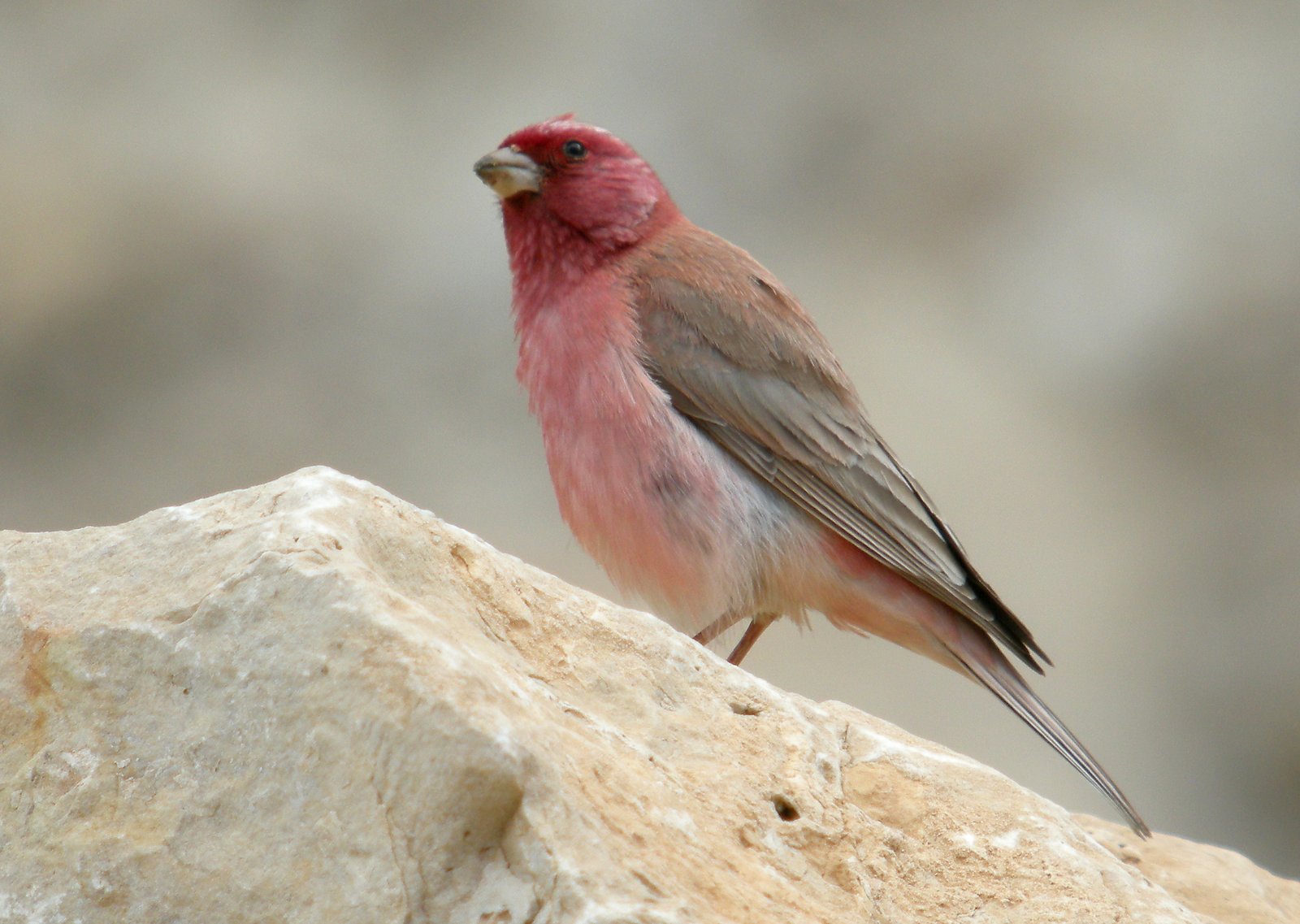
The Sinai Rosefinch is a desert rosefinch of the granite and sandstone mountains around the Gulf of Aqaba. The male, pink as the rock of Petra, is Jordan's national bird; its range lies almost entirely within the region.
Voice
Not very vocal. The call is a soft, sparrow-like chweet or chip, in flight also a short two-note twee-ip. The song is a quiet, short series of chirping notes and is seldom heard.
Recording: Steve Klasan — CC BY-NC-SA 4.0 · shortened to the first 60 s, mono · xeno-canto
Identification
14–15 cm. A slim rosefinch with a fairly long, slightly forked tail and a short, thick, pale horn-coloured bill. The male has a deep pink face and forehead with fine silvery-white spots on the crown and cheeks, a pink breast and rump and a sandy grey-brown mantle washed pink. Females and young birds are plain grey-buff to sandy, unstreaked and without wingbars; only the tail and wings are a little darker. Young males acquire the pink gradually in their second year.
Confusion species
Trumpeter Finch (Bucanetes githagineus) shares the same terrain but is smaller and more compact, with a shorter tail, a grey head and a thick bill that is coral-red in the breeding season. Common Rosefinch (Carpodacus erythrinus), a scarce passage migrant, is finely streaked with wingbars in the female and has darker olive-brown plumage. Desert Finch (Rhodospiza obsoleta) has a black bill and a black, white and pink wing.
Habitat
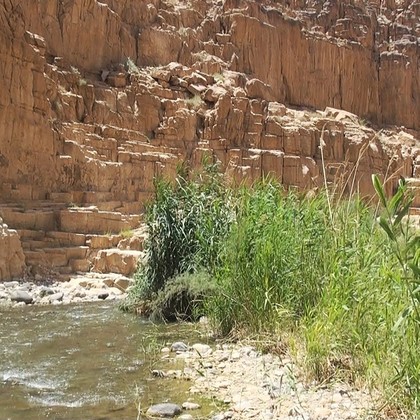
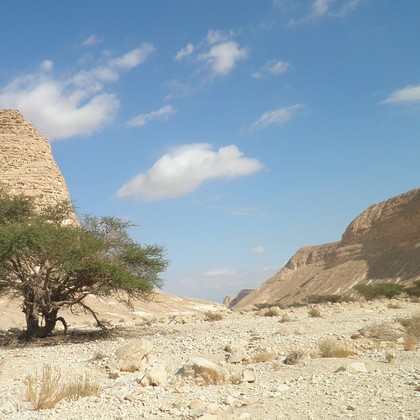
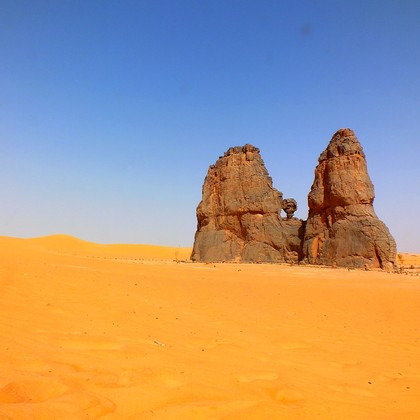
Bare, steep rock faces, gorges and wadis in desert mountains of granite and sandstone, with scattered shrubs and springs, between 300 and 2000 m. It drinks daily, usually early in the morning, gathering in small groups at springs, pools and leaking pipes.
Where the bird is most at home, classified by the habitats of North Africa and the Middle East.
Range and movements
The mountains of southern Sinai (around St Catherine and Jebel Musa) in Egypt, southern Israel (Eilat Mountains, the Negev highlands with Mitzpe Ramon, the edges of the Arava), southern Jordan (Petra, Dana, Wadi Rum) and north-western Saudi Arabia (Hisma and the Midian mountains around Tabuk). Outside the region related forms (often treated as a separate species) occur in the mountains of Afghanistan and western China.
- Resident
- Winter visitor (c. Apr–Sep)
- Passage (Mar–Apr, Oct–Nov)
- dark = core range, pale = thinly spread
How and when to look
At Petra go at sunrise to the cliffs around the theatre and the Monastery steps, or in Israel to the springs of the Eilat Mountains and the rim of the Ramon crater: the birds come to drink in small groups and can then be watched at close range.
Conservation status
Not globally threatened, with a small but stable range. Tourism around Petra and St Catherine and the loss of natural springs are local concerns; the bird also benefits from artificial water points.
Scientific name
Carpodacus synoicus | (Temminck, 1825)
Temminck described the species in 1825 as Pyrrhula synoica; because it was later moved to another genus, the author and year stand in brackets. The genus Carpodacus was introduced in 1829 by Kaup. Carpodacus is Greek, from karpos 'fruit' and dakos 'biter'. synoicus goes back to Greek sunoikos 'living together'; what exactly the name alludes to cannot be established with certainty. The specimen the first description was based on came from Mount Sinai, Egypt.