All species › Waders, gulls and terns › Sandpipers and snipes › Broad-Billed Sandpiper
Broad-Billed Sandpiper | Calidris falcinellus
Breedbekstrandloper | Correlimos falcinelo
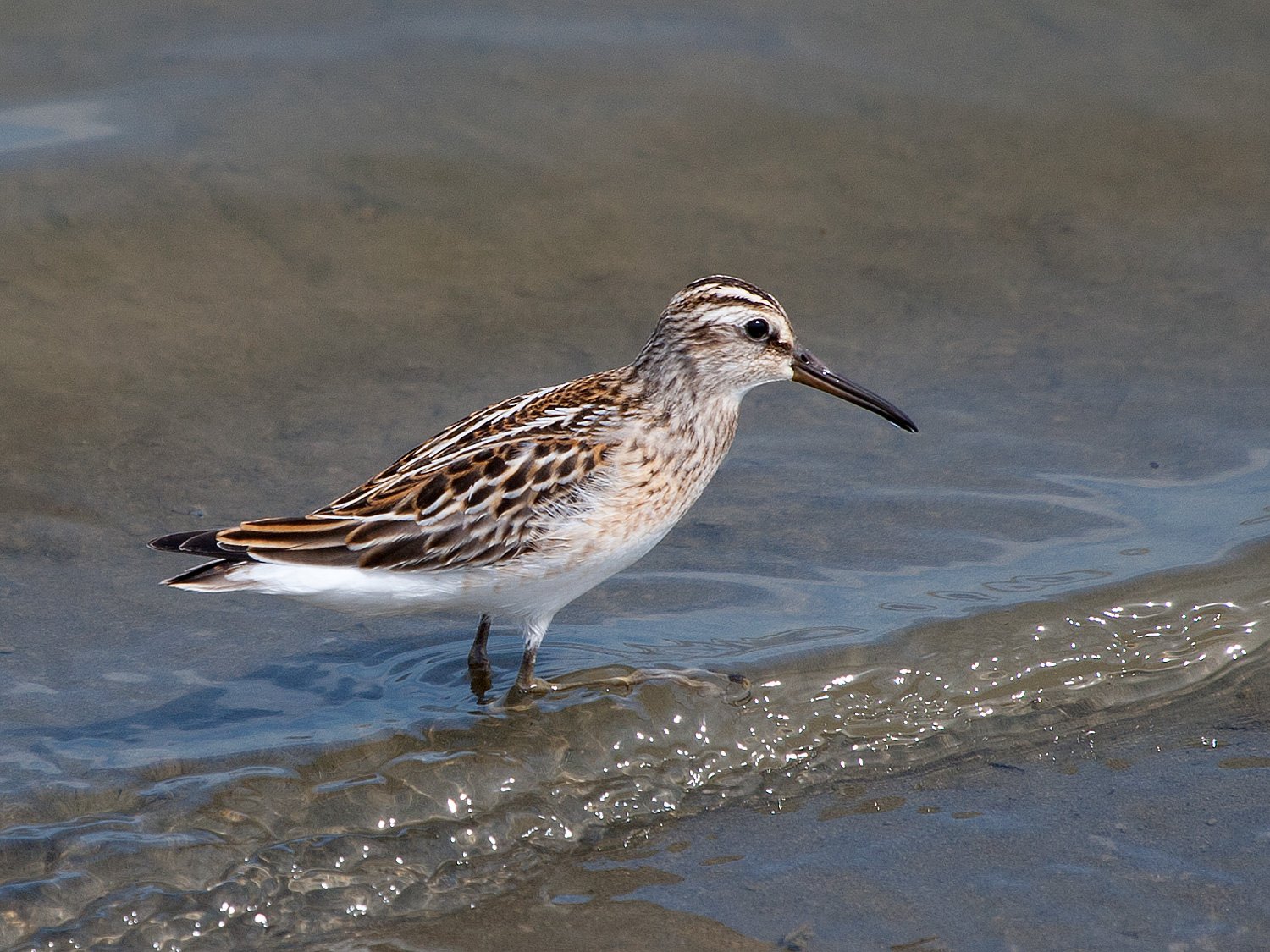
A small, dark sandpiper with a long bill that kinks downwards at the tip and a double white supercilium. While it is a sought-after rarity in Europe, the tidal flats of the Persian Gulf and Oman are among its most important wintering areas in the world.
Voice
A dry, buzzing chrrreet or brrreet, drier and more trilled than Dunlin's call.
Recording: Stanislas Wroza — CC BY-NC-SA 4.0 · converted to mono · xeno-canto
Identification
Slightly smaller than Dunlin, with shorter legs and a relatively long bill, broad at the base and clearly kinked down at the tip. Diagnostic is the split white supercilium: above the eye the pale stripe forks into a narrow upper and a broader lower branch. In breeding plumage the upperparts are dark blackish-brown with pale, snipe-like mantle stripes, and the breast is densely streaked. In winter grey above with dark centres and a dark bend of the wing, white below, but the head pattern remains visible. Juveniles resemble breeding plumage, with fresh rufous fringes. Legs dark olive-grey. In flight a narrow wingbar and a dark centre to the rump.
Confusion species
Dunlin (Calidris alpina) is larger, with longer legs, an evenly decurved bill and no split supercilium; in breeding plumage a black belly patch. Little Stint (Calidris minuta) is smaller, with a short straight bill and black legs. At a distance the striped head even recalls a miniature Common Snipe (Gallinago gallinago), but that species lives in quite different terrain and has a much longer bill.
Habitat
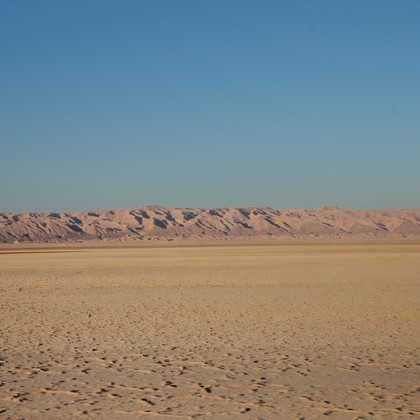
Soft, wet mudflats and the margins of shallow lagoons, often near mangroves; also salt pans, sebkhas and coastal pools with fine silt. It feeds slowly, with short probes deep into the mud, often among Dunlins and Little Stints.
Where the bird is most at home, classified by the habitats of North Africa and the Middle East.

Range and movements
Common on the Gulf coast of Kuwait (Khor al Subiya, Jahra Bay), Saudi Arabia, Bahrain, Qatar and the Emirates, where it occurs in large numbers on passage and in winter on tidal flats such as Khor al Beida, and along the coasts of Oman, with Barr al Hikman and Masirah island as strongholds. Also a passage migrant and winter visitor on the Red Sea coast of Saudi Arabia and Yemen and the shores of the Gulf of Aden. A passage migrant in southern Iraq. In Egypt scarce along the Gulf of Suez and the Red Sea; in Israel a small but regular passage migrant, mainly at Eilat in May and August–September. In North Africa scarce on passage in Tunisia and Libya and rare in Morocco and Algeria. Beyond the region it breeds in mountain bogs of northern Scandinavia and on the tundra of northern Russia and Siberia, and winters from East Africa and Arabia to South and South-East Asia and Australia.
- Resident
- Summer visitor (c. Apr–Sep)
- Winter visitor (c. Oct–Mar)
- Passage (Mar–Apr, Oct–Nov)
- dark = core range, pale = thinly spread
How and when to look
On the tidal flats of Khor al Beida (Umm al Qaiwain) and at Khor al Subiya in Kuwait hundreds of birds in breeding plumage can sometimes be seen in April and May. Come on a rising tide, when the birds move closer to shore, and look for the kinked bill and the double supercilium.
Conservation status
Vulnerable. The global population is declining fast, mainly through loss of tidal flats along the flyways in East Asia and the Middle East. The Arabian wintering grounds are of great international importance; land reclamation, port expansion and pollution along the Gulf are the main threats in the region.
Scientific name
Calidris falcinellus | (Pontoppidan, 1763)
Pontoppidan described the species in 1763 as Scolopax Falcinellus; because it was later moved to another genus, the author and year stand in brackets. The genus Calidris was introduced in 1804 by Merrem. Calidris goes back to Ancient Greek kalidris or skalidris, a name Aristotle used for an unidentified grey waterside bird. falcinellus is a diminutive of Latin falx, falcis 'sickle', so 'little sickle'. The specimen the first description was based on came from Zealand, Denmark.