All species › Waders, gulls and terns › Sandpipers and snipes › Curlew Sandpiper
Curlew Sandpiper | Calidris ferruginea
Krombekstrandloper | Correlimos zarapitín
A slender, long-legged sandpiper with an evenly decurved bill and a bright white rump. It passes through the region in large numbers between the Siberian tundra and Africa, and in May flocks in brick-red breeding plumage colour the salt pans of Tunisia, Egypt and the Gulf.

Voice
A soft, rolling, disyllabic chirrup, fuller and rounder than Dunlin's rasping kreeep.
Recording: Xavier Riera — CC BY-NC-SA 4.0 · converted to mono · xeno-canto
Identification
Slimmer, longer-necked and higher on its legs than Dunlin, with a long black bill evenly decurved along its whole length, and black legs. In breeding plumage (April–August) head and underparts are deep brick-red and the upperparts spotted black, red and white; moulting birds are blotched red. In winter pale grey above and white below, with a clear white supercilium. Juveniles have neatly scaled upperparts and a warm peachy breast. In flight the square, bright white rump above the dark tail is decisive.
Confusion species
Dunlin (Calidris alpina) is shorter in leg and bill, with a droop near the tip rather than an even curve, and always has a dark centre to the rump. Broad-billed Sandpiper (Calidris falcinellus) is smaller, shorter-legged and has a split supercilium. Red Knot (Calidris canutus) is also red below in breeding plumage, but is much stockier, with a straight bill and a grey rump. A bird with a white rump flushing among Dunlins is almost always a Curlew Sandpiper.
Habitat
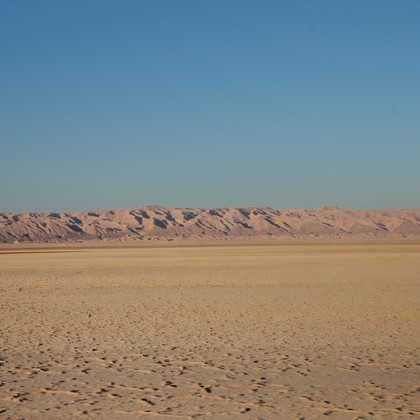
Shallow brackish and saline water with soft mud: salt pans, sebkhas, lagoons, tidal flats and coastal pools, where it wades deeper than other small sandpipers. On passage also at freshwater inland waters, sewage ponds and reservoirs, and along the Nile.
Where the bird is most at home, classified by the habitats of North Africa and the Middle East.


Range and movements
A passage migrant throughout the region. In spring large numbers move through Tunisia and Libya and along the Egyptian coast (including the delta lakes), and through the Red Sea zone, Sinai and Israel; at Eilat it is one of the commonest sandpipers in April–May. In autumn the adults come first (July–August), followed by the juveniles (August–October). It winters in numbers on the Gulf coast from Kuwait to the Emirates, along the coasts of Oman (Barr al Hikman), on the Red Sea coast of Saudi Arabia and Yemen and around Socotra; in North Africa locally in Tunisia (Gulf of Gabès) and on the Atlantic coast of Morocco and Western Sahara, and scarcely in Egypt and Iraq. Beyond the region it breeds on the tundra of northern Siberia, from Yamal to the Kolyma, and winters in sub-Saharan Africa, South Asia and Australia.
- Resident
- Summer visitor (c. Apr–Sep)
- Winter visitor (c. Oct–Mar)
- Passage (Mar–Apr, Oct–Nov)
- dark = core range, pale = thinly spread
How and when to look
In May the salt pans of Eilat and Sfax and the lagoons of the Gulf are the best places to see flocks in full red breeding plumage. When in doubt in a mixed flock of sandpipers, wait for them to fly and look for the white rump.
Conservation status
Vulnerable. The species is declining steeply along most flyways through loss of tidal flats, especially around the Yellow Sea, and through variable breeding success on the tundra. In the region salt pans and lagoons are vital stopover sites; loss to development, abandonment of salt production and hunting in parts of North Africa are threats.
Scientific name
Calidris ferruginea | (Pontoppidan, 1763)
Pontoppidan described the species in 1763 as Tringa Ferrugineus; because it was later moved to another genus, the author and year stand in brackets. The genus Calidris was introduced in 1804 by Merrem. Calidris goes back to Ancient Greek kalidris or skalidris, a name Aristotle used for an unidentified grey waterside bird. ferruginea is from Latin ferrugo, ferruginis 'iron rust', after the reddish-brown breeding plumage. The specimen the first description was based on came from Denmark.