All species › Passerines › Buntings › Cinereous Bunting
Cinereous Bunting | Emberiza cineracea
Smyrnagors | Escribano cinéreo
Cinereous Bunting is a large, cool grey bunting with a greenish-yellow wash on head and throat, with a small breeding range from the Aegean islands and western Turkey to the Zagros Mountains. For the region it is mainly a passage migrant and winter visitor: the eastern form passes through the Levant and the Gulf to the Red Sea coast of Arabia and north-eastern Africa, and a small number breed in the mountains of northern Iraq.

Voice
The song is short, hard and rather melancholy: three or four equal, plaintive notes followed by a lower one, with a metallic ring, in tone between Ortolan and Corn Bunting. The call is a short, hard tchip or kyup, the sound most heard on passage.
Recording: Stanislas Wroza — CC BY-NC-SA 4.0 · converted to mono · xeno-canto
Identification
16.5–18 cm. Large and long-tailed, with a heavy grey bill and white outer tail feathers. The male is grey with a lightly marked back and a white belly, with a greenish-yellow head, throat and upper breast and a narrow pale eye-ring. In the eastern form (semenowi), the commoner one in the region, the underparts are yellower and the breast greenish-grey. The female is duller, with a greyer head on which the yellow shows only on the throat and around the eye, and with fine streaks on the breast. Juveniles are sandy grey and faintly streaked but keep the cool ground colour.
Confusion species
Ortolan Bunting (Emberiza hortulana) is smaller and slimmer, with a pink bill, a yellow eye-ring and warm orange-brown underparts; Cinereous is grey and white to yellowish-grey below. Cretzschmar's Bunting (Emberiza caesia) is smaller, blue-grey on the head and orange-brown on throat and belly. A female Black-headed Bunting (Emberiza melanocephala) is warmer sandy brown and lacks white in the tail. Rock Bunting (Emberiza cia) has bold black head stripes and an orange-brown belly. Size, the heavy grey bill and the cool grey colour usually decide.
Habitat
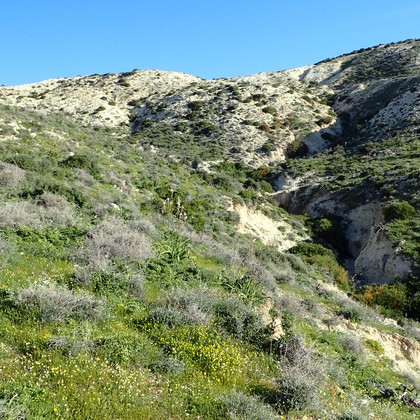
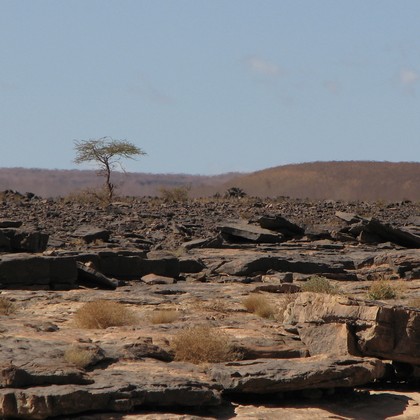
Breeds on dry, stony mountain slopes with low shrubs and scattered oaks, mostly between 1,000 and 2,000 m. On passage on bare, stony slopes, in garrigue and dry herbaceous steppe; in winter on coastal plains and stony semi-desert plains with scattered bushes along the Red Sea.
Where the bird is most at home, classified by the habitats of North Africa and the Middle East.

Range and movements
Breeds in small numbers in the uplands of Iraqi Kurdistan. On passage, mainly in March – April and September – October, scarce but regular in Israel, Jordan, Syria, Iraq and Kuwait, and rare in Bahrain, Qatar, the United Arab Emirates and Oman. Winters in western and south-western Saudi Arabia, mainly in the Tihamah and the Hejaz coastal belt, and in Yemen; in Egypt scarce along the Red Sea coast and in Sinai. Beyond the region the western form breeds on Lesbos, Chios and in western Turkey and the eastern form in south-eastern Turkey and the Zagros Mountains of Iran; Eritrea and Sudan are also part of the winter range.
- Summer visitor (c. Apr–Sep)
- Passage (Mar–Apr, Oct–Nov)
- dark = core range, pale = thinly spread
How and when to look
In Israel the best chance is in late March and early April in the Negev and the Arava, on bare slopes around Eilat and Ovda; listen for the hard call. In winter the coastal plain of Saudi Arabia and Yemen is the place, on stony plains with scattered bushes.
Conservation status
Near Threatened on the Red List, owing to its small, fragmented breeding range and declines caused by overgrazing, afforestation and changing land use in Turkey and Iran. In the region a small breeding population in northern Iraq about which little is known; passage and wintering in Arabia are poorly studied.
Scientific name
Emberiza cineracea | Brehm, 1855
Brehm described the species in 1855 and placed it straight away in the genus where it still stands. The genus Emberiza was introduced in 1758 by Linnaeus. Emberiza comes from Old German Embritz, a name for a bunting. cineracea is Latin for 'ashy', from cinis, 'ashes', after the grey plumage. The specimen the first description was based on came from Izmir, Turkey.